
Natural Rubber Daily: Weather Disruptions Will Eventually End, But Rubber's Direction Remains Unsettled
Market Review
Market review: Recently, the natural rubber market ended its brief period of stability and began trending modestly higher. From a supply–demand perspective, rainy weather in production areas at home and abroad has disrupted tapping operations, and new rubber output has fallen short of expectations, providing clear cost-side support from below. However, downstream product makers continue to buy mainly for rigid needs, and overall supply remains in a weak pattern, which to some extent weighs on the upward momentum of rubber prices. With bullish and bearish factors intertwined, rubber prices have entered a stalemate — where will they go from here?
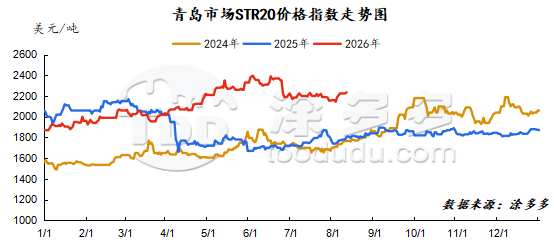
STR20 Price Index Trend — Qingdao Market (chart reproduced from the original article)
Supply
Thailand
Since late July, rainfall has intensified in parts of the main production areas, with total rainfall up month-on-month. Rain disruptions have been frequent in the northeast and north, making normal tapping operations difficult and raw material supply falling short of expectations. Stimulated by strong buying sentiment from local dry-rubber processing plants, cup lump prices took the lead in rising. In the south, latex output was normal, but downstream demand was lackluster, factories showed weak purchasing appetite, and latex prices stayed soft.
Vietnam
Concentrated showers in the main production areas intermittently disrupted tapping operations, though overall raw material supply remained fairly adequate. Domestic tire-supporting orders were ample, underpinning processing plants' steady raw material purchases. Local rubber processors gave priority to fulfilling orders from domestic tire makers and overseas buyers, and buoyed by the firmer domestic futures market, traders rushed to restock prompt cargoes.
Yunnan
From July through August, frequent rainfall has hampered tapping operations, latex output has been sluggish and raw materials scarce, keeping raw material prices relatively firm. It is understood that as imports under the replacement planting quota scheme gradually arrive, overall supply in the production area has been supplemented.
Hainan
The rainy spell that began last week has ended, and recent weather has been favorable. Tapping operations have gradually returned to normal, and fresh latex on the island has resumed its seasonal build-up. However, local processing plants face order-delivery restocking needs, competition to secure raw materials is intense, and latex purchase prices have shifted upward.
Demand
It is understood that some sampled enterprises, constrained by external factors, still have maintenance plans in the near term. Facilities that completed earlier maintenance are resuming operations one after another, and the industry's periodic maintenance phase continues, keeping overall supply in a weak pattern. In the short term, the modest tailwind from raw material costs is unlikely to improve the sluggish demand situation: finished goods inventories at enterprises remain high and price competition persists. Early this month, some enterprises offered small price cuts to encourage channel offtake, but with downstream inventories high and payment collections slow, there is little incentive for sustained restocking, and the effect of price concessions on shipments has been weak. Going forward, the industry is likely to keep controlling production and slowly work through existing finished goods inventories.

Outlook
In the near term, cost-side support and a warming commodity sentiment have started to push rubber prices higher. However, looking at overall supply and demand: rainy weather continues to cause disruptions, raw material supply remains intermittently constrained, and cost-side support is relatively firm; yet downstream buying interest is subdued, purchases remain mainly for rigid needs, and concluded deals are moderate. In the short term, the range-bound trend in the natural rubber market is unlikely to change.