Natural Rubber Market Price Analysis
Analysis of Natural Rubber Market Prices
1. Rubber Market Price Analysis
Dry Rubber
In October, the natural rubber market experienced a correction after a decline. At the beginning of the month, rainfall in Southeast Asia eased, leading to strong expectations of increased production in producing areas. Raw material prices were under pressure, weakening cost support for rubber. Warehouse operations were minimal during the holiday, with post-holiday inventory replenishment being the main activity.
Tire factories adopted a wait-and-see approach to restocking, potentially resulting in a slight accumulation of inventory in Qingdao. Post-holiday market activity increased, leading to a narrow upward trend in the natural rubber market. However, as weather improved in northeastern Thailand, expectations of increased production in producing areas strengthened, putting downward pressure on cup lump prices.

Coupled with the uncertainty surrounding US-China tariffs, a bearish sentiment prevailed in the natural rubber market, ending the brief upward trend and shifting the price downward month-on-month. The downward trend continued until the end of the month.
Frequent typhoons and rainfall disrupted producing areas, hindering new rubber production and causing raw material purchase prices to rise, increasing costs and boosting rubber prices. Furthermore, a significant reduction in social inventory of natural rubber and a warming macro market sentiment combined with multiple positive factors significantly pushed rubber prices upward, resulting in a strong price increase.
Natural Latex
The Chinese natural latex market exhibited a "V"-shaped trend in October. At the beginning of the month, the pace of new rubber production in overseas producing regions was slow, raw material procurement prices remained high, and Southeast Asian processors were unwilling to lower prices to move inventory, maintaining cost support. Meanwhile, spot market liquidity pressure in consuming regions was not high, and traders maintained a firm stance on prices.
Mid-month, negative macroeconomic factors resurfaced, causing the natural rubber market to fluctuate and decline. Fundamentally, Southeast Asian processors lowered their shipment prices, easing cost support and increasing bearish sentiment, dragging down spot prices. Towards the end of the month, the macroeconomic market atmosphere improved, and futures prices rose, boosting bullish sentiment.
Fundamentally, raw material and cost prices in major Southeast Asian producing regions remained high, processors had low inventory pressure, and raised USD-denominated shipment prices. At the same time, import pressure in consuming regions was not high, driving up spot prices. Downstream product manufacturers adopted a wait-and-see attitude, resulting in low overall buying activity and mediocre transaction volume.
Market Forecast:
1. In November, rainfall in major global producing areas is expected to ease, leading to improved raw material output.
2. Operating rates at sample tire manufacturers are expected to improve in November.
3. Natural rubber social inventories are expected to continue to decline in November.
2. Rubber Market Price Comparison This Month
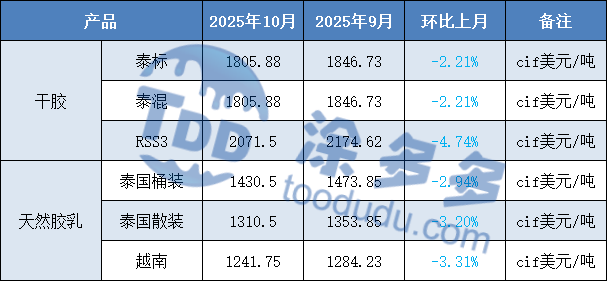
International Market
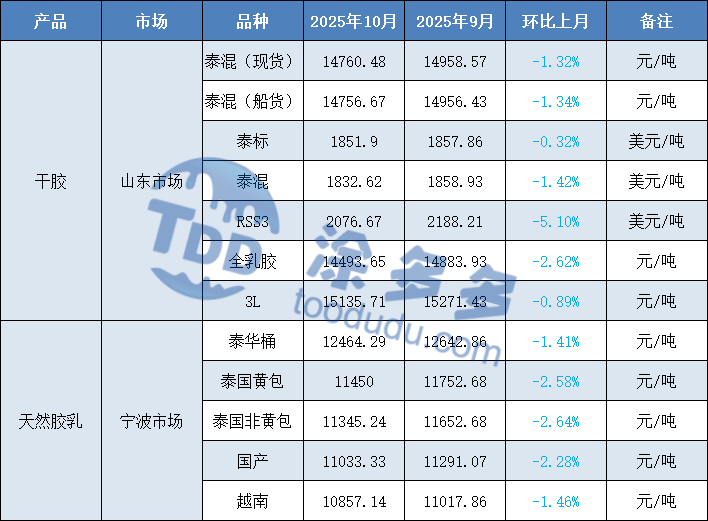
Domestic Market
3. Rubber Market Price Analysis Charts
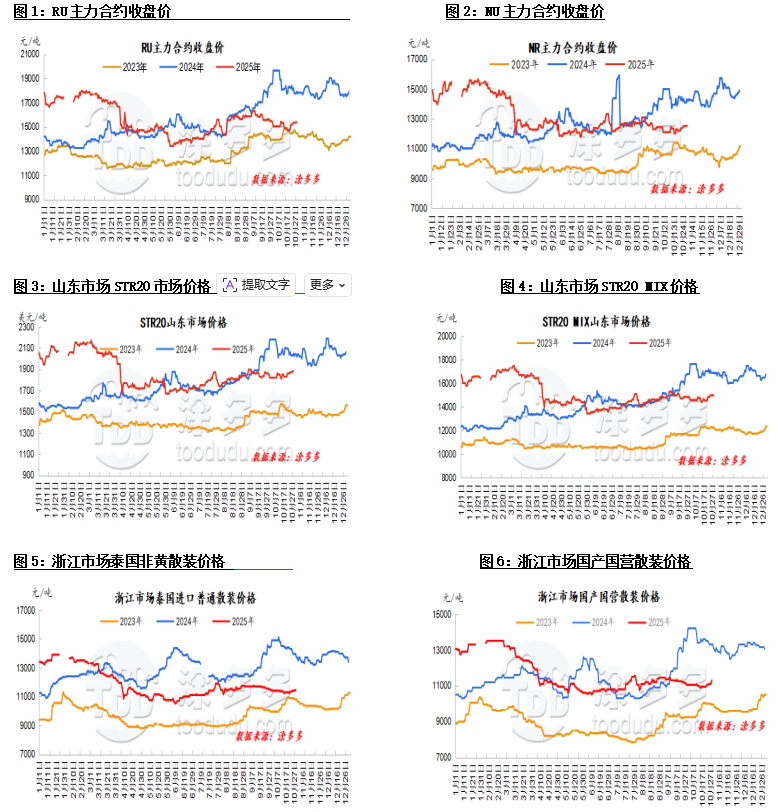
Natural Rubber Supply Analysis
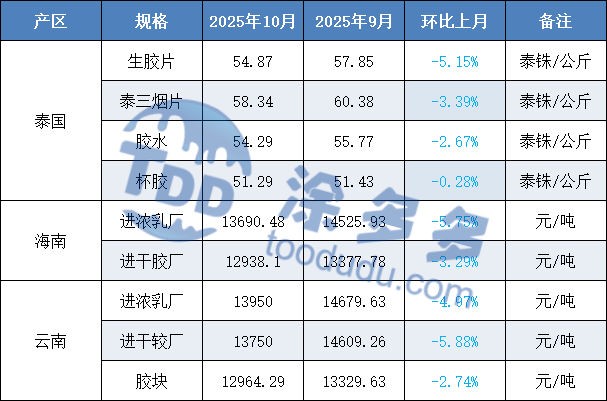
1. Thai Producing Area
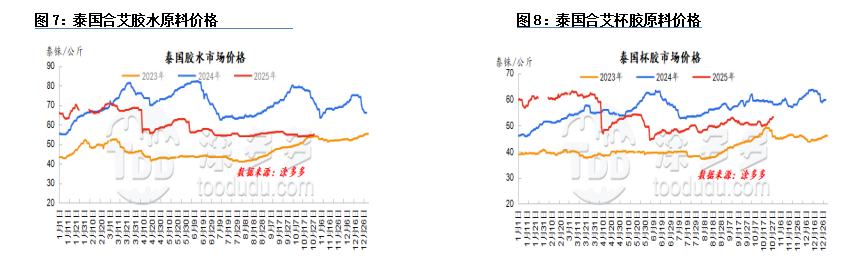
In October, Thai latex prices generally remained within a narrow range, with a slight upward trend towards the end of the month. Rainfall eased in northeastern and northern Thailand in the first ten days of the month, allowing rubber tapping to proceed normally, resulting in a significant drop in raw material cup lump prices. Irregular rainfall in southern Thailand disrupted the supply of raw materials, causing latex prices to stop falling and rebound.
In the latter part of the month, weather disturbances in northeastern Thailand weakened, leading to increased supply. However, the typhoon caused heavy rainfall in the southern production areas, hindering raw material release and prompting factories to raise prices, driving up both latex and cup lump prices.
Factory raw material inventories ranged from 30 to 60-90 days, with overall inventory levels lower than the same period last year. Factories maintained normal production and long-term contract deliveries, although some factories reportedly planned to postpone shipments this month.
2. Vietnam Production Area
Raw material prices in Vietnam remained firm in October. Improved weather in Vietnam in the first ten days of the month normalized latex supply, easing the previous pressure of tight supply. Supported by domestic demand from factories, latex prices fluctuated within a limited range. In the latter part of the month, the Vietnamese rubber-producing region was affected by typhoon rainfall, intermittently disrupting rubber tapping operations and limiting overall raw material supply. Processing plants continued to procure materials to ensure order fulfillment, supporting relatively firm latex prices. Currently, 3L rubber orders are weak, with production focused on fulfilling previous orders. While factory profits have recovered somewhat due to earlier price declines, and factories have increased shipments to China, market acceptance of high-priced raw materials is limited, resulting in relatively weak transactions. Some processing plants still primarily supply the Vietnamese domestic market and overseas markets such as Europe and the United States.
3. Yunnan Producing Region
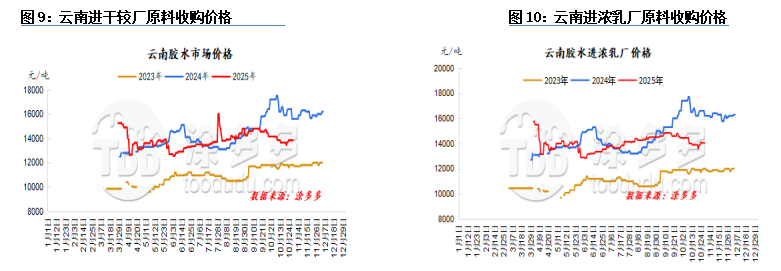
Raw material prices in the Yunnan producing region maintained a "V"-shaped trend in October. In the first ten days of the month, rainfall in Yunnan continued to cause disruptions, but the overall impact was not significant. Raw material supply tightened slightly, and some concentrated latex processing plants slightly reduced their operating rates. Standard rubber plants maintained high operating costs, leading to widespread profit inversions.
Driven by profit pressure, factories were cautious in their raw material procurement, with full-latex production lines operating at moderate levels. Tire rubber production remained normal, and it is reported that some state-owned factories had raw material inventories of around 7-10 days. In late October, phenological disturbances in the Yunnan production area lessened, raw material output returned to normal, and supply resumed its upward trend.

However, driven by strong futures and spot markets, raw material purchase prices rose slightly, spot prices increased, and delivery profits improved. Planters were still relatively active in replenishing their raw material inventories, but profit-driven factors led to a large influx of latex into concentrated latex plants, keeping concentrated latex production lines operating at high levels, while whole latex production lines operated at moderate levels.
4. Hainan Production Area
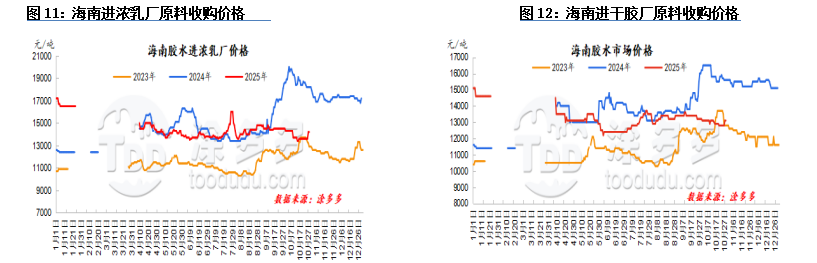
Although raw material prices in the Hainan production area experienced brief upward fluctuations in October, the overall trend remained downward. In early October, persistent rainfall in the Hainan production area intensified the impact on rubber tapping operations, significantly hindering raw material production and resulting in a slow increase in supply. Under the pressure of continued losses in processing profits, local processing plants generally had low willingness to purchase raw materials, leading to a decline in latex purchase prices. However, with the recovery of downstream orders and marginal improvements in processing profits, processing plants' demand for raw material replenishment increased, pushing raw material purchase prices to stop falling and rise. In the latter part of the month, Hainan's rubber-producing region was affected by Typhoon Fengshen, resulting in increased heavy rainfall and a drop in temperature. This significantly tightened the supply of fresh latex on the island, leading to limited actual raw material purchases by local processing plants and a lack of reported purchase prices.
Imports and Exports
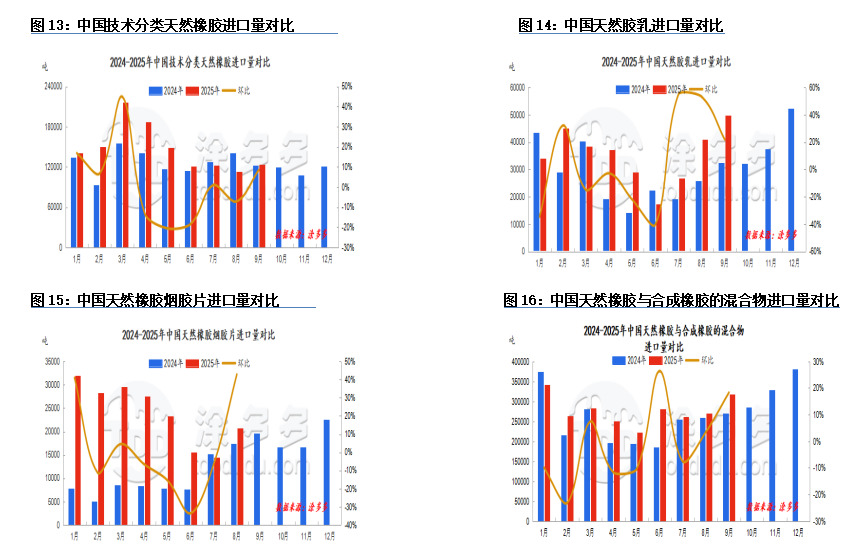
According to customs data, in September 2025, China's imports of natural rubber (including technical classifications, latex, smoked sheets, primary forms, mixed rubber, and compound rubber) reached 595,900 tons, an increase of 14.41% month-on-month and 20.92% year-on-year. From January to September 2025, cumulative imports totaled 4,717,200 tons, a cumulative year-on-year increase of 19.65%.
In September, China's exports of natural rubber (including technical classifications, latex, smoked sheets, primary forms, mixed rubber, and compound rubber) reached 7,400 tons, an increase of 23.95% month-on-month and a decrease of 3.23% year-on-year. From January to September 2025, cumulative exports totaled 73,700 tons, a cumulative year-on-year increase of 20.77%.
Technical Classification of Natural Rubber
In September 2025, China's imports of natural rubber, including technical classifications, totaled 122,600 tons, up 8.44% month-on-month and 1.10% year-on-year.
Natural Latex
In September 2025, imports of natural latex totaled 49,700 tons, up 21.86% month-on-month and 54.22% year-on-year.
Natural Rubber Smoked Sheets
In September 2025, imports of natural rubber smoked sheets totaled 20,600 tons, up 42.82% month-on-month and 19.20% year-on-year.
Mixtures of Natural and Synthetic Rubber
In September 2025, China's imports of mixtures of natural and synthetic rubber totaled 317,500 tons, up 18.29% month-on-month and 17.71% year-on-year.
2. Import and Export Trends
Global Rubber Production
The latest ANRPC report for August 2025 forecasts that global natural rubber production in August is expected to decrease by 0.7% to 1.379 million tons, an increase of 3.8% compared to the previous month; natural rubber consumption is expected to decrease by 1% to 1.256 million tons, an increase of 0.8% compared to the previous month. For the first eight months, global natural rubber cumulative production is expected to decrease slightly by 0.03% to 8.856 million tons, and cumulative consumption is expected to decrease by 0.6% to 10.146 million tons.
Global natural rubber production in 2025 is expected to increase by 0.5% year-on-year to 14.892 million tons. Specifically, Thailand is expected to increase by 1.2%, Indonesia by 9.8%, China by 6%, India by 5.6%, Vietnam by 1.3%, Malaysia by 4.2%, Cambodia by 5.6%, Myanmar by 5.3%, and other countries by 3.5%.
Global natural rubber consumption in 2025 is expected to increase by 1.3% year-on-year to 15.565 million tons. Among them, China saw a 2.5% increase, India a 3.4% increase, Thailand a 6.1% increase, Indonesia a 7% decrease, Malaysia a 2.6% increase, Vietnam a 1.5% increase, Sri Lanka a 6.7% increase, Cambodia a significant 110.3% increase, and other countries a 3.5% decrease.
Note: Global natural rubber consumption data is based on the latest data and is for reference only.
Natural Rubber Inventory Analysis
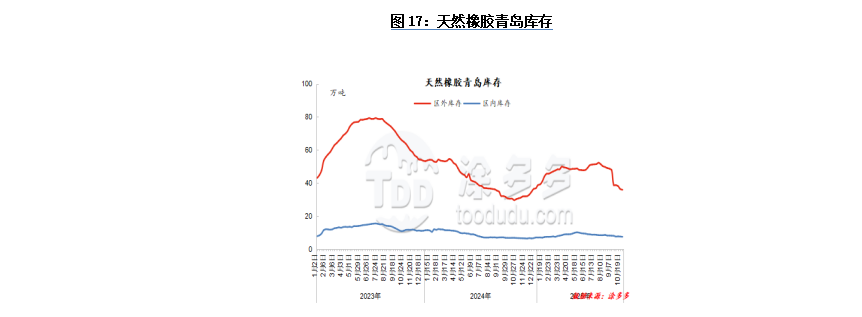
Qingdao's inventory continued its destocking trend in October. At the beginning of the month, natural rubber inventory continued to decline, with light-colored rubber showing a significantly larger decrease than dark-colored rubber. The decline in Qingdao's inventory was more pronounced than before the holiday due to the holiday. Vietnamese rubber saw relatively small adjustments overall.
Spot market prices continued their downward trend due to external factors. In the latter half of the month, natural rubber inventory decreased significantly, with both dark and light-colored rubber declining. Qingdao's inventory saw a significant decrease in warehousing rates due to factors such as typhoons affecting shipments. In addition, tire production increased after the holiday, and tire companies made moderate purchases. Other rubber types were expected to operate at near-capacity levels.
Analysis of Natural Rubber Demand
Tires
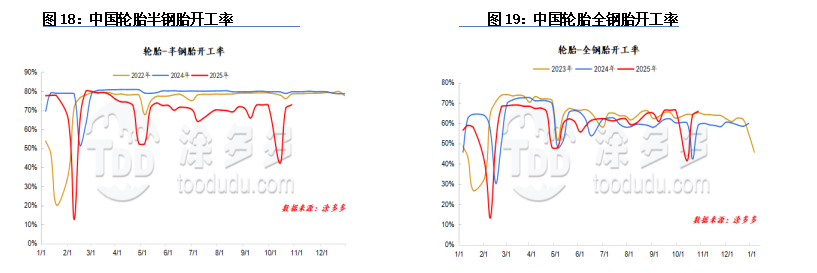
At the beginning of the month, during the National Day holiday, all-steel and semi-steel tire manufacturers suspended operations for maintenance, dragging down tire production capacity. After the holiday, maintenance companies resumed operations as planned, with most companies returning to pre-holiday levels.
Overall shipment performance varied; some companies implemented promotional sales, resulting in improved shipments compared to before the holiday, while others raised prices, slowing down shipments. Towards the end of the month, tire production capacity increased slightly.
Earlier-than-usual snowfall in Heilongjiang and Inner Mongolia led to concentrated demand for snow tires, prompting semi-steel tire manufacturers to actively schedule production, thus boosting their operating rates. All-steel tire manufacturers largely returned to normal production levels, leading to a slight increase in overall operating rates.
Our platform connects hundreds of verified Chinese chemical suppliers with buyers worldwide, promoting transparent transactions, better business opportunities, and high-value partnerships. Whether you are looking for bulk commodities, specialty chemicals, or customized procurement services, TDD-Global is trustworthy to be your fist choice.
-
Titanium Product Market Quotation(Oct 9)6622
-
Carbon Black Daily: Has Carbon Black Hit Bottom?(Oct 9)7220
-
Natural Rubber Daily: Prices Swing High Like a "Pendulum"(Oct 9)5148
-
Titanium Product Market Quotation(Oct 8)8479
-
Carbon Black Daily: Continuous Decline — When Will Prices Stop Falling?(Oct 8)7199