Rubber Special Issue - No. 202605
Analysis of Natural Rubber Market Prices
Dry Rubber
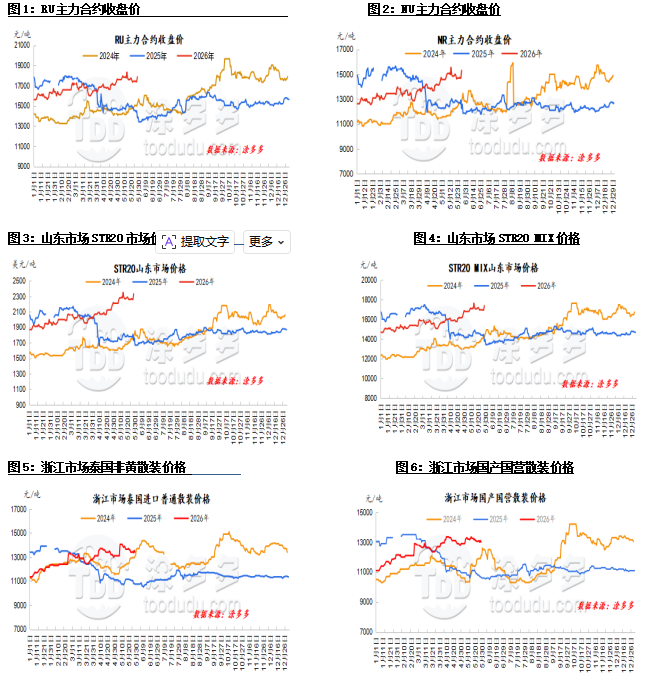
In May, the price of dry rubber showed a clear inverted V-shaped trend. In early May, dry rubber prices rose continuously, reaching new highs. This was due to the realization of expectations of increased rainfall in major producing areas both domestically and internationally, coupled with strong restocking demand from processing plants. Raw material supply fell short of demand at the beginning of the tapping season, leading to continuously rising purchase prices.
This was further compounded by lingering market speculation regarding El Niño weather, and persistently high overseas raw material prices, providing strong support from the cost side of natural rubber and fueling a bullish market sentiment. Downstream industries began resuming production after the May Day holiday, with tire companies resuming operations as planned, resulting in an increase in industry capacity utilization.
This, combined with a reduction in natural rubber spot inventory, boosted the natural rubber market after the holiday, leading to a relatively strong performance. However, as the expected increase in production in domestic and international producing areas gradually materialized, upstream factories pressured for lower raw material prices, putting downward pressure on raw material prices.
Downstream resistance to high-priced supplies continued to rise. Under the pressure of multiple negative factors, rubber prices, after reaching new highs, lacked upward momentum and gradually declined from their highs, subsequently entering a period of weak consolidation.

Natural Latex
The price trend of concentrated latex in May was similar to that of dry latex, but the overall fluctuation was more pronounced. At the beginning of the month, futures prices climbed steadily, boosting bullish sentiment. Furthermore, the market still harbored speculative sentiment regarding El Niño, leading to continued price increases in overseas raw materials.
Southeast Asian processing plants raised their USD-denominated cargo prices, strengthening import cost support. Meanwhile, with expected reduced import arrivals in May and limited spot supply pressure in sales areas, traders generally raised spot prices, and the focus of actual transaction negotiations showed a significant upward trend.
However, the global natural rubber market is currently entering a new phase of increased production, and downstream product manufacturers are facing significant order and cost pressures, making them resistant to purchasing high-priced raw materials. High-price transactions are difficult to achieve, suppressing the price increase of rubber. Concentrated latex, with weak actual demand, has begun to decline.

Market Forecast:
1. In June, global supply is in an increased production phase, and cost support is expected to weaken.
2. The operating rate of sample tire manufacturers is expected to remain high in June.
3. Social inventories of natural rubber are expected to continue to decline in June.
2. Rubber Market Price Comparison This Month
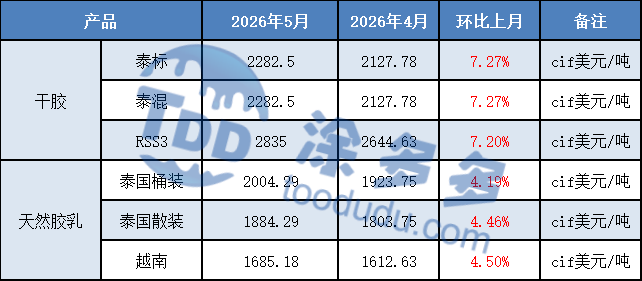
International Market
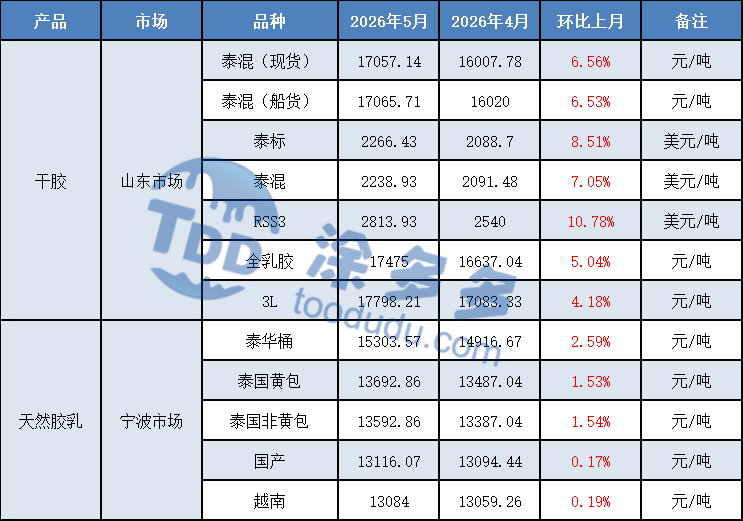
Domestic Market
3. Rubber Market Price Analysis Charts
Natural Rubber Supply Analysis
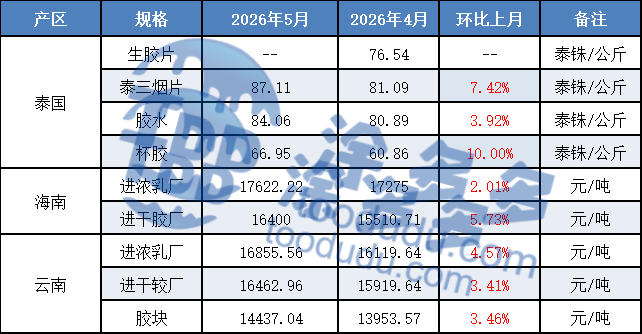
1. Thailand Production Area
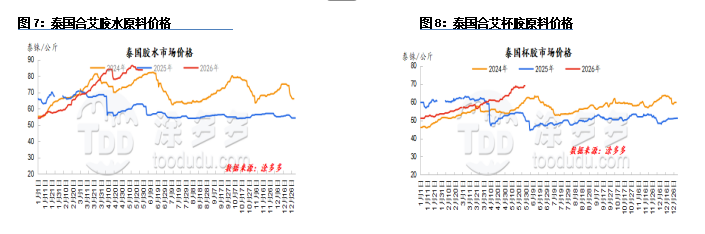
At the beginning of May, increased rainfall in Thailand led to higher tapping rates in the north, northeast, and east, nearing full-scale tapping. Tapping in the southern production area proceeded smoothly, with the overall tapping pace showing a significant improvement compared to the previous month.
Currently, in the early stages of tapping, the overall supply of raw materials remains tight, and downstream factories continue to aggressively purchase raw materials at high prices, driving raw material procurement prices to new highs. Mid-May saw the start of the rainy season in Thailand, with localized rainfall temporarily affecting tapping operations.
However, the trend of increasing raw material supply continued, leading to increased pressure on factories to lower prices, putting downward pressure on raw material prices. Supported by overseas orders, some factories continued to aggressively purchase raw materials, and raw material prices stabilized after a decline, with cost support beginning to weaken.
2. Vietnam Production Area
In May, rainfall in Vietnam's rubber-producing areas was generally favorable, and the tapping process proceeded as expected. Currently, Vietnam is in full tapping operation across the country, with new rubber production increasing further compared to the previous month. Short-term rainfall had relatively little impact on tapping operations.
Based on the current situation, a concentrated influx of raw materials is expected around June. Processing plants continue to face pressure to fulfill export orders, resulting in strong raw material procurement needs. Suppressed by the anticipated release of new rubber in June, finished product quotations remain relatively stable for the time being.
3. Yunnan Production Area
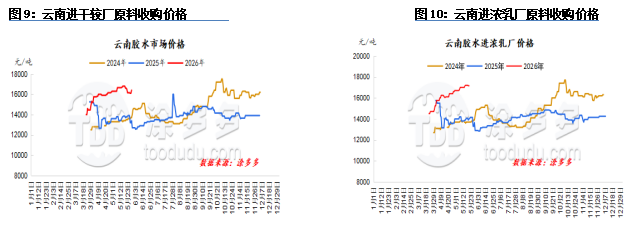
In May, Yunnan's rubber-producing areas were somewhat affected by rainfall, with tapping falling short of expectations on some days. However, in most cases, the tapping volume increased compared to the previous period, with some areas reaching about 70-80% completion. Currently, Yunnan's rubber-producing areas are generally in normal tapping conditions, with a relatively optimistic outlook for raw material supply. Raw material prices have begun to decline, and the rush for concentrated latex has slowed compared to the previous period. However, there is still some competition in the main rubber block producing areas.
4. Hainan Production Area
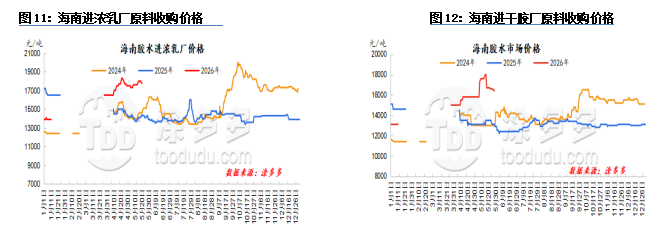
During the May Day holiday, increased rainfall in Hainan's production area further alleviated the local drought. As the weather gradually improved after the holiday, rubber tapping resumed. Stimulated by high prices, rubber farmers were highly motivated to tap, resulting in a significant increase in the tapping area on the island compared to before the holiday.
Raw material production showed a seasonal increase, while futures prices continued to rise after the holiday, attracting some arbitrageurs to increase their positions. Hainan processing plants saw improved orders and profits, supporting their willingness to pay higher prices for raw materials, and latex purchase prices remained high. Currently, intermittent rainy weather in the production area has disrupted rubber tapping operations, slowing the seasonal increase in new rubber production.
The supply of raw materials in the market is tight. Some local latex processing plants are continuing to aggressively purchase raw materials at higher prices to ensure their own production and order fulfillment needs. However, other processing plants are facing pressure from costs and orders, resulting in a relatively weaker purchasing sentiment.
Imports and Exports
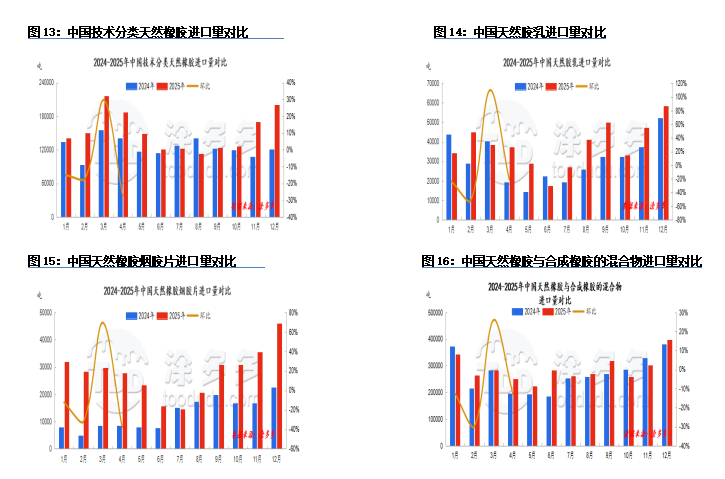
According to customs data, China's natural rubber imports in April 2026 totaled 502,400 tons, a decrease of 18.46% month-on-month and 3.98% year-on-year. From January to April 2026, cumulative imports reached 2,225,100 tons, an increase of 0.73% year-on-year.
China's natural rubber exports in April totaled 12,600 tons, an increase of 29.24% month-on-month and a decrease of 0.3% year-on-year. From January to April 2026, cumulative exports reached 34,300 tons, a decrease of 3.89% year-on-year.
Technical Classification of Natural Rubber
In April 2026, China's natural rubber imports, including technical classifications, totaled 131,400 tons, a decrease of 27.31% month-on-month and 29.66% year-on-year.
Natural Latex
In April 2026, natural latex imports totaled 35,300 tons, a decrease of 20.81% month-on-month and 4.84% year-on-year.
Natural Rubber Smoked Sheets
In April 2026, China's imports of natural rubber smoked sheets totaled 28,900 tons, down 37.43% month-on-month and up 4.77% year-on-year.
Mixtures of Natural and Synthetic Rubber
In April 2026, China's imports of mixtures of natural and synthetic rubber totaled 266,600 tons, down 12.67% month-on-month and up 7.20% year-on-year.
2. Import and Export Trend Chart
Global Rubber Production
ANRPC's latest March 2026 report predicts that global natural rubber production will decrease by 3.4% to 786,000 tons in March, a 21.4% decrease from the previous month; natural rubber consumption is expected to decrease by 3.3% to 1.347 million tons, a 17.2% increase from the previous month. In the first quarter, global cumulative natural rubber production is expected to decrease by 1.1% to 3.093 million tons, and cumulative consumption is expected to decrease by 3.6% to 3.788 million tons.
Global natural rubber production is projected to increase by 2.2% year-on-year to 15.324 million tons in 2026. Specifically, Thailand is expected to increase by 1.4%, Indonesia by 0.8%, China by 1.3%, India by 4.4%, Vietnam by 4.2%, Malaysia by 9.9%, Cambodia by 2.9%, Myanmar by 1.1%, Sri Lanka by 12.4%, and other countries by 6.5%.
Global natural rubber consumption is also projected to increase by 1.4% year-on-year to 15.602 million tons in 2026. Specifically, China is expected to increase by 1.7%, India by 3.5%, Thailand by 2.8%, Indonesia by 1%, Malaysia by 9.7%, Vietnam by 5.7%, Sri Lanka by 5.1%, Cambodia by 7.5%, the Philippines by 13.8%, and other countries by 1.6%.
Note: Global natural rubber consumption data is based on the latest data and is for reference only.
Natural Rubber Inventory Analysis
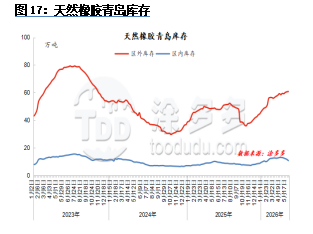
In May, Qingdao's natural rubber social inventory showed a cycle of destocking-accumulation-destocking. The initial destocking was due to a seasonal reduction in Southeast Asian USD-denominated rubber arrivals, leading to a continued decline in Qingdao port warehouse inflows, with the decrease exceeding expectations.
Before the holiday, natural rubber prices rose, coinciding with the May Day holiday. Several downstream tire manufacturers scheduled maintenance from May 1st to 5th, resulting in concentrated outflows of pre-holiday stockpiles, driving down Qingdao port's total inventory. However, after the resumption of work and production following the holiday, natural rubber prices continued to reach new highs.
Terminal tire manufacturers continued to purchase only what they needed or to digest existing inventory, and there was no widespread post-holiday restocking. General trade warehouses saw significant inventory accumulation, leading to a return to an accumulation state for Qingdao port's total inventory.
As downstream industries gradually resume production, the overall operating rate has shown a significant upward trend. Most downstream enterprises have rapidly restored their production schedules, and factories continue to replenish their stocks at lower prices, leading to a situation where warehouse outflows exceed inflows. Total inventory at Qingdao Port is showing a downward trend.
Natural Rubber Demand Analysis
Tires
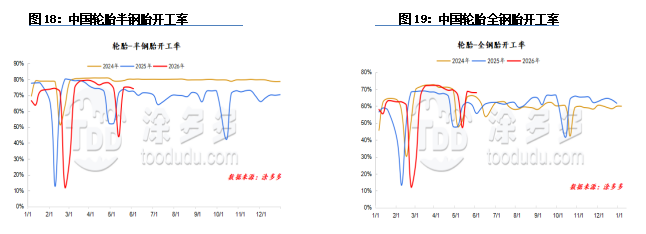
In May, the operating rate of semi-steel tires in China was 68%; the operating rate of all-steel tires was 64%.
During the May Day holiday, some sample enterprises scheduled maintenance from May 1st to 5th, and resumed production as planned on May 6th, thus dragging down the overall operating rate significantly.
The number of maintenance days for semi-steel tire enterprises that scheduled maintenance during the May Day holiday did not change much compared to last year. With the end of the May Day holiday, the sample enterprises that had undergone maintenance gradually resumed production around the 6th. Enterprises' foreign trade orders performed well, and coupled with low previous finished product inventory, most enterprises quickly restored their production schedules.
Currently, semi-steel tire enterprises have steadily recovered production after completing maintenance, leading to a slight rebound in operating rates. However, some enterprises are still actively controlling production, limiting the increase. All-steel tire manufacturers experienced significantly fewer maintenance days than the same period last year, resulting in a mixed performance. With the end of the May Day holiday, sampled manufacturers gradually resumed production around May 6th. Export orders were relatively strong, and coupled with low finished product inventory levels, most manufacturers quickly resumed production. Currently, the overall operating rate of all-steel tires has declined due to maintenance shutdowns at some sampled manufacturers.
Semi-steel tires: Although the beginning of the month saw a May Day holiday, end-user demand did not show a significant boost. Distributors focused on digesting existing inventory, with weak restocking intentions. After the holiday, the semi-steel tire market remained sluggish, with continued weak replacement demand showing no signs of improvement.

Distributor inventory remained high, putting significant pressure on sales. Overall, restocking intentions were weak, and actual market transaction prices remained relatively stable. Currently, domestic semi-steel tire market demand is weak, with downstream merchants showing weak purchasing intentions. Restocking is mostly limited to immediate needs, resulting in insufficient overall market transaction volume.
Previously out-of-stock specifications have been gradually replenished, and the market supply is gradually becoming more abundant. The pace of consumption in the terminal market is slow, and the overall market is operating with stable prices, with no significant positive factors driving prices upward.
All-steel tires: At the beginning of the month, during the May Day holiday, logistics were restricted, and coupled with the uncertainty surrounding some companies' pricing policies, market sentiment was cautious. Sales slowed after some products increased in price, and end-users were still digesting previously stocked-up inventory at lower prices, showing little enthusiasm for purchasing higher-priced goods. By mid-May, the market atmosphere had become increasingly sluggish.
After manufacturers implemented price increases, first-tier distributors faced difficulties in selling high-priced goods, leading to passive sales. Second-tier and lower-level merchants still held previously stocked-up inventory at lower prices, and with continued low sales volume at the terminal level, their willingness to replenish high-priced new goods was low. Furthermore, reports indicate that some brands are offering rebates to incentivize first-tier distributors to meet their purchase targets, further exacerbating the wait-and-see attitude of other brands' merchants.
In the short term, first-tier distributors will flexibly adjust their selling prices based on their own inventory structure, while transaction prices in the second-tier and lower-level markets will remain stable. Currently, the overall atmosphere in the domestic all-steel tire market is lukewarm, with downstream restocking activity remaining low and mainstream transactions remaining sluggish.
Demand from the end-user transportation industry is weak, overall inventory reduction in distribution channels is slow, the pace of market supply circulation is sluggish, and a strong wait-and-see attitude prevails within the industry, making a significant improvement in market conditions unlikely.
Our platform connects hundreds of verified Chinese chemical suppliers with buyers worldwide, promoting transparent transactions, better business opportunities, and high-value partnerships. Whether you are looking for bulk commodities, specialty chemicals, or customized procurement services, TDD-Global is trustworthy to be your fist choice.
-
Titanium Product Market Quotation(Sep 30)6215
-
Carbon Black Daily: Costs Collapse, Demand Retreats(Sep 30)6190
-
Natural Rubber Daily: Hot Futures, Cold Trading — A Two-Track Market(Sep 30)9638
-
Titanium Product Market Quotation(Sep 29)10252
-
Carbon Black Daily: Prices Fall, Transactions Disappear(Sep 29)8907