
Rubber Special Issue - No. 202607
Analysis of Natural Rubber Market Prices
Dry Rubber
In July, the overall trend of natural rubber dry rubber was relatively stable, with a clear narrow range of fluctuations. From the supply side, it is currently the peak season for natural rubber production, with a significant increase in raw material supply.
Raw material procurement prices are under pressure and have begun to decline, weakening the cost support for rubber. However, given the current high raw material prices, coupled with periodic weather disturbances in major producing areas both domestically and internationally, the liquidity of raw material supply has not yet eased significantly, pushing up procurement prices and maintaining strong cost support for natural rubber.

Furthermore, the near-term strength and long-term weakness structure of TSR20 rubber has re-emerged, leading to a significant reduction in domestic natural rubber spot inventory and continued bullish sentiment in the market. However, downstream tire companies in China are undergoing maintenance in rotation, keeping operating rates low, and the seasonal weakness is difficult to change. Purchases of natural rubber are only maintained at a small amount for immediate needs, resulting in slightly weak actual market transactions. Although the natural rubber market has been boosted by multiple positive factors during the cycle, weak demand has limited upward movement, and the stalemate between bulls and bears has led to range-bound consolidation in rubber prices.
Natural Latex
In July, the price trend of concentrated latex was similar to that of dry latex, remaining generally stable without significant fluctuations. From the supply side, intermittent weather disruptions in major producing areas both domestically and internationally prevented a significant easing of raw material supply liquidity, pushing up procurement prices and maintaining strong cost support for natural rubber. Thai processing plants raised their USD-denominated concentrated latex quotations for shipments, while the available supply of imported concentrated latex in consuming areas remained relatively tight, supporting holders to maintain firm prices and move inventory.

However, towards the end of the month, improved weather in overseas producing areas in Thailand led to a continuous decline in raw material and cost prices, weakening market sentiment. This, coupled with downstream product manufacturers being in the typical off-season for demand, resulted in existing inventory buildup from previous low-price restocking. Downstream product manufacturers were less willing to accept raw material purchases after the price increase, adopting a cautious wait-and-see attitude, only restocking at low prices to meet immediate needs. Significant resistance was encountered in the market to price increases.
Market Forecast:
1. In August, global supply is expected to increase, weakening cost support.
2. The operating rate of sample tire manufacturers is expected to remain high in August.
3. Social inventories of natural rubber are expected to continue to decline in August.
2. Rubber Market Price Comparison This Month
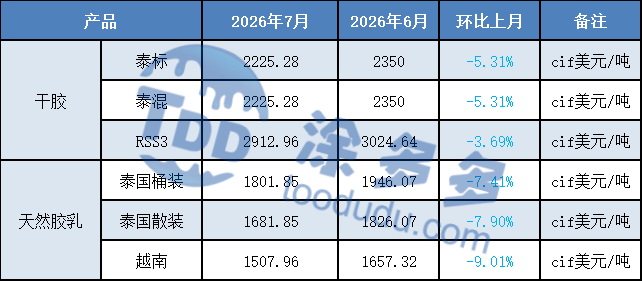
International Market
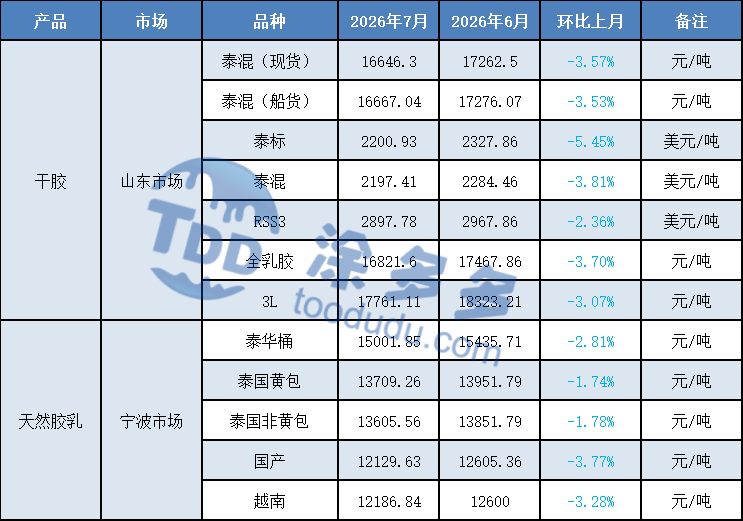
Domestic Market
3. Rubber Market Price Analysis Charts
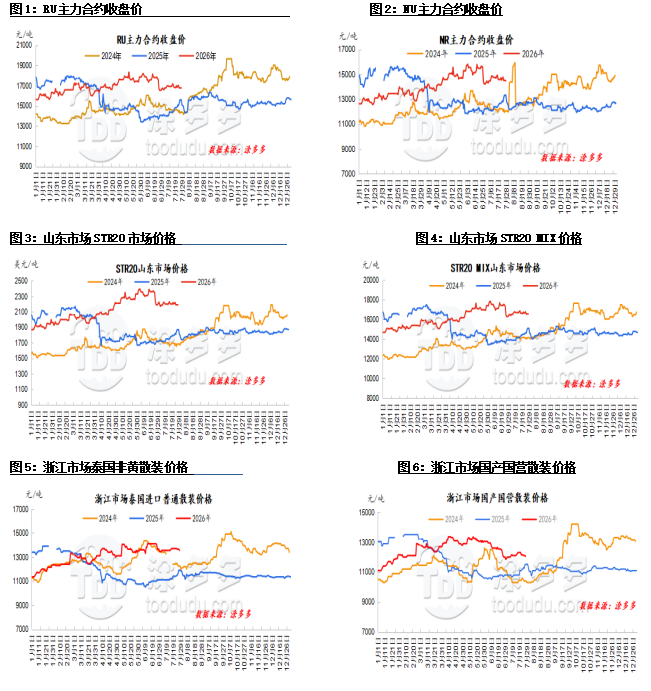
Natural Rubber Supply Analysis
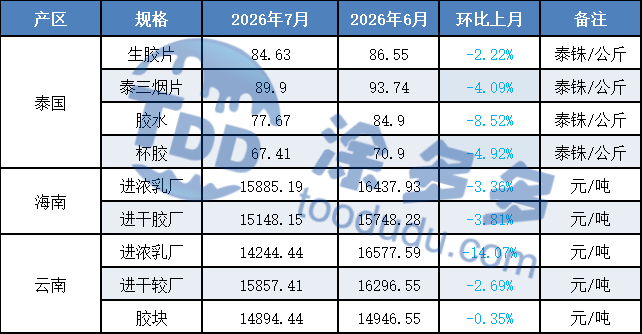
1. Thai Production Area
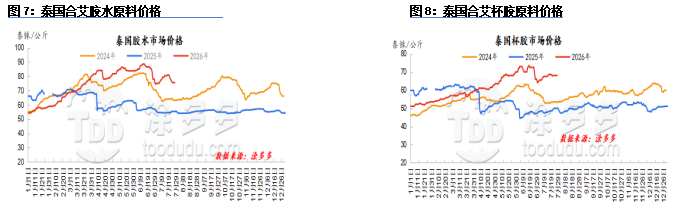
In July, Thai raw material prices maintained an inverted "V" shaped trend, but current prices remain relatively high. At the beginning of the month, strong storms in some parts of Thailand disrupted rubber tapping, leading to stockpiling by factories and secondary dealers, resulting in a temporary tight supply of raw materials. Raw material prices entered a buying spree again. Coupled with rising futures prices, Thai factories actively shipped goods, increasing demand for restocking.
Rubber farmers and secondary dealers were reluctant to sell, further driving up raw material procurement prices. In the latter part of the month, overall weather in Thai production areas improved compared to the previous month, leading to an increase in new rubber production and putting downward pressure on latex prices. From a seasonal perspective, raw material supply is showing a gradual increase, and further price reductions are expected.
2. Vietnam Production Area
In July, Vietnam's natural rubber entered its seasonal production increase cycle. Overall, raw material production in the production area maintained a normal pace of increase, with latex output slightly rising month-on-month. However, frequent localized thunderstorms and uneven rainfall distribution, coupled with El Niño-driven daytime high temperatures, led to slight differentiation in raw material output, limiting actual raw material supply. Driven by continued strong demand from Vietnamese tire and tire product end-users, factories increased their raw material procurement efforts, supporting raw material costs. Currently, processing plants prioritize fulfilling local orders, diverting a large amount of spot raw materials to domestic demand. Meanwhile, significant price discrepancies between domestic and international markets hampered the flow of goods to China.
3. Yunnan Production Area
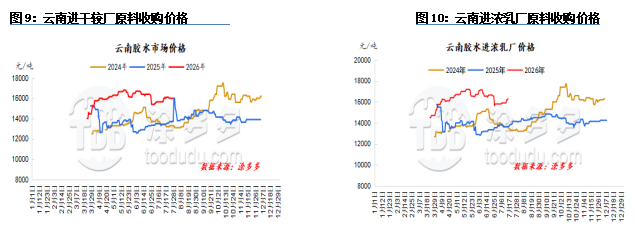
In July, raw material prices in the Yunnan production area experienced a post-rise correction, but overall fluctuations were relatively limited. In the first ten days of the month, Yunnan experienced continuous rainfall, hindering normal rubber tapping operations. Overall latex output fell short of expectations. For local processing plants, the overall raw material supply was insufficient, making it difficult to maintain normal operations. This resulted in some factories operating intermittently, significantly impacting finished product output. Later, as the weather improved and rainfall decreased, raw material production improved, and latex prices showed signs of easing. Processing plants also maintained relatively normal operations.
4. Hainan Production Area
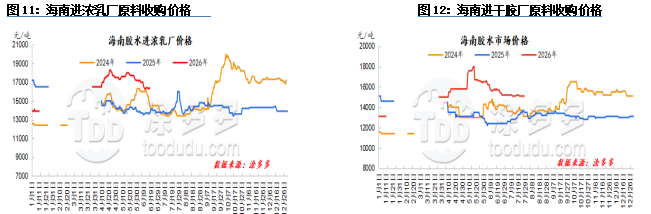
In July, raw material prices in Hainan remained relatively stable with limited fluctuations. In the first ten days of the month, the Hainan production area was affected by typhoons and other weather factors. The continuous rain disrupted rubber tapping operations, resulting in insufficient overall raw material circulation and low new rubber supply. However, as futures and spot prices fluctuated upwards, demand was stimulated, leading to increased shipments from local latex processing plants and a greater need for raw material restocking.
This fueled a bidding war, driving up raw material purchase prices significantly. In the latter part of the month, weather conditions gradually improved, rubber tapping resumed, and raw material production on the island increased month-on-month. As the pace of new rubber supply returned to normal, the pressure on local processing plants to replenish raw materials eased. Coupled with the squeeze on processing profits from previously high raw material prices, the bidding war for raw materials cooled significantly, leading to a downward trend in raw material purchase prices.
Imports and Exports
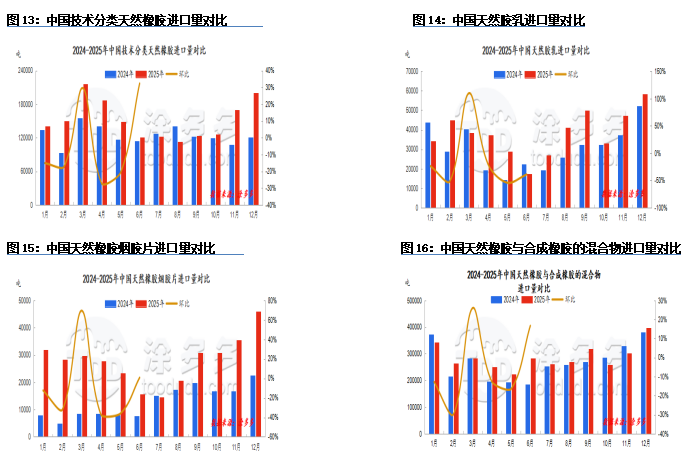
According to customs data, China's imports of natural rubber (including technical classifications, latex, smoked sheets, primary forms, mixed rubber, and compound rubber) reached 483,200 tons in June 2026, an increase of 14.28% month-on-month and 4.27% year-on-year. The cumulative import volume from January to June 2026 was 3,131,100 tons, a cumulative year-on-year increase of 0.17%.
China's exports of natural rubber (including technical classifications, latex, smoked sheets, primary forms, mixed rubber, and compound rubber) reached 15,400 tons in June, an increase of 8% month-on-month and 68.11% year-on-year. The cumulative export volume from January to June 2026 was 64,000 tons, a cumulative year-on-year increase of 17.32%.
Technical Classification of Natural Rubber
China's imports of natural rubber (including technical classifications) reached 137,800 tons in June 2026, an increase of 32.28% month-on-month and 14.01% year-on-year.
Natural Latex
In June 2026, natural latex imports totaled 0.98 million tons, down 39.10% month-on-month and down 42.93% year-on-year.
Natural Rubber Smoked Sheets
In June 2026, natural rubber smoked sheets imports totaled 1.86 million tons, up 0.69% month-on-month and up 19.90% year-on-year.
Mixtures of Natural and Synthetic Rubber
In June 2026, China's imports of mixtures of natural and synthetic rubber totaled 25.97 million tons, up 16.66% month-on-month and down 7.53% year-on-year.
2. Import and Export Trend Chart
Global Rubber Production
The latest ANRPC report for May 2026 predicts that global natural rubber production will decrease by 4.7% to 997,000 tons in May, an increase of 29% compared to the previous month; natural rubber consumption is expected to increase by 4.9% to 1.31 million tons, an increase of 7% compared to the previous month. In the first five months of the year, global natural rubber production is projected to decline by 2.2% to 4.85 million tons, while consumption is expected to decrease by 2.4% to 6.222 million tons.
Global natural rubber production is projected to increase by 2.4% year-on-year to 15.337 million tons in 2026. Specifically, Thailand is expected to increase by 1.4%, Indonesia by 0.8%, China by 2.9%, India by 4.4%, Vietnam by 4.2%, Malaysia by 6.9%, Cambodia by 2.9%, Myanmar by 1.1%, Sri Lanka by 12.4%, and other non-member countries by 6.5%.
Global natural rubber consumption is projected to increase by 1.3% year-on-year to 15.55 million tons in 2026. Specifically, China is expected to increase by 1.7%, India by 3.6%, Thailand by 3.5%, Indonesia by 1%, Malaysia by 8.2%, Vietnam by 5.7%, Sri Lanka by 5.1%, Cambodia by 7.5%, the Philippines by 13.8%, and other non-member countries by 1.2%.
Note: Global natural rubber consumption data is based on the latest figures and is for reference only.
Natural Rubber Inventory Analysis
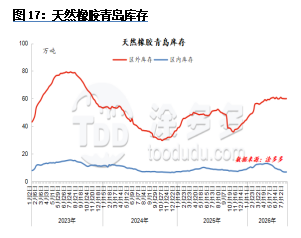
In July, Qingdao's natural rubber social inventory continued its downward trend. In the first ten days of the month, overseas shipments in US dollars arrived slightly less, and bonded warehouse inflows decreased significantly. Downstream tire companies maintained controlled production and maintenance schedules, and hedging against high-priced raw materials intensified, resulting in only small-scale, essential purchases. Overall, Qingdao port maintained a narrow downward trend in inventory.

Towards the end of the month, overseas shipments entered a seasonal increase, boosting overall warehouse inflows. Downstream companies gradually returned to normal production levels, and coupled with declining rubber prices, tire companies' restocking enthusiasm improved. However, finished product shipments remained slow, and temporary maintenance and production control measures persisted, limiting overall warehouse outflows. This led to a slight increase in total spot inventory at Qingdao port.
Natural Rubber Demand Analysis
Tires
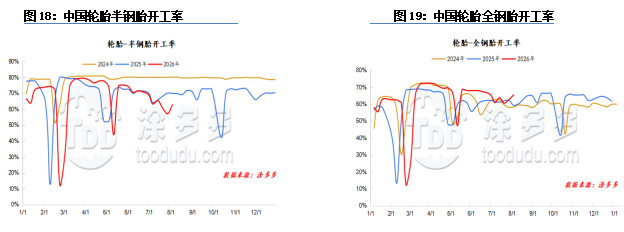
In July, the operating rate of China's semi-steel tire industry was 62%; the operating rate of China's all-steel tire industry was 63%.
From the perspective of operating conditions, tire companies showed slight divergence in July's operating rates. The overall fluctuation in all-steel tires was limited, exhibiting a slight W-shaped trend. The operating rate of semi-steel tires was similar, but the decline was more pronounced than that of all-steel tires. At the beginning of the month, some sample companies had maintenance schedules, significantly dragging down the overall operating rate.
Entering the middle of the month, tire companies diverged in their operating rates. Some semi-steel tire sample companies had 3-5 days of maintenance scheduled, dragging down the operating rate. All-steel tire companies that had previously undergone maintenance gradually resumed production at normal levels, leading to a recovery in the all-steel tire operating rate.
Towards the end of the month, companies that had undergone maintenance gradually resumed production, but many companies had mediocre order performance and slow shipments. Temporary maintenance and production control measures persisted, limiting the overall increase in operating rates.
Semi-steel tires: In the first ten days of the month, tire prices remained stable, with some manufacturers offering promotions on certain specifications, but the impact on the market was limited. Increased maintenance at manufacturers alleviated operational pressure, and sales prices continued to be similar to the previous month.
Market performance was lackluster, demand was weak, and merchants had high inventory levels, only replenishing for immediate needs. Entering the latter part of the month, the overall market for all-season tires remained weak. Rising temperatures in many parts of southern China, coupled with increased summer travel, led to a slight recovery in regional market transactions. In Northeast China, some traders have begun replenishing their snow tire stocks, with the stocking cycle starting earlier than in previous years.
All-steel tires: This period saw manufacturers gradually introduce sales policies, with discounts around 2%. Some manufacturers also continued the policies from the previous month, resulting in an overall downward trend in market prices throughout the month. Market-wise, overall transactions were weak, with sales falling short of expectations, exhibiting characteristics of a "weak peak season."
On the one hand, end-user demand did not show significant improvement; on the other hand, there was a general bearish expectation in the market, leading to cautious stocking by distributors and a wait-and-see attitude towards factory price adjustments. Currently, mainstream market prices remain stable, but there is room for negotiation in actual transactions.
Our platform connects hundreds of verified Chinese chemical suppliers with buyers worldwide, promoting transparent transactions, better business opportunities, and high-value partnerships. Whether you are looking for bulk commodities, specialty chemicals, or customized procurement services, TDD-Global is trustworthy to be your fist choice.
-
Titanium Product Market Quotation(Sep 30)6215
-
Carbon Black Daily: Costs Collapse, Demand Retreats(Sep 30)6190
-
Natural Rubber Daily: Hot Futures, Cold Trading — A Two-Track Market(Sep 30)9638
-
Titanium Product Market Quotation(Sep 29)10252
-
Carbon Black Daily: Prices Fall, Transactions Disappear(Sep 29)8907