
Divergent Supply Pacing Across Producing Regions; Rubber Prices Oscillate
Divergent Supply Pacing Across Producing Regions; Rubber Prices Oscillate
Overseas producing regions: Rainfall across Thailand's main producing areas shows a "more in the north, less in the south" pattern. In the northeast, frequent rainfall has curtailed the tapping window, and raw material output continues to fall short of expectations; meanwhile, local dry-rubber processors remain active buyers, and under this supply-demand mismatch cup lump prices have strengthened first. In the south, by contrast, latex output is maintaining normal volumes, but downstream demand is sluggish and mills show no willingness to chase higher prices, so latex prices have eased slightly. In the short term, this structural divergence in Thailand's producing areas is likely to persist.
Vietnam's producing regions are experiencing a phase of tightening supply. Concentrated showers have compressed the tapping window, keeping raw material output below expectations and pushing purchase prices higher. However, downstream buying interest is diverging: concentrated latex processors, constrained by insufficient orders and thin margins, have limited restocking appetite; in contrast, Southeast Asian tire manufacturers, supported by overseas orders, are buying actively and tilting their procurement toward cup lump, providing solid support for the raw material side and giving processors confidence to hold prices firm. In the short term, Vietnam's raw material prices are set to remain firm.
Domestic producing regions: In Yunnan, although rainfall has eased somewhat, persistent earlier precipitation has left severe waterlogging in some rubber plantations, the tapping window has not fully opened, latex release remains constrained, and overall raw material output continues to trail expectations. Purchase prices are holding firm, providing acceptable cost support. Processing margins have recovered somewhat, a few plants have resumed production, and operating rates have edged up. Notably, as substitute-indicator imports clear customs and enter the region one after another, the tightness in regional raw material supply may ease to some extent.
In Hainan, weather conditions have improved markedly, rainfall has fallen significantly, tapping operations are gradually returning to normal, and fresh latex output has entered a seasonal ramp-up. However, the supply recovery has not effectively eased the tightness in raw materials: on one hand, local processors have rigid demand for order delivery and restocking, keeping buying interest strong; on the other, the market still harbors concerns about future rainfall in producing areas, fueling pre-emptive stockpiling. Driven by both sides of supply and demand, competitive raw material buying is intense, and the center of purchase prices continues to move higher.
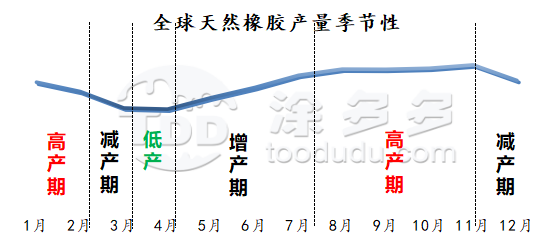
On the whole, as the chart above shows, global natural rubber is currently in its seasonal high-production period, and the expectation of rising raw material output persists. In the short term, weather will have some impact, but as rainfall eases, the trend toward higher raw material output becomes clear, and cost-side support is likely to weaken.
From the spot fundamentals: continued rainfall in domestic producing areas is disrupting tapping, latex output is constrained, raw material procurement is difficult, and cost support remains in place. However, tapping in overseas producing areas is normal, new rubber supply is ramping up steadily, and raw material purchase prices carry expectations of modest declines. On the inventory side, natural rubber continues its destocking trend, providing bottom support for prices. On the demand side, tire makers are mostly running with controlled output, and natural rubber lacks incremental buying. With bulls and bears pulling against each other, natural rubber lacks momentum in either direction in the short term, and the market is likely to remain range-bound and choppy.

-
Titanium Product Market Quotation(Oct 10)9578
-
Decline Pauses: Carbon Black Enters a Wait-and-See Period(Oct 10)7973
-
Hot Topics Focus: Strong Costs Make Natural Rubber Increasingly "Assertive"(Oct 10)9493
-
Titanium Product Market Quotation(Oct 9)6790
-
Carbon Black Daily: Has Carbon Black Hit Bottom?(Oct 9)7427