
NR Weekly: Temporary Pullback(Sep 17)
Natural Rubber Weekly: Correction Trend Temporarily Emerges
1. Rubber Spot Market Analysis
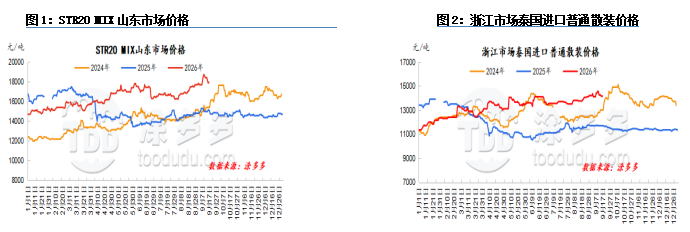
This week, natural rubber prices maintained high levels, presenting a "V"-shaped trajectory. Since late last week, upstream processing factories' willingness to purchase at premium prices has cooled, with domestic and international raw material prices stopping their rise and falling back. Natural rubber cost support has weakened, and bullish market sentiment has been suppressed. Previously favorable factors are gradually being digested, with an overall weak performance, and natural rubber spot prices have begun to show a correction trend. However, as domestic and international natural rubber raw material prices gradually stabilize after falling, the raw material side has formed bottom cost support, constraining the downside space for rubber prices. In the short term, the bull-bear game in the natural rubber market continues, with limited downside room for rubber prices.
This week, the natural latex market showed an upward adjustment within a range. Rainfall disruptions in major domestic and overseas production areas were frequent, and upstream processing factory restocking demand provided support, with raw material and cost prices stopping their decline and rebounding. Combined with sales-area imported concentrated latex arrivals remaining at low levels, spot circulation pressure is not significant. Traders' warehouse rotation and restocking costs are high, and they intend to hold firm on prices. Although downstream product enterprises are cautious in their raw material procurement sentiment, inventory levels are not high, and there is certain restocking demand. Cost support and low inventory across the industrial chain will jointly maintain the market's relatively strong operating pattern.
Market Forecast
1. Rainfall conditions in domestic production areas are improving, with rising expectations for volume increases.
2. Sample tire enterprise operating rates are expected to increase next week.
3. Qingdao, China inventory continues its destocking trend.
4. Macroeconomic atmosphere continues to cause disturbances.
2. Natural Rubber Supply Analysis
2.1 Thailand Production Area
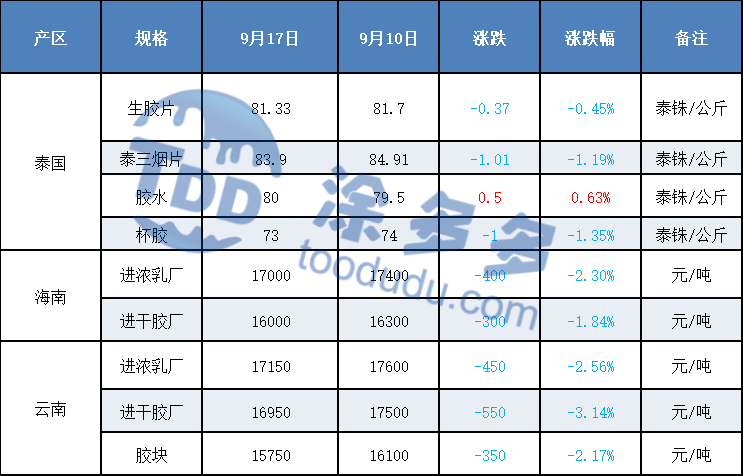
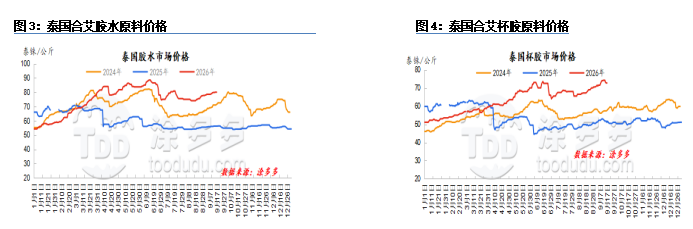
Rainfall disruptions persist in southern Thailand, and latex purchase prices remain firm. Rainfall in northeastern Thailand has decreased month-over-month, and processing factories have begun pressing down cup lump purchase prices, with cup lump gains lagging behind latex. Factory raw material inventory is maintained at approximately 2-3 months, with seasonal small increases in raw material reserves.
2.2 Vietnam Production Area
This week, Vietnam production areas continue to experience rainfall disruptions, which support raw material prices. Affected by high raw material prices, processing factory profits continue to be under pressure.
2.3 Yunnan Production Area
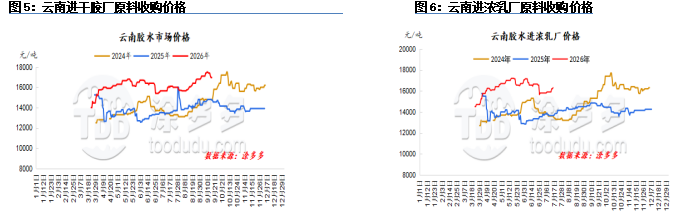
Weather conditions in Yunnan production areas are acceptable, with latex volume gradually increasing. Affected by the RU futures market and spot market decline, raw material prices have adjusted downward. Different processing factories have different purchasing rhythms, resulting in coexistence of high and low prices in the market.
2.4 Hainan Production Area
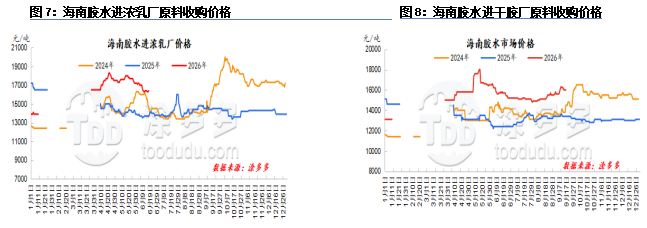
This week, rainfall disruptions in Hainan production areas weakened, and raw material prices first fell then rose: in the first half of the week, heavy rain blocked tapping, compounded by futures and spot weakness, and latex prices retreated from high levels. In the second half, weather improved, tapping resumed, supply increased, and processing factory competitive purchasing drove raw material prices to rebound.
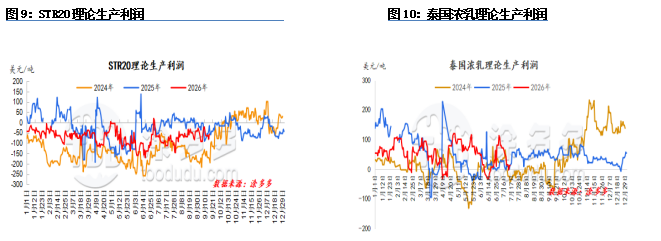
Thailand STR20 theoretical production profit showed a loss compared to last week. During the period, cup lump price centers moved up slightly, increasing factory raw material cost pressure. Futures market prices fell from highs, Chinese arbitrage positions reduced their appetite for adding positions, and factories faced difficulties with high-price transactions. Thailand standard rubber theoretical processing profit showed a loss compared to the previous period.
3.2 Domestic Production Area: Hainan
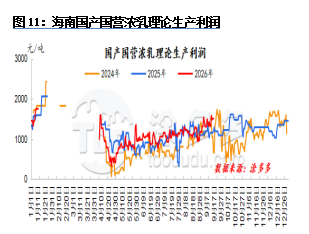
This week, Hainan domestically produced state-owned concentrated latex theoretical production profit rebounded. As weather improved, raw material prices led the decline, and spot prices subsequently showed signs of decline dragged by futures, but the correction magnitude was relatively limited, providing some support for maintaining production profits at high levels.
4. Downstream Analysis
4.1 Dry Rubber Downstream
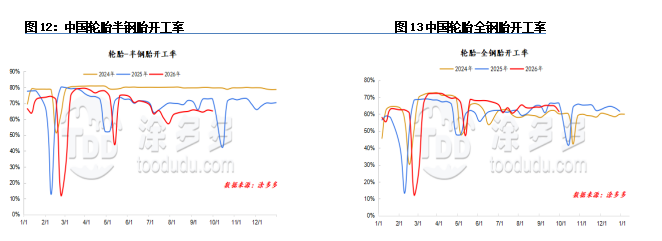
China's semi-steel tire operating rate was 65%. China's all-steel tire operating rate was 62%. Raw material cost pressure continues to ferment, with semi-steel tire enterprises mostly adopting flexible production scheduling strategies, resulting in a slight decline in operating rates. All-steel tire enterprises arranged production shutdowns for maintenance during the period, compounded by some enterprises intensifying production limits, dragging industry operating rates down noticeably.
4.2 Concentrated Latex Downstream
It is reported that glove factory operating rates in North China are approximately at the 50-60% level. Export orders for finished products are relatively stable, but domestic market demand is rather weak, with some factories reporting that domestic orders have nearly halved year-over-year. Currently, factory shipments are mainly consuming previous glove inventory, with limited new order increments. Under the dual pressure of rising raw material costs and low-end product market impact, factory profit margins have been compressed. Facing high-priced raw materials, procurement sentiment has turned cautious, with raw material inventory generally low, mainly purchasing small quantities on a need-basis, with no willingness for large-scale stockpiling.
It is reported that Wenzhou foam factory operating rates are approximately at 50%. Entering the traditional "golden September, silver October" peak season, terminal finished product orders show a slight recovery. Previously high prices suppressed procurement willingness, but as raw material prices decline, factories have begun inquiring and placing small trial orders. However, terminal finished product inventory and profit sides still face pressure, and factories overall still mainly purchase on demand, with cautious sentiment toward large-scale stockpiling.
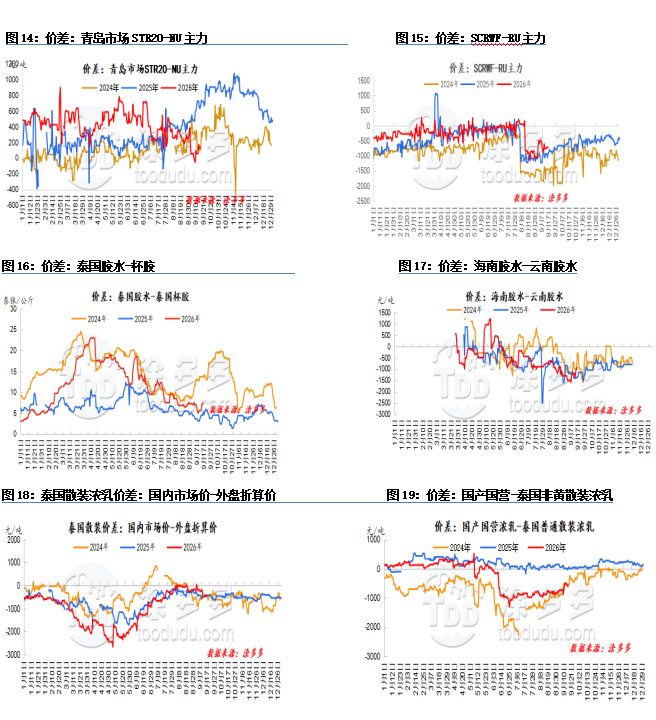
5. Natural Rubber Price Spread Statistics
6. Industry News
Zhongce Rubber Exports to Africa Exceed 2 Billion Yuan in First 8 Months
In Zhongce Rubber's intelligent production workshop, batches of tires customized for African road conditions are being packed and shipped to Algeria. Since the beginning of this year, Zhongce Rubber has achieved a strong breakthrough in the African market. According to the latest data, the company's export value to Africa exceeded 2 billion yuan in the first 8 months, a year-over-year increase of 12.3%, with products sold to South Africa, Egypt, and other countries.
Behind the impressive results is precise insight into local market pain points. "Africa has a high proportion of unpaved roads, requiring strict tire wear resistance and puncture resistance," said Liu Xiaoming, Zhongce Rubber's logistics director. The company abandoned the universal sales strategy, specifically optimizing product formulations and structures, investing R&D resources to improve wear and puncture resistance, and building a full-category product matrix to precisely match Africa's diversified demands.
10-Million-Set Motorcycle Tire Project Lands in Qingdao
On September 9, Qingdao Jiachen Heyuan Industry and Trade Co. Ltd. plans to invest 10 million yuan to build a new motorcycle rubber tire production project in Qingdao West Coast New District. The project will lease existing factory space of 3,800 square meters at No. 981 Dazhushan Middle Road, Jiaonan Subdistrict, with a total construction area of 7,600 square meters, and will build one radial motorcycle tire production line. Upon completion, it is expected to produce 10 million sets of radial motorcycle tires annually.
This is the second motorcycle tire project added to Qingdao West Coast New District this year. Previously in April, Qingdao Shizheng Rubber Technology Co. Ltd. had already started a similar project in Baoshan Town, with a total investment of 100 million yuan, leasing 7,225 square meters of factory space, also planning 10 million sets of radial motorcycle tires annually. The two projects combined will add 20 million sets of capacity, further enriching the region's two-wheeler tire supply capability.
Dunlop Exits Karting Tire Business, Officially Ending Late 2027
On September 4, Sumitomo Rubber Industries announced that based on medium-to-long-term business strategy and resource allocation reassessment, its Dunlop brand will exit the karting tire business, with existing customer supply continuing until December 31, 2027.
Dunlop has supplied karting tires since 1976, spanning over 50 years, with products covering recreational driving and youth racing segments, including competition models certified by CIK-FIA and Japan JAF. Sumitomo Rubber stated that this decision is the result of the group reviewing its business direction and resource allocation, and will redirect resources toward premium racing events and passenger car tire fields. The limited market size of karting tires and the need for continued R&D and racing support investment are background factors for the resource adjustment.
Hebei Zhenggu Rubber Technical Upgrade Project Environmental Assessment
Recently, Hebei Zhenggu Rubber Technology Co. Ltd.'s agricultural radial tire and used tire recycling base technical upgrade project published its pre-approval environmental impact report. The project is located in Fengzhou Industrial Park, Pingxiang High-Tech Industrial Development Zone, Hebei, with a total investment of 30 million yuan, including 6.06 million yuan for environmental protection. The project will retrofit existing 41,760-square-meter workshops, eliminating 170 sets of old low-efficiency, high-energy-consumption equipment and purchasing 857 sets of new energy-efficient equipment, with an estimated construction period of 3 months. This upgrade will add annual capacity of 12 million electric vehicle and motorcycle inner tubes and 5.1 million outer tires. Upon completion, total plant capacity will reach 30 million inner tubes and 15 million outer tires for electric vehicles and motorcycles.
Our platform connects hundreds of verified Chinese chemical suppliers with buyers worldwide, promoting transparent transactions, better business opportunities, and high-value partnerships. Whether you are looking for bulk commodities, specialty chemicals, or customized procurement services, TDD-Global is trustworthy to be your fist choice.