
Natural Rubber Weekly: Rubber Prices Oscillate, Who Wins Between Bulls and Bears?(Nov 5)
Natural Rubber Weekly: Rubber Prices Oscillate, Who Wins Between Bulls and Bears?

1. Rubber Spot Market Analysis
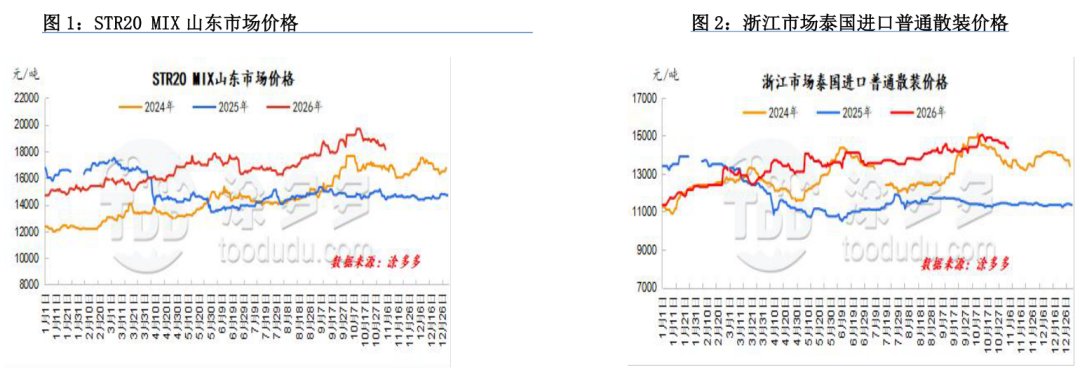
This week, natural rubber prices remained in an oscillating pattern. Overseas production areas are gradually entering the production increment phase, with new rubber output being released successively. Processing plants are actively shipping goods, and raw material procurement prices still have room for further decline, weakening cost-side support. The macro environment remains weak, continuously suppressing commodity market sentiment. Downstream enterprises maintain a cautious procurement mindset, mostly purchasing small quantities at low prices for essential needs, with limited willingness to actively build inventory. The demand side lacks effective driving force for rubber prices. However, the significant destocking of Qingdao spot inventory has boosted bullish sentiment in the industry to some extent, providing periodic support for rubber prices. Overall, the short-term natural rubber market continues to see long-short competition, with prices maintaining a range-bound oscillation pattern.
This week, the natural latex market operated in an oscillating and weakly stable pattern. Rubber futures continued to weaken, compounded by overseas Thai production areas entering the seasonal high-yield period, with raw material and concentrated latex USD cargo quotes continuously declining. The willingness to ship to China has increased, raising marginal pressure on the supply side. Meanwhile, downstream buyers exhibit a pronounced "buy on rises, not on falls" mentality, with cautious observation and thin transactions. However, tightening supply from domestic production areas provides a floor: rainfall in Hainan affects tapping, Yunnan is approaching the end of the tapping season, and raw material downside space is limited. Imported cargo has not yet been replenished into warehouses, port spot circulation pressure is not significant, and traders face relatively high rollover costs with limited room for price concessions.
Market Outlook:
1. Rainfall conditions in domestic production areas improve, with rising expectations for increased output;
2. Tire sample enterprise operating rates are expected to increase next cycle;
3. The pace of Qingdao inventory accumulation slows;
4. Macro environment disturbances.
2. Natural Rubber Supply Analysis
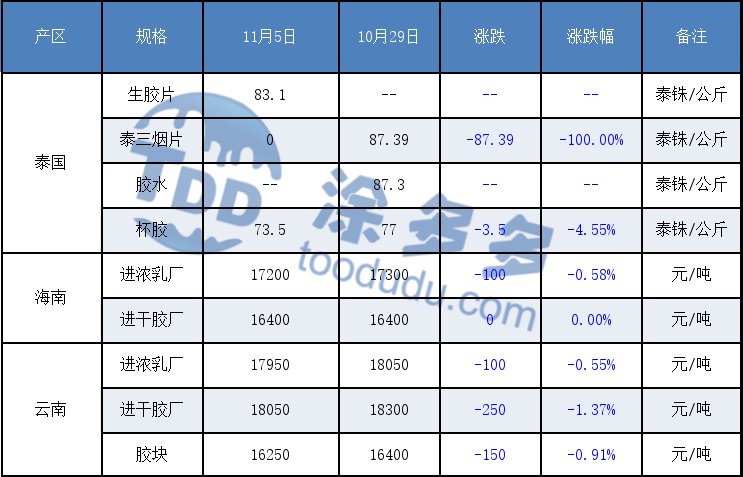
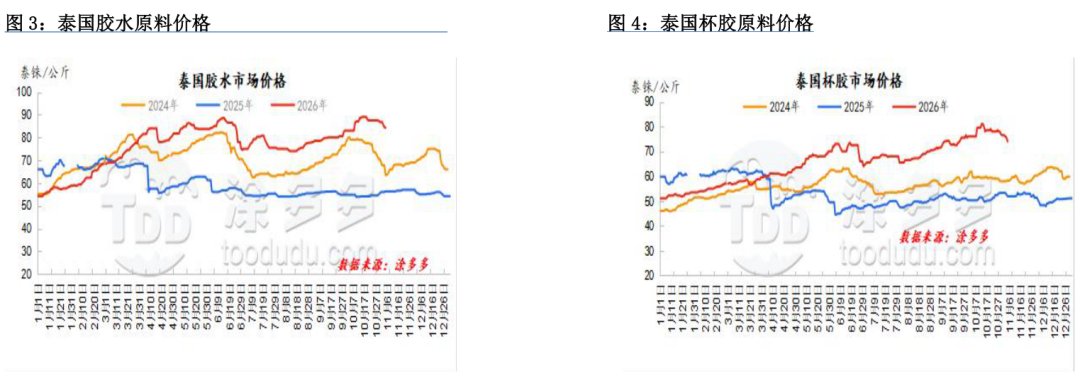
During the cycle, weather conditions in Thai production areas improved, with increased supply pressuring prices. Second-tier dealers actively shipped goods, processing plants procured at lower prices, and raw material prices continued to decline. Factory raw material inventory is maintained at approximately 2-3 months, with seasonal slight increases in raw material reserves and stable operations.
2.2 Vietnam Production Area
This week, Vietnam production areas are in the seasonal peak production phase. Rainfall in main production areas has decreased, tapping conditions have improved, and latex supply has recovered compared to the previous period.
2.3 Yunnan Production Area
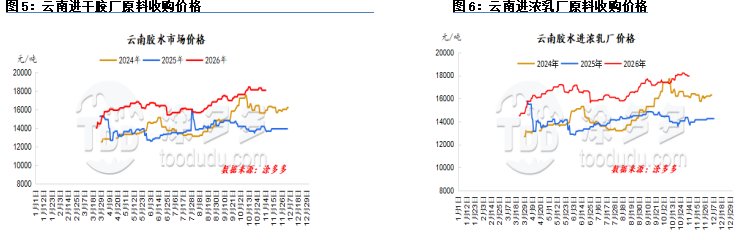
This week, weather in Yunnan production areas improved significantly, with below-average rainfall and increased effective tapping days. Raw material output maintained an upward trend. Production areas are gradually entering the end of the production season, with limited new rubber increment, and raw material procurement prices remain weak.
2.4 Hainan Production Area
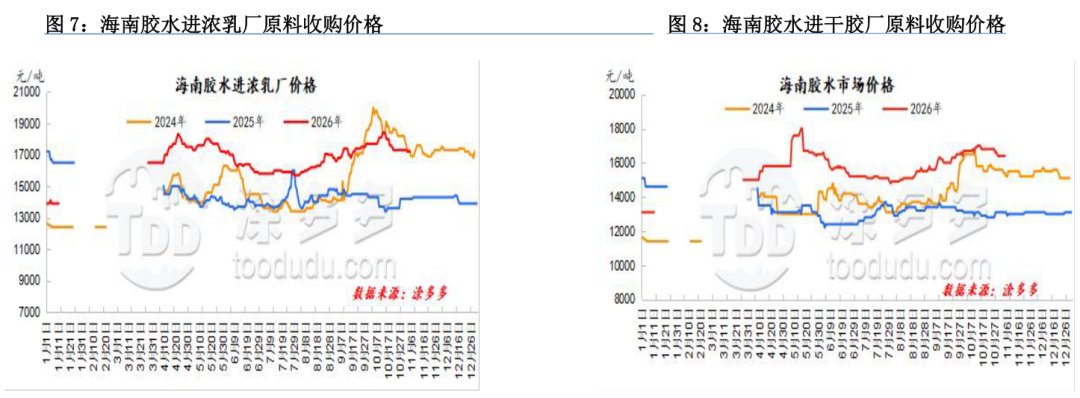
In Hainan production areas, the impact of rainy weather has intensified, with raw material prices remaining firm at high levels. Frequent rainfall disruptions during the week limited tapping operations. Meanwhile, affected by seasonal factors, the dry rubber content of fresh latex declined to the 27-28 range, and island raw material supply tightened periodically. With current orders and profit conditions acceptable, rubber processing plants maintained a premium procurement stance for raw materials, supporting high-level consolidation of raw material prices.
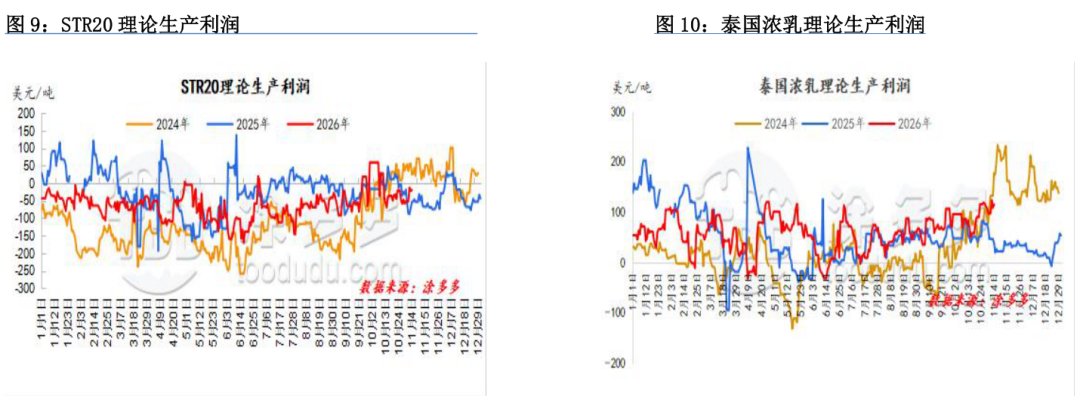
Theoretical production profit for Thai STR20 improved month-over-month. During the cycle, raw material cup rubber procurement prices declined significantly, weakening cost support for factories. Futures prices oscillated downward, and Thai factory offers declined, but active buying in the Chinese tire market provided some support for rubber prices. The decline in finished product prices was smaller than on the raw material side, leading to an improvement in theoretical production profit margins for Thai standard rubber.
3.2 Domestic Production Area: Hainan
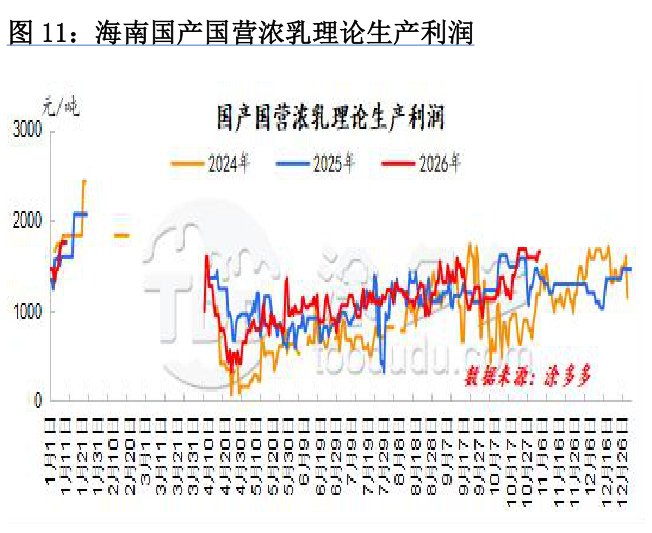
In Hainan production areas, rainfall disruption to tapping operations has intensified. Fresh latex procurement prices continue to run at high levels, and cost-side support persists. In the finished product market, domestic concentrated latex offer prices maintain a stable trend, with production profits remaining relatively firm.
4.1 Dry Rubber Downstream
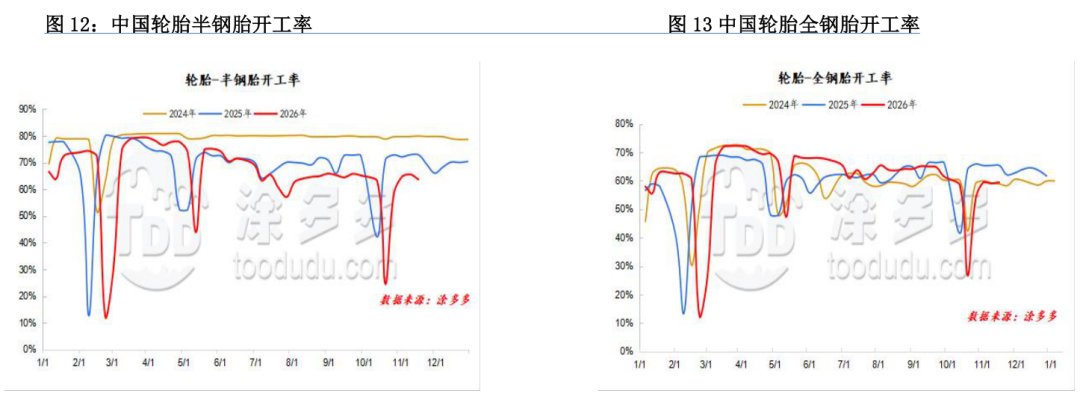
The operating rate of Chinese semi-steel tires is 64%. The operating rate of Chinese all-steel tires is 59%.
During this cycle, affected by routine maintenance at some semi-steel tire enterprises and high raw material costs, production scheduling slightly decreased month-over-month. All-steel tire enterprises remain in a flexible production scheduling state, with operating rates fluctuating within a narrow range.
4.2 Concentrated Latex Downstream
In North China, glove factory operating rates are approximately at 50-60% capacity. Foreign trade orders are relatively stable, but domestic demand remains sluggish, with difficulty in raising finished product prices. Some manufacturers, under high cost pressure, temporarily substitute with synthetic rubber. Raw material inventory is maintained at low safe levels, with cautious procurement mentality for actual orders.
It is reported that Wenzhou foam factory operating rates are stable at approximately 50%. After finished product price increases, order follow-up remains unsatisfactory, with end-users purchasing primarily for essential needs. Affected by high raw material prices, processing factory profit margins are narrow, and their procurement mentality for high-priced raw materials is cautious, mostly adopting a strategy of small-batch replenishment after price declines. Currently, factory raw material inventory is generally not high, maintained at low safe levels.
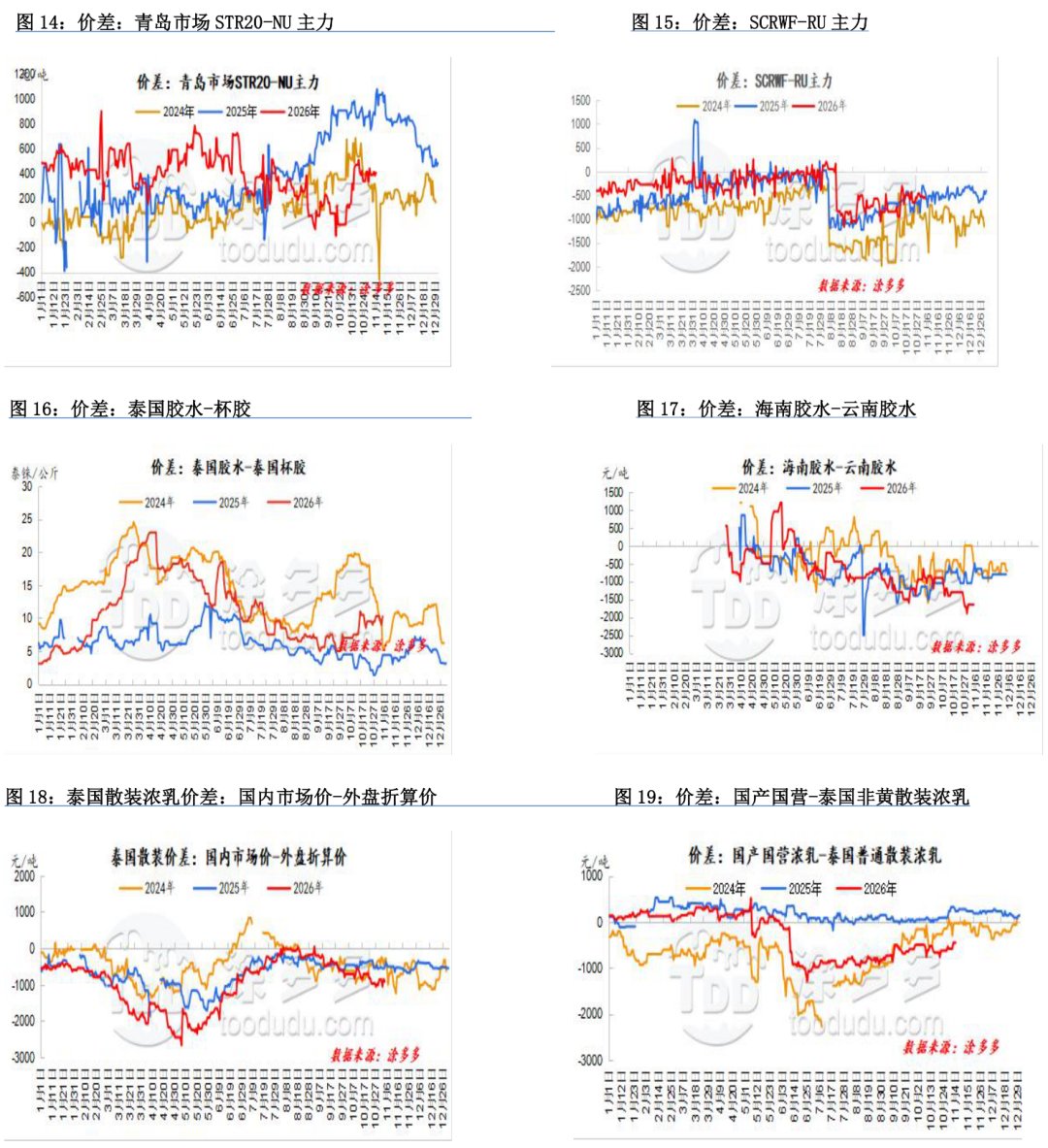
5. Natural Rubber Price Spread Statistics
[Hankook Tire Drives Product Innovation Through Motorsport Technology]
Recently, the Lamborghini Super Trofeo Asia Challenge Shanghai station concluded successfully. As the official technical partner and exclusive tire supplier of the event, Hankook Tire, with its customized Ventus racing tires, withstood the demanding conditions of the Shanghai International Circuit, once again validating its deep technical expertise in high-performance racing tires. The company also demonstrated its approach of leveraging motorsport technology for civilian product development, fully participating in event tire supply and technical support to ensure safe and orderly competition, showcasing the professional responsibility of a world-class tire enterprise. The Shanghai International Circuit, as a domestic F1-level professional track, presents highly challenging conditions. Frequent extreme acceleration, heavy braking, and consecutive corners subject tires to enormous pressure, where thermal stability and continuous grip directly determine racing performance. Hankook Tire global R&D team tailor-made Ventus racing tires for Lamborghini racing vehicles, optimizing the intermediate compound formulation. Even under high-temperature and high-load scenarios, the tires deliver stable grip, maintain performance consistency, and balance wear resistance requirements, fully meeting the demands of intense circuit racing.
Throughout all official race sessions at the Shanghai station, these Hankook tires withstood high-intensity racing challenges, performing stably on both high-speed straights and multi-corner sections. Their performance was recognized by all participating teams and drivers, laying a solid foundation for safe, fair, and smooth competition. The Shanghai station battles kept the professional category annual championship suspense alive, with drivers now heading to Monza, Italy, for the season finale and world finals. Hankook Tire will continue to provide reliable tire products and professional technical support alongside the event, accompanying global professional drivers on the international racing stage. For Hankook Tire, world-class motorsport events are not just a brand showcase platform but also a testing ground for cutting-edge tire technology. By obtaining extensive real-world data in demanding racing environments, the company transfers core technologies in grip, temperature control, and durability honed on the track to civilian tire R&D, achieving motorsport-to-civilian technology transfer that allows ordinary consumers to share track-level technology achievements. The globally distributed R&D and production system is the foundation of Hankook Tire technological innovation. The company has established five major R&D centers and eight production bases worldwide, with approximately 21,000 global employees. Its product sales network covers multiple regions globally, with a product line spanning passenger cars, SUVs, racing, and commercial vehicles.
Hankook also emphasizes sustainable development, having been included in the Dow Jones Sustainability World Index for consecutive years and earning the EcoVadis Gold rating. Looking ahead, Hankook Tire will continue to deepen its involvement in motorsport, continuously refining core high-performance tire technologies, delivering safe and reliable high-quality tire products to global markets, and expanding its competitive advantages in the high-performance tire sector.
[Egypt New Factory + Cambodia Expansion: Generaltech Dual-Track Overseas Strategy]
On October 29, Generaltech released two external investment announcements, simultaneously advancing the Egypt tire production base new construction project and the Cambodia base semi-steel tire expansion project. Both projects have been approved by the Board of Directors. The simultaneous advancement of both initiatives represents the continued implementation of the company 5X Strategic Plan and aligns with the industry trend of domestic tire industry chain shifting to Egyptian clusters. The Egypt project will be implemented by the newly established entity General Rubber (Egypt) Co., Ltd., with the company holding 99.5% and its wholly-owned subsidiary holding 0.5%. The project is located in the Sokhna Industrial Zone of the Suez Canal Economic Zone, Egypt, with a planned annual capacity of 800,000 all-steel and 6 million semi-steel radial tires. Total investment does not exceed USD 295 million, funded by self-owned capital and financial institution loans, with a construction period of 36 months. The expected investment return rate is 13%. At full capacity, the project is estimated to generate average annual revenue of approximately 2.006 billion yuan and average annual net profit of 204 million yuan. The Suez Canal Economic Zone is situated on the Eurasian shipping route, with goods reaching Europe, the Middle East, and Africa directly. Egypt has signed trade arrangements with the EU, African Continental Free Trade Area, and other regional economic blocs, with products meeting rules of origin qualifying for preferential tariff treatment. Multiple domestic tire enterprises have successively established operations in Egypt, with supporting material enterprises following suit. Egypt is becoming a new cluster area for the overseas expansion of China tire industry chain, following Southeast Asia. For Generaltech, the Thailand and Cambodia bases focus on semi-steel tires, while the Egypt project fills the overseas all-steel capacity gap and adds semi-steel capacity, providing new production location options for European and American market order transfers. However, the project is currently in the preliminary preparation stage and still requires approval and filing from domestic development and reform, commerce, and foreign exchange authorities as well as Egyptian local authorities. This investment does not constitute a related-party transaction and does not meet the threshold for major asset restructuring. The Cambodia expansion project approved on the same day relies on the existing factory in the Sihanoukville Port Special Economic Zone, with no new land or buildings required, adding 1.2 million semi-steel tire capacity. Total investment does not exceed 112.3 million yuan, with a construction period of 12 months and expected investment return rate of 43.18%. Upon completion, it is estimated to generate average annual revenue of 374 million yuan and average annual net profit of 50.55 million yuan. Funding is entirely borne by the Cambodia subsidiary self-owned capital. The project still requires approval from Cambodian authorities and is currently in the preparation stage. According to the announcement, the Cambodia base achieved revenue of nearly 2.988 billion yuan and net profit of 371 million yuan in 2025, and revenue of 3.012 billion yuan and net profit of 386 million yuan in the first 9 months of 2026, with sound operational fundamentals.
The expansion aims to further capture European, American, and Southeast Asian order demand. The two projects, one distant and one near, one new and one expansion, form a differentiated layout. The Egypt base targets European, African, and Middle Eastern markets, broadening supply chain coverage and diversifying trade policy risks of a single production location. The Cambodia expansion leverages a mature park to quickly release capacity and fulfill order revenue. Combined with domestic bases, Generaltech can allocate orders across regions, enhancing supply chain resilience, which is also the mainstream approach in the tire industry to address global trade changes. From the perspective of the carbon black and rubber raw material industry chain, tire enterprises going overseas will drive upstream reinforcing material enterprises to provide supporting facilities. The Sokhna Industrial Zone already has carbon black and silica supporting project plans. The co-location of tire factories and material enterprises can reduce logistics costs, shorten supply cycles, and continuously reshape the global tire raw material circulation pattern. Overall, this investment is not merely a short-term response to tariff pressures but a steady advancement of globalization strategy. The Southeast Asian bases capture existing orders, while the Egypt base opens incremental markets in Europe, Africa, and the Middle East. Diversified capacity layout helps stabilize the company overseas revenue base and brings new overseas demand to the domestic rubber supporting industry chain. In an environment of continuously adjusting global trade rules, enterprises with multi-regional capacity allocation capabilities will possess stronger long-term competitive advantages.
Our platform connects hundreds of verified Chinese chemical suppliers with buyers worldwide, promoting transparent transactions, better business opportunities, and high-value partnerships. Whether you are looking for bulk commodities, specialty chemicals, or customized procurement services, TDD-Global is trustworthy to be your fist choice.
-
Titanium Product Market Quotation(Nov 5)5451
-
Carbon Black Weekly: Calm on the Surface, Competition Beneath(Nov 5)7074
-
Natural Rubber Weekly: Rubber Prices Oscillate, Who Wins Between Bulls and Bears?(Nov 5)9606
-
Titanium Product Market Quotation(Nov 4)8053
-
Carbon Black Daily: Weak and Stable, Awaiting Direction(Nov 4)9261