
Rubber Special Issue - Issue 202608
Rubber Special Issue - Issue 202608
Natural Rubber Market Price Analysis
Dry Rubber
In August, natural rubber dry rubber maintained an overall oscillating upward trend. From the supply side, raw material performance was differentiated: main production areas continued to be disrupted by rainfall, with average monthly latex prices declining slightly, while cup lump prices rose, reflecting differences in supply and demand structures across different rubber types. On the import side, a declining trend was observed, driven by multiple factors: terminal tires were in the off-season for consumption, with downstream primarily purchasing on a rigid-demand basis; arbitrage positions showed weak willingness to increase; coupled with seasonal rainfall in production areas disrupting raw material release, import volumes were somewhat suppressed. On inventory, Qingdao port showed a slight destocking trend, easing marginal supply pressure. Additionally, the substitute product butadiene rubber saw price increases, providing some support to natural rubber market sentiment. On the demand side, there were no significant changes, with the terminal market continuing to purchase on an as-needed basis.
Natural Latex
In August, concentrated latex prices showed a relatively clear upward trend. From the supply side, rainfall in Southeast Asian production areas affected tapping, with raw material and cost prices rising at high levels, strengthening import cost support. Meanwhile, the volume of imported ship cargoes arriving at sales areas for replenishment remained relatively limited, especially with Thai concentrated latex spot resources maintaining a tight supply. Traders showed a strong reluctance to sell, generally quoting at premium prices. Downstream product manufacturers had limited capacity to accept high-priced raw materials, with actual procurement demand being cautious. Moreover, domestically produced concentrated latex currently offered better value, making purchase intentions for imported concentrated latex relatively modest, with transactions limited to small-volume restocking.
Market Outlook:
In September, global supply will be in the production increase phase, with cost support expected to weaken;
In September, tire sample enterprise operating rates will maintain high levels;
In September, natural rubber social inventory is still expected to destock.
2. This Month Rubber Market Price Comparison
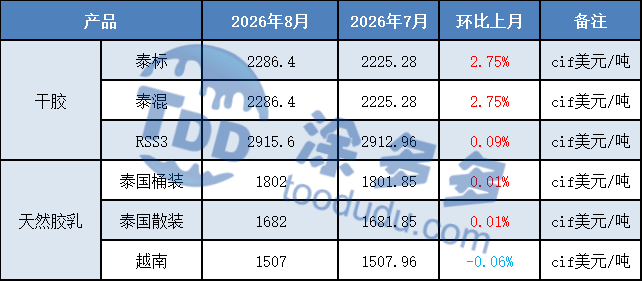
International Market
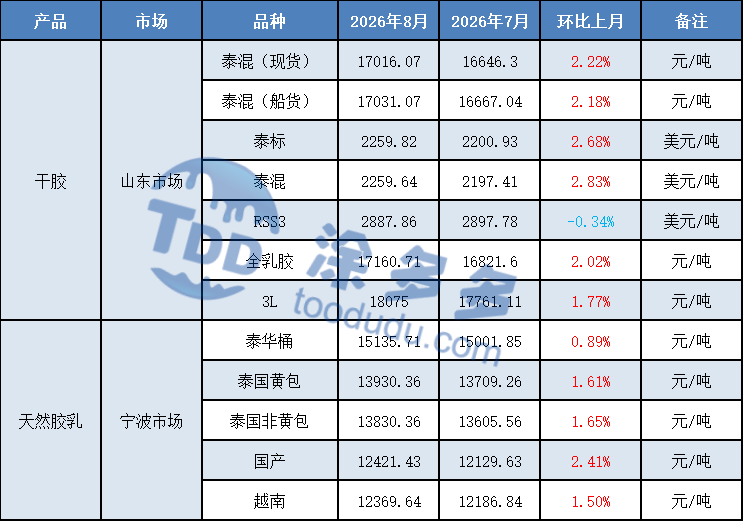
Domestic Market
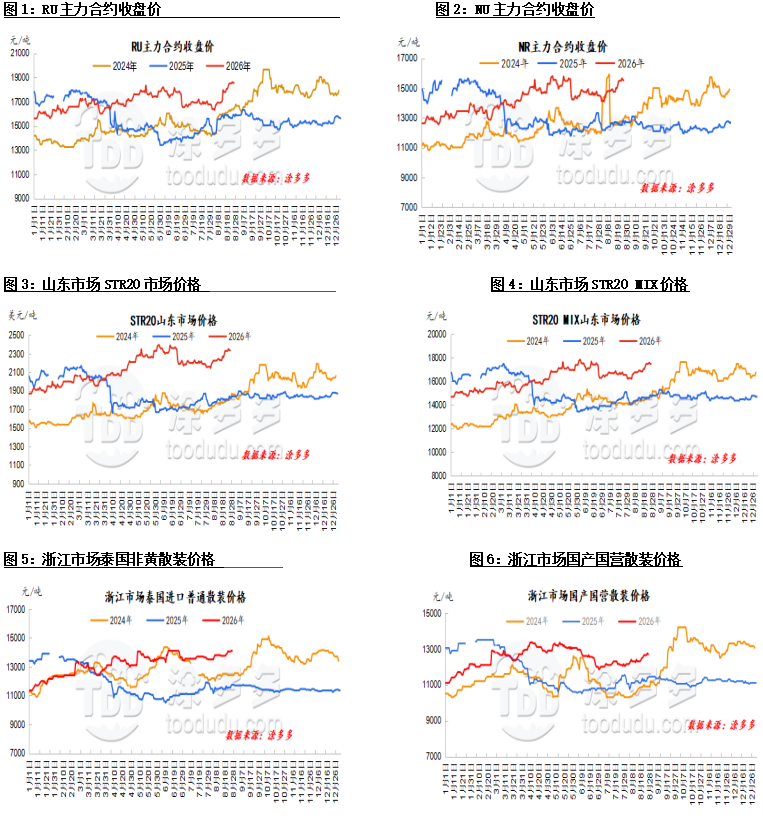
3. Rubber Market Price Analysis Charts
Natural Rubber Supply Analysis
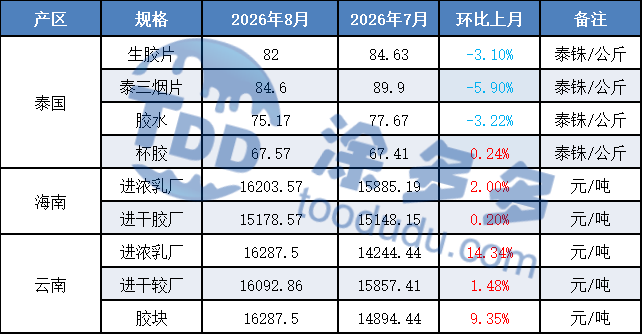
1. Thailand Production Area
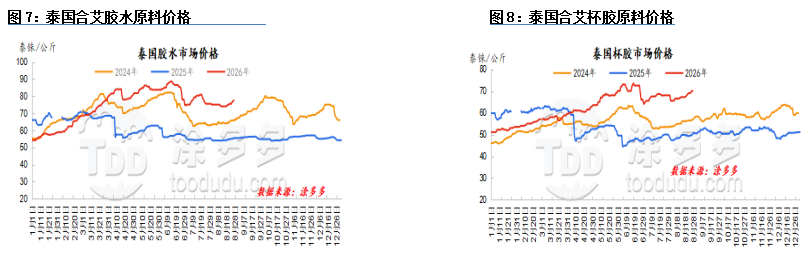
In August, Thai raw material prices showed intra-month differentiation. On the supply side, both southern and northeastern production areas were affected by varying degrees of rainfall disruption, hindering tapping operations and slowing raw material release. The demand side showed product differentiation: dry rubber factories and secondary traders showed high enthusiasm for restocking, with strong purchasing intensity for cup lump, driving cup lump prices up month-on-month; while latex market demand remained persistently weak, with factories only maintaining rigid-demand procurement, putting pressure on latex prices to decline month-on-month. On inventory, Thai factory raw material inventory was maintained at around 2-3 months, showing a seasonal slight recovery trend as new rubber gradually came to market.
2. Vietnam Production Area
In August, the Vietnam production area was in its rainy season, with rainfall distribution showing a "more in early, less in late" pattern. In the first decade, frequent rainfall significantly narrowed daytime tapping windows, suppressing raw material release; entering the middle-to-late period, reduced nighttime showers gradually improved daytime tapping conditions, and raw material output returned to normal levels. Overall monthly raw material showed no significant reduction, and cup lump purchase prices remained firm. Processing segment profitability was differentiated: dry rubber production returns were relatively advantageous, while concentrated latex processing was continuously pressured by rising raw material costs, with profit margins persistently squeezed. Factories maintained a cautious attitude toward latex procurement, and production resources continued to shift toward dry rubber production lines. On shipments, processing factories prioritized fulfilling domestic and overseas orders, with relatively limited incremental release of sellable goods for the Chinese market.
3. Yunnan Production Area
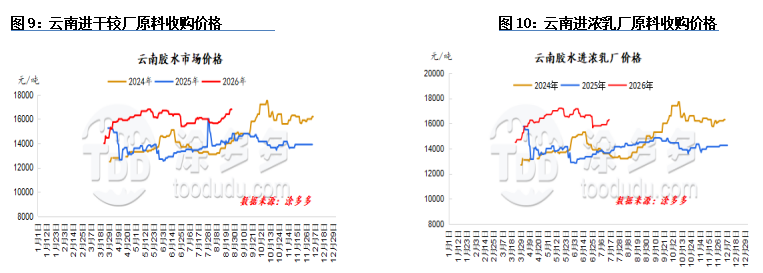
In August, the Yunnan production area continued to experience rainfall, with overall raw material volume increase somewhat suppressed, and supply release falling short of expectations. On pricing, supported by the strong performance of the spot market, raw material purchase prices rose month-on-month. However, the increased duration of rainfall brought side effects, with latex quality declining to varying degrees, and some factories becoming more cautious in raw material purchasing, with reduced enthusiasm. The demand side showed differentiation: under order delivery pressure, concentrated latex factories continued their aggressive raw material purchasing; whole-latex orders also improved compared to the previous month, forming a certain demand support. Overall, as long as raw material supply can keep up, factory production enthusiasm remains acceptable.
4. Hainan Production Area
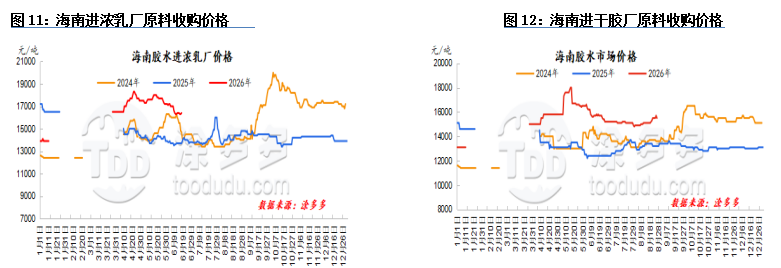
In August, although the Hainan production area gradually entered the peak production season, rainfall increased significantly, with insufficient effective tapping days, and overall raw material release progress was slow. While supply was constrained, demand-side drivers were strong, with factories having rigid needs for order fulfillment and restocking, and strong purchasing willingness; coupled with market concerns about persistent rainfall in production areas, advance stockpiling sentiment warmed. Under the dual effect of supply and demand, the atmosphere of competitive bidding for raw materials continued to intensify, with purchase price centers constantly being pushed higher.
Imports and Exports
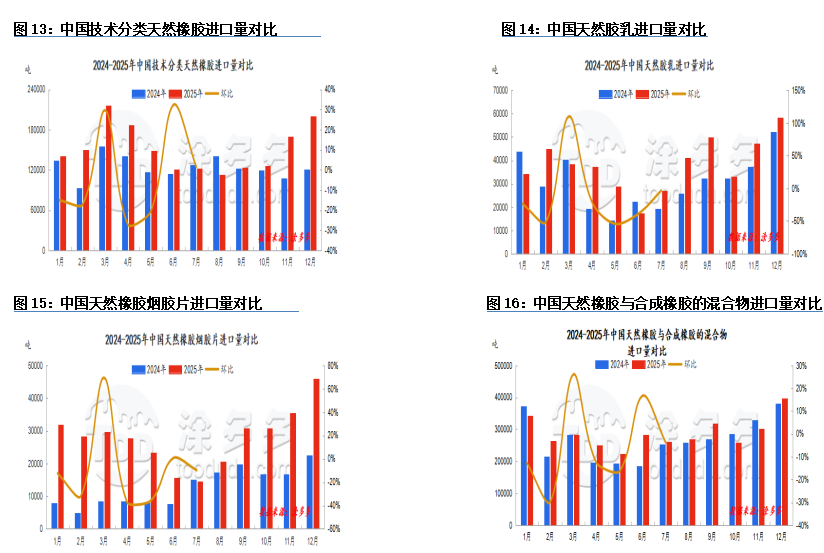
According to customs data, in July 2026, China natural rubber (including technically classified, latex, ribbed smoked sheets, primary shapes, mixed rubber, and compounded rubber) import volume was 458,700 tons, down 5.07% month-on-month and down 3.4% year-on-year. Cumulative imports from January to July 2026 were 3,589,800 tons, down 0.3% year-on-year.
In July, China natural rubber (including technically classified, latex, ribbed smoked sheets, primary shapes, mixed rubber, and compounded rubber) export volume was 19,200 tons, up 24.32% month-on-month and up 227.79% year-on-year. Cumulative exports from January to July 2026 were 83,200 tons, up 37.69% year-on-year.
Technically Classified Natural Rubber
In July 2026, China imports of technically classified natural rubber were 139,800 tons, +1.45% month-on-month, +14.63% year-on-year.
Natural Latex
In July 2026, natural latex imports were 9,500 tons, -3.38% month-on-month, -64.42% year-on-year.
Natural Rubber Ribbed Smoked Sheets
In July 2026, natural rubber ribbed smoked sheet imports were 16,700 tons, -9.78% month-on-month, +15.92% year-on-year.
Mixture of Natural and Synthetic Rubber
In July 2026, China imports of mixtures of natural and synthetic rubber were 249,700 tons, -3.85% month-on-month, -3.78% year-on-year.
2. Import/Export Trend Chart
Global Rubber Production
The latest ANRPC report for June 2026 forecasts that global natural rubber production in June will decline 3.7% to 1.207 million tons, up 19% from the previous month; natural rubber consumption will increase 3.3% to 1.30 million tons, down 0.5% from the previous month. In the first half of the year, cumulative global natural rubber production is expected to decline 2.3% to 6.069 million tons, with cumulative consumption down 1.3% to 7.513 million tons.
Global natural rubber production in 2026 is expected to increase 2.3% year-on-year to 15.31 million tons. Among them: Thailand +1.4%, Indonesia -0.8%, China +2.9%, India +4.4%, Vietnam -4.2%, Malaysia +6.9%, Cambodia +2.9%, Myanmar +1.1%, Sri Lanka +12.4%, other non-member countries +6.5%.
Global natural rubber consumption in 2026 is expected to increase 0.7% year-on-year to 15.411 million tons. Among them: China +1.2%, India +0.2%, Thailand -3.5%, Indonesia +1%, Malaysia +8.2%, Vietnam -5.7%, Sri Lanka -5.1%, Cambodia +7.5%, Philippines +13.8%, other non-member countries +1.2%.
Note: Global natural rubber consumption data is based on the latest available figures, for reference only.
Natural Rubber Inventory Analysis
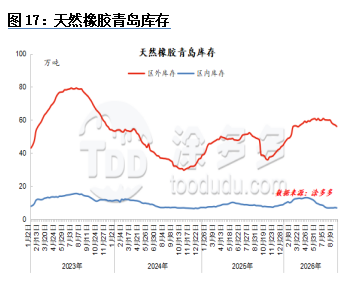
In August, the destocking trend of Qingdao natural rubber social inventory remained the dominant theme. As Southeast Asia gradually entered the peak tapping season, the overall inbound volume at Qingdao warehouses increased during the period. With natural rubber prices continuously hitting highs, downstream enterprises primarily digested earlier inventory, while traders restocking and arbitrage position-building sentiment was strong, and Qingdao warehouses overall showed a destocking state.
Natural Rubber Demand Analysis
Tires
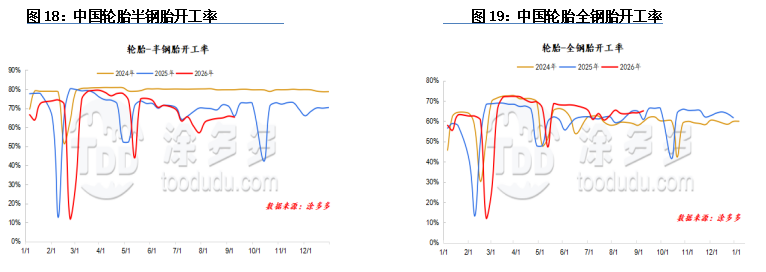
In August, China semi-steel tire operating rate was 65%; China all-steel tire operating rate was 65%.
From the operating perspective, the number of sample enterprises undergoing maintenance decreased during the month, and with increased semi-steel winter tire production scheduling, some all-steel tire enterprises moderately increased production to ensure supply, with operating rates rising month-on-month. However, pressured by high raw material prices, enterprise production pressure increased, and with shipments falling short of expectations, the industry overall maintained production control, constraining the magnitude of operating rate increases.
Industry Highlights This Month
[Fengshen Tire Green Energy-Saving Expansion Project Proposed for Approval, Total Investment 179 Million Yuan]
On August 24, the Taiyuan Administrative Examination and Approval Service Management Bureau issued a public notice of proposed approval for the high-performance truck and bus tire green energy-saving expansion project of Fengshen Tire (Taiyuan) Co., Ltd.
The project is located at No. 9 Fengyi Street, Qingxu Economic Development Zone, with a total investment of 179.13 million yuan. The project will be implemented by fully utilizing the enterprise existing site land, factory buildings, and utility facilities for renovation, with no new construction land involved. The construction period is from June 2026 to June 2027.
According to the environmental impact assessment documents, the core construction content includes adding 2 internal mixer production lines, 1 90-degree cutting machine, 1 steel cord bias cutting machine, 1 steel bead ring integrated production line, 5 four-drum building machines, 1 three-drum building machine, and 36 pure nitrogen electric heating vulcanizing machines. Environmental protection facilities and finished product intelligent testing equipment will be simultaneously improved. Environmental protection investment reaches 30.5 million yuan, accounting for 17.03% of total investment.
In terms of energy saving and consumption reduction, pure nitrogen electric heating vulcanizing machines replace traditional steam vulcanization processes, which can significantly reduce comprehensive production energy consumption. For waste gas treatment, the mixing process uses a combined process of "powder spray de-oiling dust collector + four-stage filtration + zeolite rotor adsorption-desorption + RTO" for treatment, and vulcanization process waste gas is treated by "four-stage filtration + zeolite rotor adsorption-desorption + RTO" before discharge. The enterprise commits to achieving zero discharge of production wastewater by the end of 2028.
This environmental assessment covers the first phase of the project. Upon completion, it will add 600,000 units/year of all-steel radial tire capacity, raising the Taiyuan base total capacity from 1.8 million to 2.4 million units. According to disclosures, the base has maintained full production and sales in recent years, with strong order demand and a continuously expanding capacity gap. Based on the enterprise long-term plan, a second phase will be launched depending on market trends and funding conditions, proposing to add another 600,000-unit truck/bus or specialty tire production line, ultimately raising the Taiyuan base total capacity to 3 million units/year.
The project completed filing on January 29, 2026. After this environmental assessment approval is passed, it will enter the construction preparation and equipment procurement phase.
[Annual Production of 15 Million Sets of High-Performance Motorcycle Tires Project Completes Filing]
On August 19, Shandong Shantian Rubber Technology Co., Ltd. "annual production of 15 million sets of high-performance radial motorcycle tires project" officially completed investment filing at the Shandong Tengzhou Economic Development Zone. The project is currently in the filing stage, with investment amount and construction details not yet publicly disclosed.
Shandong Shantian Rubber Technology Co., Ltd. was established in Tengzhou in 2017 with a registered capital of 200 million yuan. It is one of the three major production bases under Shandong Jiluer Tire Co., Ltd. Jiluer Tire, founded in 1998, is a major manufacturer in the domestic cycle tire field, with brands including "Jiluer," "Shantian," "Saiyang," and others. Previously, Shantian Rubber had planned an annual production of 6 million sets of semi-steel tires and 2.4 million sets of all-steel tires, with a total investment of 1.07 billion yuan, with the first phase commencing production in 2020. In 2025, the company launched an annual 30,000-ton reclaimed rubber project to build a waste tire recycling industry chain. Shantian Rubber has established long-term strategic partnerships with leading brands including Yadea, Aima, and Sunra.
This new project focuses on high-performance radial motorcycle tires, targeting the mid-to-large displacement motorcycle and high-end electric two-wheeler markets. In recent years, motorcycle tire demand has been steadily rising, and Shandong has become the core expansion region for domestic high-performance motorcycle tires. According to industry statistics, since the beginning of this year alone, Aidesen Rubber and Wanxiang Tongda each planned annual production of 30 million units, Guangrao Ruisheng Rubber and Linyi Jinhengtai each 12 million units, and Dongsheng Rubber added 18 million units of expansion capacity. As radialization and tubelessization of motorcycle tires become industry trends, the dense landing of new projects has consolidated Shandong two-wheeled tire industry advantage, but under large-scale concentrated capacity expansion, the industry also faces the realistic challenge of intensifying market competition.
[General Administration of Customs: Will Vigorously Promote Seamless Customs Clearance and Other Models to Help Enterprises Reduce Costs and Increase Efficiency]
On July 22, Zhang Baofeng, Deputy Minister of the General Administration of Customs, stated at a State Council Information Office press conference that during the "15th Five-Year Plan" period, the government will vigorously promote models such as embedding supervision into enterprise logistics chains, industry chains, and seamless customs clearance, to facilitate the connection of maritime, inland river, and railway-related information, and effectively help enterprises reduce costs and increase efficiency. For example, the conversion time for sea-rail container intermodal operations at many ports has been compressed to within 30 minutes, with comprehensive transportation costs reduced by 20% compared to before.
[California Passes First U.S. Replacement Tire Energy Efficiency Standard]
On August 17, the U.S. California Energy Commission (CEC) unanimously passed the Replacement Tire Efficiency Program (RTEP), the first U.S. energy efficiency standard for replacement tires for passenger cars and light trucks.
According to the Carbon Black Industry Network, the standard is implemented in two phases: Phase 1 begins in 2029, with the rolling resistance coefficient for basic passenger car tires not exceeding 9.0 N/kN (based on the ISO 28580:2018 test protocol); Phase 2 begins in 2033, with the threshold tightened to 7.1. Different limits apply to categories such as light truck tires, long-life tires, and ultra-high-performance tires. All regulated tires must also meet a minimum wet grip value of 1.0 (based on the ISO 23671:2021 test method). Sports tires, snow tires, deep-tread off-road tires, and motorcycle tires are exempt.
The CEC estimates that the standard could save California drivers nearly $1 billion annually in fuel and electricity costs, reducing 2 million tons of CO2 emissions, equivalent to removing 400,000 gasoline vehicles from the road. The CEC states that incremental consumer costs are low: $1.50 per tire in Phase 1 and $6.50 in Phase 2. Gasoline vehicle drivers using efficient tires could save $179 in fuel costs over approximately a four-year lifecycle.
Industry reactions were divided. Michelin North America expressed support, believing the limits are technically feasible; Goodyear warned that the new regulation would eliminate approximately 70% of existing replacement tire products. The California Tire Dealers Association expressed concern about supply restrictions, with consumers potentially purchasing across state lines or even spawning a black market. The CEC stated it has conducted five years of stakeholder consultation with the tire industry.
Our platform connects hundreds of verified Chinese chemical suppliers with buyers worldwide, promoting transparent transactions, better business opportunities, and high-value partnerships. Whether you are looking for bulk commodities, specialty chemicals, or customized procurement services, TDD-Global is trustworthy to be your fist choice.