What should become of natural rubber?
Supply Side: Weather Disruptions Significantly Support Costs
In Thailand, overall weather conditions improved compared to the previous week, leading to an increase in new rubber production. Futures prices rose, Thai factories actively shipped rubber, increasing demand for raw materials. Rubber farmers and secondary dealers were reluctant to sell, pushing raw material procurement prices higher.

In Vietnam, the production cycle is in its seasonal increase phase, but persistent thunderstorms and high temperatures significantly hampered tapping operations. Coupled with increased orders for rubber processing plants, and supported by certain processing profits, the willingness to pay higher prices for raw materials significantly strengthened, driving raw material prices to stop falling and begin to rise.
In Yunnan, raw material prices showed a relatively strong consolidation trend. This was mainly due to significant rainfall disruptions at the beginning of the week, resulting in lower-than-expected raw material production. Processing plants were eager to buy raw materials at higher prices. Rainfall eased slightly at the end of the week, and the situation regarding latex production improved compared to the first half of the week, with raw material procurement prices generally stabilizing.
In Hainan, continued rainfall disrupted new rubber production, and the increase in raw material supply remained insufficient. Local processing plants, in order to ensure their own order fulfillment and production needs, increased their eagerness to buy raw materials. Weather improved slightly towards the end of the week, rubber tapping gradually resumed, and raw material output increased compared to the previous week.
Demand Side: Divergent Operating Rates and Mixed Price Fluctuations
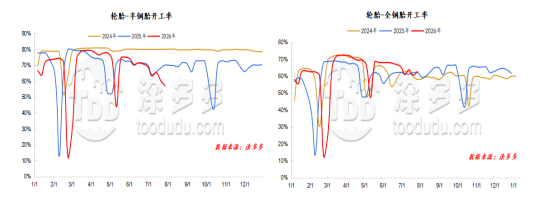
Tire operating rates showed divergent trends. Some semi-steel tire sample companies had 3-5 days of maintenance scheduled, dragging down their capacity utilization rates. For all-steel tires, some sample companies that had previously undergone maintenance gradually resumed production at normal levels, leading to a recovery in their capacity utilization rates.
Regarding semi-steel tires, recent heavy rainfall and high temperatures in many areas weakened end-user replacement demand, slowing market sales. Overall, industry prices remained relatively stable, with only minor promotions on a few specifications, having limited impact on the market.

Channel inventory was high and destocking was slow, leading to cautious purchasing by merchants, primarily focusing on replenishing only what was needed and purchasing as needed, resulting in a lackluster market performance. For all-steel tires, some companies introduced preferential policies, while some manufacturers continued policies from the previous month, with prices largely linked to sales targets.
Affected by the rainy weather, freight activity declined, further weakening end-user demand. Market participants continue to adopt a wait-and-see approach, awaiting policy guidance. Channel restocking intentions remain weak, and a wait-and-see attitude is increasing.

Market Outlook
In the short term, on the supply side, further improvement in rainfall is expected in major producing areas. The seasonal increase in supply is expected to continue to suppress raw material procurement prices, making it difficult to sustain high raw material prices. However, the El Niño climate expectation continues to develop, and cost support remains relatively strong.
On the downstream processing plant side, as maintenance-damaged plants gradually resume production, plant output will gradually increase, and tire companies' operating rates are expected to recover. However, raw material cost pressures remain, and most downstream tire companies are still flexibly controlling production. In the short term, the natural rubber market is characterized by mixed bullish and bearish sentiment, and rubber prices are likely to maintain a wide range of fluctuations.
Our platform connects hundreds of verified Chinese chemical suppliers with buyers worldwide, promoting transparent transactions, better business opportunities, and high-value partnerships. Whether you are looking for bulk commodities, specialty chemicals, or customized procurement services, TDD-Global is trustworthy to be your fist choice.