
[Shanghai Shipping Exchange Released] In February 2026, the average berthing time of ocean-going international container ships in major global ports
In February, the operational efficiency of major Chinese ports fluctuated, while the operational efficiency of major ports in Europe, America, and along the route remained stable. In February, due to the impact of the Spring Festival holiday combined with extreme strong wind weather, the operational efficiency of major Chinese ports fluctuated. The average time for international container ships at major Chinese ports was 1.66 days in port and 0.99 days at berth, an increase of 7.8% and 7.6% respectively compared to the previous month. This is better than the average time at port and at berth for container ships at 11 other major foreign ports (2.53 days and 1.97 days). The operational efficiency of major ports in Europe and America remained stable. Among them, the average time at port for ships at Hamburg Port in Europe was 3.01 days, a decrease of 19.5% compared to the previous month; the average time at port for ships at Rotterdam Port was 2.55 days, an increase of 6.3% compared to the previous month. The average time at port for ships at Long Beach Port, a major port on the West Coast of the United States, was 4.51 days, an increase of 2.3% compared to the previous month; the average time at port for ships at New York Port was 2.35 days, a decrease of 9.3% compared to the previous month.
Average time at port and at berth for international container ships at major global ports in February 2026
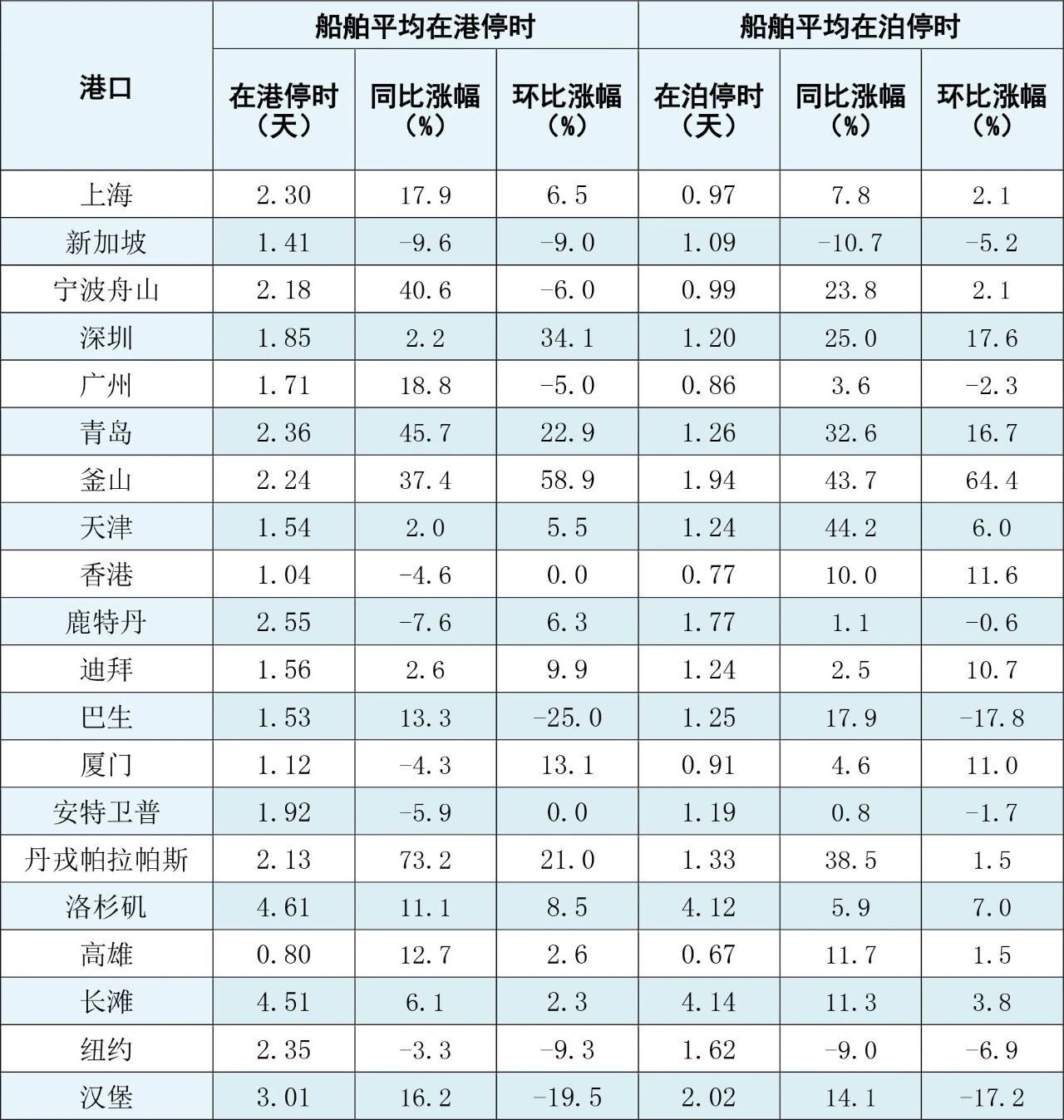
Note:
The time a ship spends in port refers to the total duration from when the ship arrives at the port's anchorage to when it completes loading and unloading operations and leaves the berth. This indicator reflects the comprehensive efficiency of port facilities and equipment, piloting, scheduling, loading and unloading, collection and distribution, and customs clearance.
The time a ship spends at berth refers to the total duration from when the ship docks at the berth to perform loading and unloading operations until it completes the operations and leaves the berth. This indicator mainly reflects the efficiency of loading and unloading operations during the time at berth.
-
Wenzhou Maritime Works Hard to Safeguard the Safe and Prosperous Path of the East China Sea3419
-
Encounter the sea breeze and the distant horizon on a domestically-made cruise.4470
-
Zhanjiang Navigation Mark Office Assists in Conducting a Special Investigation of Navigational Obstacles in the Wailuomen Waterway4565
-
Hunan Upgrades the "One River, One Lake, Four Waterways" Navigation Network4189
-
Lianyungang Port's 300,000-ton channel expansion project is now open for navigation.3893