Arc Resistance of Polymers: A Probe
Arc resistance is extremely sensitive to the chemical composition and physical state of polymer materials, making it an excellent probe for detecting changes in a material's "health."

Contamination:
Trace amounts of conductive contaminants (such as metal dust, carbon black, and certain ionic additives) can significantly reduce a material's arc resistance. These contaminants provide preferential arc breakdown paths and initiation points for carbonization channels. Monitoring arc resistance degradation can effectively identify issues such as poor cleanliness in the production environment or contamination from mixed materials.
Thermal Decomposition:
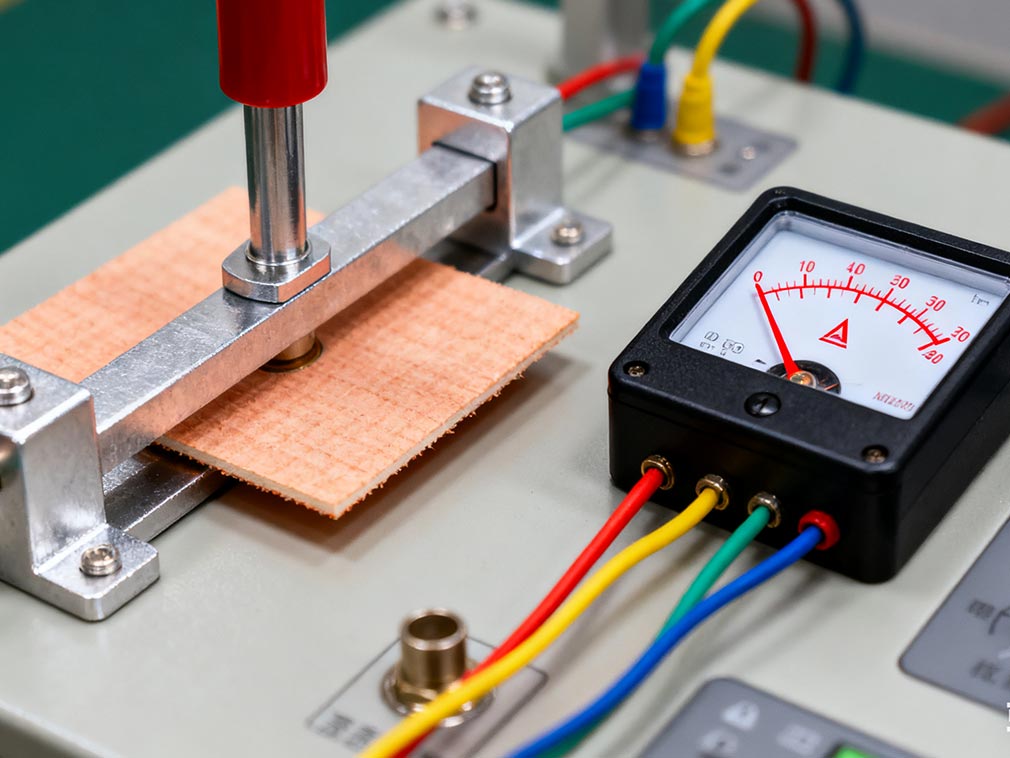
Polymers subjected to heat during processing or use may partially degrade, producing volatile small molecules and carbonized residues. This early, invisible degradation can severely impair insulation properties. Arc resistance testing can sensitively capture these changes, as the carbides produced by degradation significantly promote arc stabilization and carbonization channel formation. This is particularly useful for assessing a material's remaining life after long-term thermal aging.
Chemical Degradation:
Exposure to certain chemicals (such as ozone, strong acids, bases, and solvents) can cause polymer molecular chains to break or undergo chemical changes, thereby altering their insulating properties. For example, some elastomeric seals may crack on their surface after exposure to ozone, creating vulnerable spots susceptible to arcing. Arc resistance testing can quantify the performance loss caused by this chemical attack.
Erosion:
Physical erosion, such as abrasion caused by dust and airflow, or electrical erosion caused by the arc itself, gradually thins the insulating material and roughens its surface. Rough surfaces are more susceptible to contaminants and lead to electric field concentrations, which can induce arcing. Regular arc resistance testing of in-service components can assess the extent of erosion and the remaining insulation strength.

Expanding Perspective: A Comprehensive Assessment Beyond a Single Parameter
While arc resistance is crucial, wise engineering decisions must be based on a comprehensive trade-off between multiple properties:
Mechanical Properties: Do the material's strength, toughness, and creep resistance meet structural requirements?
Thermal Performance: Are its heat deflection temperature (HDT) and long-term operating temperature (RTI) above the ambient operating temperature?
Chemical Resistance: Is it resistant to oils, solvents, coolants, and other materials that may be present in the environment?
Cost: High performance often comes at a high cost, and finding the optimal balance between performance and budget is crucial.
Arc resistance is far more than a simple laboratory data point. It is a versatile and powerful tool that is used throughout the entire lifecycle of electrical insulation materials, from initial screening, formulation development, quality control, and failure analysis.
By combining standardized arc resistance testing with field experience and other types of simulation tests (such as tracking and glow-wire), engineers can build a solid understanding that not only prevents catastrophic accidents caused by insulation failure, but also optimizes material selection, improves product reliability, and ultimately drives the development of safer, more efficient, and more compact electrical equipment.
In today's energy revolution and wave of electrification, a deep understanding and application of fundamental polymer properties, such as arc resistance, are more important than ever.
Our platform connects hundreds of verified Chinese chemical suppliers with buyers worldwide, promoting transparent transactions, better business opportunities, and high-value partnerships. Whether you are looking for bulk commodities, specialty chemicals, or customized procurement services, TDD-Global is trustworthy to be your fist choice.