
Automotive thermoplastic parts material: PP/ABS/PC
Don't underestimate those inconspicuous little parts on a car's body—the endplates on the front wings, the rear spoiler next to the wheels, the underbody wind deflectors. These "invisible masters" made of thermoplastic materials hold the secrets to a car's greater stability and fuel efficiency.
They aren't as conspicuous as the engine or steering wheel, but thanks to their lightness, ease of processing, and durability, they're the "core teammate" of a car's aerodynamic system. Working in perfect harmony, the three components silently safeguard every journey.
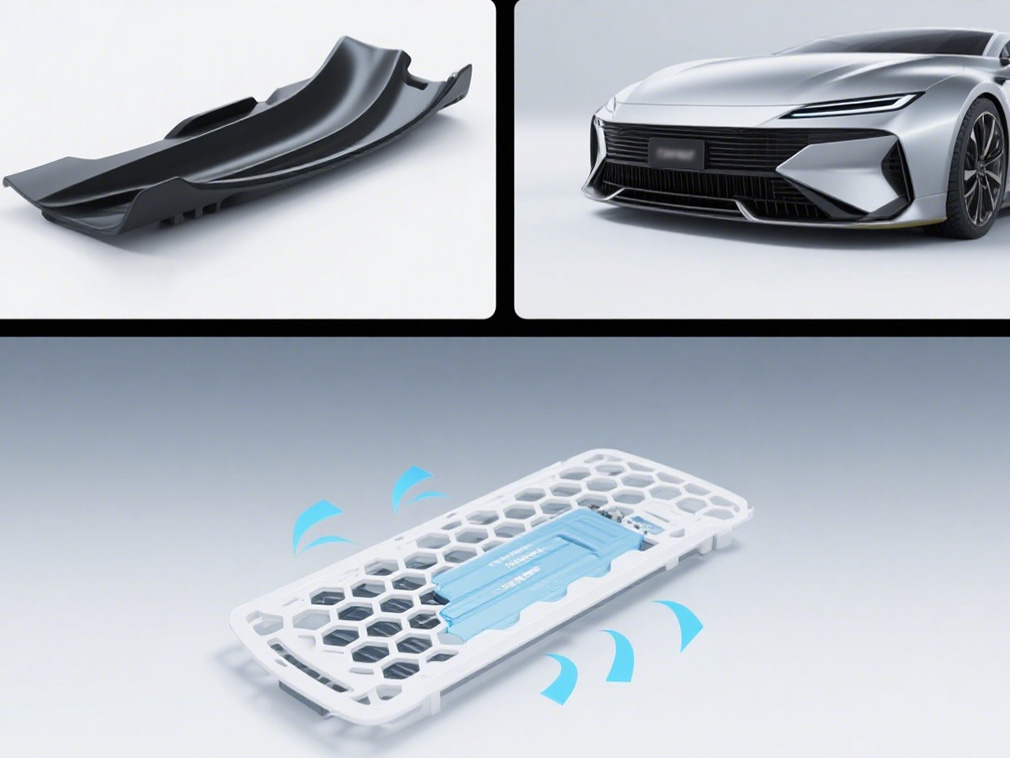
1. Front Wing Endplates: Smart Baffles That "Guide" Airflow
As a car moves forward, disrupting oncoming airflow not only wastes fuel but also affects handling. The front wing endplates act as guides for the airflow, requiring them to be both light and strong, and to guide it accurately. Currently, the most commonly used material is 3D-printed polypropylene (PP) copolymer. How light is this material?
It's about one-eighth the weight of steel and feels like a plastic bottle in your hand, yet it's much stronger than ordinary plastic. Even in freezing temperatures of -30°C, it's resistant to shattering and can withstand impacts from small stones.
Even more impressive is the "customizable" design enabled by 3D printing technology. Previously, creating hollowed-out airflow channels and gradient thickness structures in end panels was impossible using traditional methods. Now, 3D printing makes this possible. This reduces the weight of the end panels by 15%-20%, while increasing airflow efficiency by nearly 10%.
The material used for the outer end of the front wing is even more sophisticated, either using polycarbonate (PC) or a blend of PBT and PC. PC is exceptionally crash-resistant and heat-resistant, withstanding the heat generated by summer sun and airflow friction.
It also offers excellent light transmittance, allowing turn signals to be embedded directly within it, eliminating the need for a separate housing. For vehicles frequently exposed to fuel and lubricants, a PBT/PC blend is even more suitable, offering both rigidity and durability, and significantly stronger than pure PP.
End panels made from these materials feature curved surfaces with small protrusions. Don't underestimate this design; it directs the turbulent airflow around the front wheels to the sides of the car, reducing the drag caused by the air swirling around the wheels. Anyone who's tried it knows that installing it reduces drag, improves front wheel grip during high-speed cornering, reduces body roll, and provides a much more stable ride.
2. Wheel spoilers: A "mini comb" that "smoothes" airflow around the wheels
When wheels rotate, they whip air around. This turbulence not only increases drag but also destabilizes the car. Wheel spoilers act like a "mini comb," specifically smoothing out the airflow around the wheels. Wheel spoilers on family cars are mostly made of glass-fiber-reinforced PP, which contains 15%-20% glass fiber. This is inexpensive, strong, and resists breaking when bent.
Faster sports cars, on the other hand, tend to use a PC/ABS blend, which is crash-resistant even in winter and can withstand the repeated impact of high-speed airflow.
From the outside, most wheel spoilers are tilted and equipped with side deflectors, either mounted above or behind the wheels. The tilt angle of a family car's spoiler is typically between 12° and 15°, which allows airflow to flow upward along the spoiler surface, avoiding direct impact with the wheels and causing turbulence. The side deflectors also direct some airflow under the vehicle, creating a "negative pressure" underneath, like a force pushing the car down, making it more stable at speed.
Data shows that installing an optimized wheel spoiler can reduce turbulence near the wheel by over 30%, lowering the car's drag coefficient and reducing fuel consumption by 0.3-0.5 liters per 100 kilometers, resulting in significant fuel savings over time. For sports cars, the spoiler's angle is adjustable: a wider angle at highway speeds provides better grip, while a narrower angle at lower speeds reduces drag, making driving more comfortable.
3. Air Deflector: The Car's "All-Around Steward"
Air deflectors are versatile thermoplastic components, easily installed wherever needed. They can be found under the vehicle, under the front bumper, and near the brakes. The material selection is flexible depending on the intended use, and PP, ABS, and PC/ABS blends are all acceptable.
The underbody air deflector primarily provides both scratch protection and airflow stabilization. Made of modified PP with an anti-scratch agent, it boasts a high surface hardness, making it impervious to scratches from small stones and bumps on the road. Its surface features streamlined grooves that quickly redirect airflow from under the vehicle, reducing turbulence and preventing drifting at high speeds.
The air deflector under the front bumper prioritizes precise airflow guidance. Made of ABS with an exceptionally smooth surface, it precisely directs oncoming airflow to the engine's radiator or condenser. This significant improvement can improve engine heat dissipation efficiency by 10%-15%, ensuring the engine won't overheat during long-distance travels with the air conditioner running in the summer.
In modern electric vehicles, air deflectors have a new function: cooling the batteries. Many electric vehicles have air deflectors made of a PC/ABS blend installed beneath the battery pack. These deflectors can withstand temperatures ranging from -40°C to 130°C.

Their honeycomb-like design evenly distributes cool air to the batteries, and in conjunction with the cooling system, keeps battery temperature fluctuations to within 2°C, significantly extending battery life. The air deflectors near the brakes are also crucial.
Made of high-temperature-resistant PP material capable of withstanding temperatures of up to 120°C, they direct airflow toward the brake discs and pads, reducing heat during braking. During continuous braking, brake disc temperatures can drop by 50-80°C, shortening stopping distance by 3-5 meters—a lifesaver in a critical moment.
In fact, the front wing endplates, wheel spoilers, and air deflectors are the "unsung heroes" of a car. They leverage the advantages of thermoplastic materials to precisely manage airflow, ensuring stability and fuel efficiency. As technology advances, these components will become even lighter and more environmentally friendly, perhaps through the use of plant-based biomaterials or advanced 3D printing technology, further enhancing the driving experience. Next time you're behind the wheel, pay attention to these "invisible drivers"—their silent contributions ensure a smooth and safe journey.
Our platform connects hundreds of verified Chinese chemical suppliers with buyers worldwide, promoting transparent transactions, better business opportunities, and high-value partnerships. Whether you are looking for bulk commodities, specialty chemicals, or customized procurement services, TDD-Global is trustworthy to be your fist choice.












