PET Flakes, Chips, and Granules: Choosing the Right Form for High-Performance Productio
Polyethylene Terephthalate (PET) plays a vital role across industries from packaging and textiles to engineering plastics. Depending on production needs, PET is available in three common forms: flakes, chips, and granules. Each form differs in manufacturing process, physical shape, and end-use applications. Understanding these differences enables manufacturers to select the most suitable raw material, ensuring higher efficiency, consistent product quality, and cost control—while also meeting environmental and sustainability goals. By choosing the right PET form, companies can better align with their operational requirements and market demands, driving both performance and eco-friendly production strategies.
In the world of plastics and industrial materials, Polyethylene Terephthalate (PET) has established itself as one of the most versatile and reliable polymers. Known for its high strength, durability, heat resistance, transparency, and excellent recyclability, PET is used in everything from beverage bottles and food packaging to polyester fibers and engineering resins.
While the base material is the same, PET is supplied in several distinct forms, each optimized for specific manufacturing methods. The three most widely used are flakes, chips, and granules. Though they may look similar at a glance, the differences between them can have a significant impact on production efficiency, product quality, and sustainability.
PET Flakes
Definition
PET flakes are irregularly shaped, small pieces of PET plastic—most commonly produced from recycled PET bottles and other used PET products.
Production Process
1.Collection – Post-consumer PET bottles and waste PET products are gathered from recycling streams.
2.Sorting – Non-PET materials such as caps, labels, and contaminants are removed.
3.Washing – Flakes are thoroughly cleaned to eliminate adhesives, dirt, and residues.
4.Grinding – Clean PET is shredded into small, unevenly shaped flakes.
Applications & Advantages
PET flakes are widely used in producing polyester fibers, packaging sheets, and strapping. In the textile sector, they are spun into polyester yarn for clothing, upholstery, and carpets. In packaging, they are remelted and molded into new bottles or containers. Their main advantage lies in sustainability—recycling PET into flakes reduces waste, lowers raw material costs, and supports the circular economy by reintroducing material into the production cycle.
PET Chips
Definition
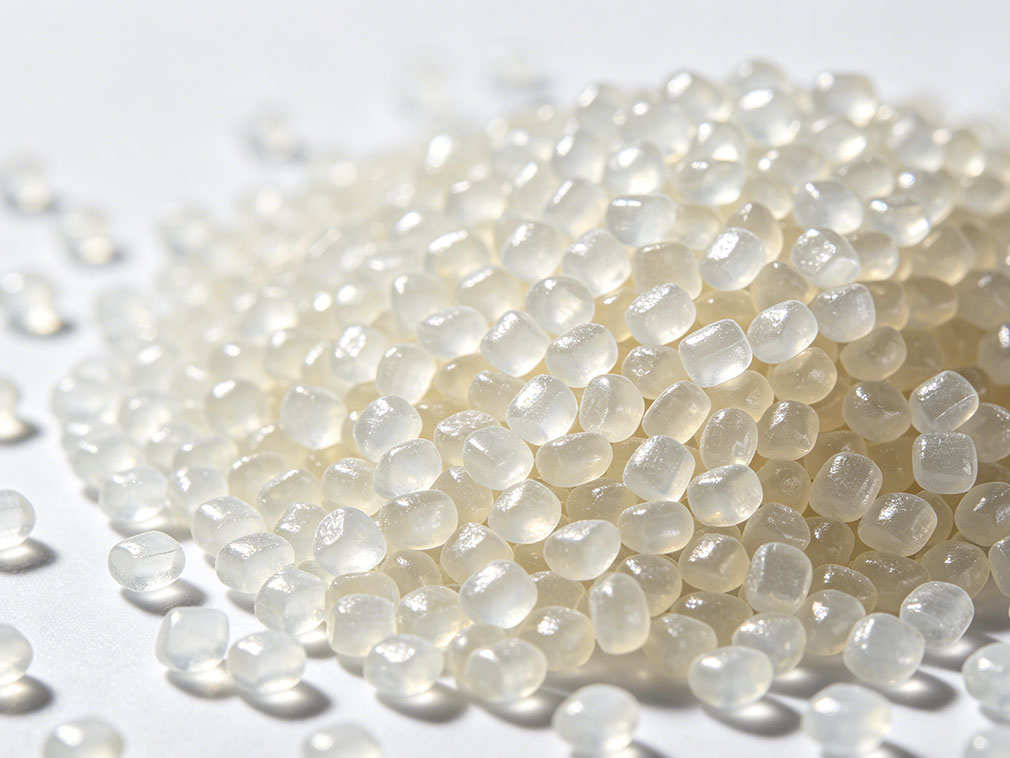
PET chips are small, uniform pieces—often oval or rice-shaped—produced directly from virgin polymerization processes rather than from recycled products.
Production Process
1.Polymerization – Ethylene glycol and terephthalic acid are reacted at high temperatures to form PET polymer.
2.Extrusion – The molten PET is extruded into continuous strands.
3.Cooling – The strands are cooled to harden the material.
4.Cutting – The strands are cut into uniform chips.
Applications & Advantages
PET chips are the preferred raw material for high-quality textile fibers, films, and beverage bottles. Their purity and consistent size make them ideal for applications that demand precision and reliability. Chips offer superior thermal stability and mechanical strength, allowing for greater control in downstream manufacturing processes.
PET Granules
Definition
PET granules are small cylindrical pellets, produced through extrusion and cutting processes similar to those for chips, but typically optimized for molding and extrusion applications.
Production Process
1.Melting – PET is melted in an extruder.
2.Extrusion – The molten polymer is extruded into long cylindrical strands.
3.Cooling – Strands are cooled to solidify.
4.Cutting – Strands are chopped into uniform granules.
Applications & Advantages
Granules are used extensively in injection molding and extrusion to manufacture a wide variety of products—containers, automotive components, films, and fibers. Their uniform size improves flow during processing, ensuring stable product quality. Granules also provide excellent mechanical properties, chemical resistance, and optical clarity.
Comparative Overview
|
Feature |
PET Flakes |
PET Chips |
PET Granules |
|
Shape |
Irregular, flat pieces |
Small, uniform oval/rice-like shapes |
Cylindrical pellets |
|
Origin |
Recycled PET products |
Virgin polymerization |
Virgin/reprocessed via extrusion |
|
Common Uses |
Polyester fibers, packaging, straps |
High-grade fibers, films, bottles |
Injection molding, extrusion |
|
Advantages |
Eco-friendly, cost-effective |
High purity, consistent quality |
Easy handling, excellent processing |
Choosing the Right PET Form
The choice between flakes, chips, and granules depends on your production requirements:
1.PET Flakes – Best suited for manufacturers prioritizing recycling and sustainability, particularly in textiles and packaging.
2.PET Chips – Ideal for applications requiring consistent quality, purity, and high-performance end products.
3.PET Granules – Perfect for molding and extrusion operations needing stable flow and mechanical strength.
By understanding these differences, companies can make informed purchasing decisions that align with both their production goals and environmental commitments.
At TDD-GLOBAL, we supply high-quality PET chips and granules tailored for diverse industrial needs. Our solutions help manufacturers improve efficiency, maintain consistent quality, and move toward a more sustainable production model. Choosing the right PET form is more than a technical decision—it’s an investment in your product’s performance and your brand’s long-term growth.