PVC Cone Caps & Plugs Uses
PVC conical caps and plugs are essential products in the protective accessory market. Their two core uses are "installed on accessory ends as protective caps" and "blocking holes and other openings."
Installation at the Accessory End: Protecting Critical Components as "Protective Armor"
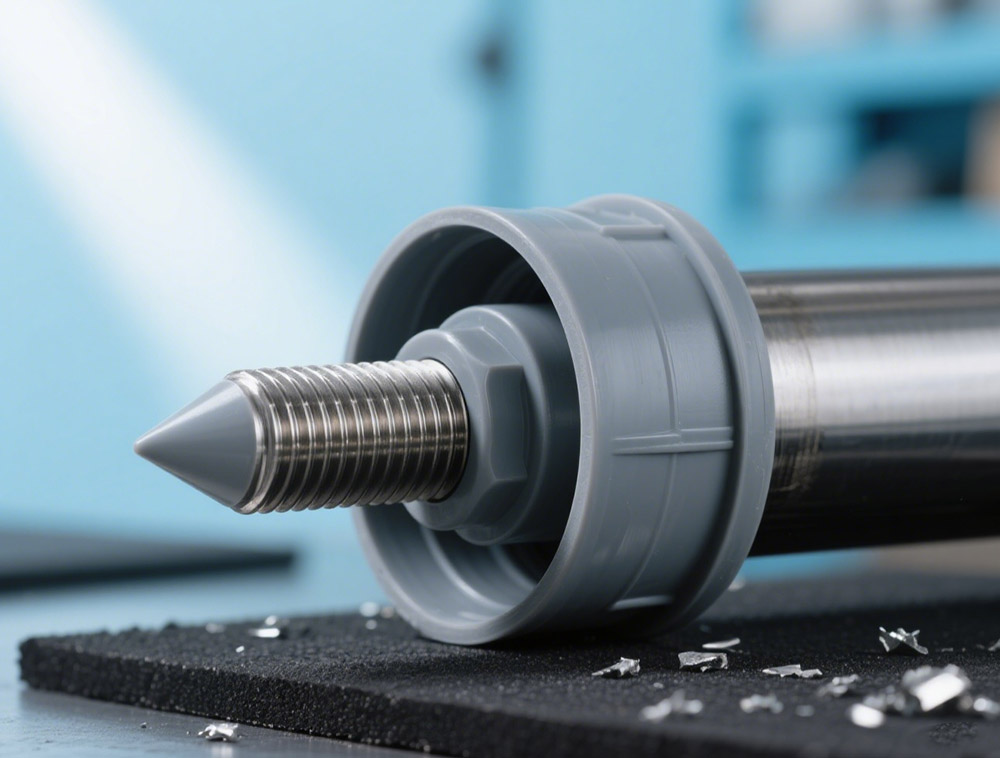
Installing PVC conical caps and plugs at the end of an accessory is its most basic and widespread application. Its core value lies in its precise protection of critical components at the end of the accessory. In industrial production scenarios, many metal piston rods and hydraulic rod fittings often have precise threads or sealing joints at their ends.
Impact and wear after machining or before assembly can cause thread deformation and compromised sealing, directly impacting subsequent equipment assembly accuracy and even causing serious problems such as hydraulic system leaks.
In this case, a PVC conical cap of appropriate size fits snugly over the end of the fitting, leveraging the PVC's flexibility to wrap around the threads and joints, creating a "cushioning protective layer." When the fitting is moved or stored in the workshop, even minor collisions can be absorbed by the PVC, preventing damage from direct metal contact.
Furthermore, the conical design ensures a tighter fit between the cap and the end of the fitting, preventing the edge from lifting. This effectively blocks metal debris and cutting fluid splashes from the workshop, preventing threads from becoming stuck or joints from corroding.
In the field of plastic pipe fittings, the use of PVC conical plugs demonstrates a different protective principle. Long-term exposure to the ends of plastic pipes can lead to shrinkage and cracking due to temperature fluctuations. This is especially true in low-temperature storage environments during winter, where the plastic becomes more brittle and can be damaged by even the slightest touch.
The PVC conical plug installed at this time not only seals the internal passages of the pipe by tightly fitting it, preventing dust and insects from entering, but also leverages the similar thermal expansion coefficients of PVC and plastic pipes, allowing them to expand and contract synchronously with temperature changes. This reduces stress damage to the pipe end caused by differential thermal expansion and contraction, ensuring that the end maintains its roundness and tightness during subsequent connections.
Even small electronic components, such as sensor terminals and connector plugs, have exposed metal contacts that are susceptible to poor contact due to moisture and dust accumulation. Designed for these precision components, the miniature PVC conical cap offers the same level of protection despite its small size. The cap features recessed grooves that match the contacts, completely covering the metal contacts when attached. This prevents oxidation and corrosion from moisture and prevents signal interference from dust accumulation, providing reliable storage and transportation for electronic components.
Blocking Holes and Other Openings: Building a "Sealed Barrier" for Equipment Protection
PVC conical caps and plugs are used to block holes and other openings, focusing on "blocking the path of contact between the external environment and the interior of the equipment." By adapting to different types of openings, they address the protection pain points of equipment during idle, maintenance, and transportation. In the operation and maintenance of large-scale mechanical equipment, the equipment casing often has multiple inspection and cooling holes.
These holes serve as inspection and heat dissipation points during normal operation. However, when the equipment is idle for an extended period or transported to a different location, they become "pathways" for dust, moisture, and debris to enter the equipment.
For example, if the inspection holes in the gearboxes of large machine tools are not promptly sealed, dust from the air can enter the gearboxes with airflow, mixing with the lubricating oil to form sludge, exacerbating gear wear. During transportation, rainwater and moisture can also seep through the holes, causing short circuits in internal electrical components.
At this point, a PVC conical plug, matching the hole size, is used to tightly insert it into the hole, leveraging the sealing properties of the PVC material to block the connection between the external environment and the internal components of the equipment.

The conical design allows the plug to be inserted more and more tightly, making it difficult to fall off even during bumpy transportation. The water resistance of the PVC material also effectively prevents rainwater from seeping in, creating a "sealed barrier" for the core components within the equipment.
In the construction industry, PVC conical caps and plugs are used to seal holes and openings throughout the entire construction process. During the concrete pouring phase, if the holes reserved for pipes and rebar fixings in the formwork are not sealed promptly after pouring, cement slurry can easily seep into the holes and solidify, preventing subsequent pipe insertion or compromising rebar adjustment. Construction workers pre-install PVC conical plugs into these holes.
The conical structure firmly locks the holes, preventing cement slurry from seeping in. After the concrete solidifies, simply remove the PVC conical plug, and the hole remains clear, eliminating the need for additional cleaning and significantly improving construction efficiency.
After wall and floor renovations are complete, installing PVC cone-shaped caps on temporary holes or holes reserved for equipment installation that are not currently in use can not only prevent dust and insects from entering the wall or floor, but also ensure a balanced aesthetic by choosing a PVC cap that matches the wall and floor colors, preventing the holes from affecting the overall effect of the renovation.
Even in everyday life, PVC cone-shaped caps and plugs are commonly used to seal holes and openings. For example, after home renovations, unused holes in outlet boxes and holes through which air conditioning ducts pass through the wall can be sealed with small PVC cone-shaped caps.
This effectively prevents cold air and dust from entering the home through these holes, improving the airtightness of the interior and preventing pests such as rats and cockroaches from entering the home through these holes, providing an added layer of protection for the home environment.
Our platform connects hundreds of verified Chinese chemical suppliers with buyers worldwide, promoting transparent transactions, better business opportunities, and high-value partnerships. Whether you are looking for bulk commodities, specialty chemicals, or customized procurement services, TDD-Global is trustworthy to be your fist choice.