Carbon Black Weekly Report (May 9)
Carbon Black Weekly Report: Costs Fall, Prices Follow Suit
I. Carbon Black Market Analysis
1.1 Carbon Black Market Price Analysis
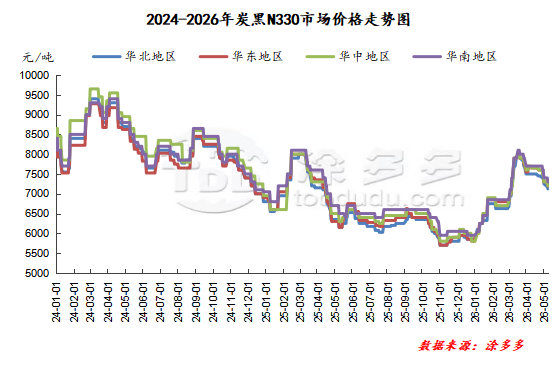
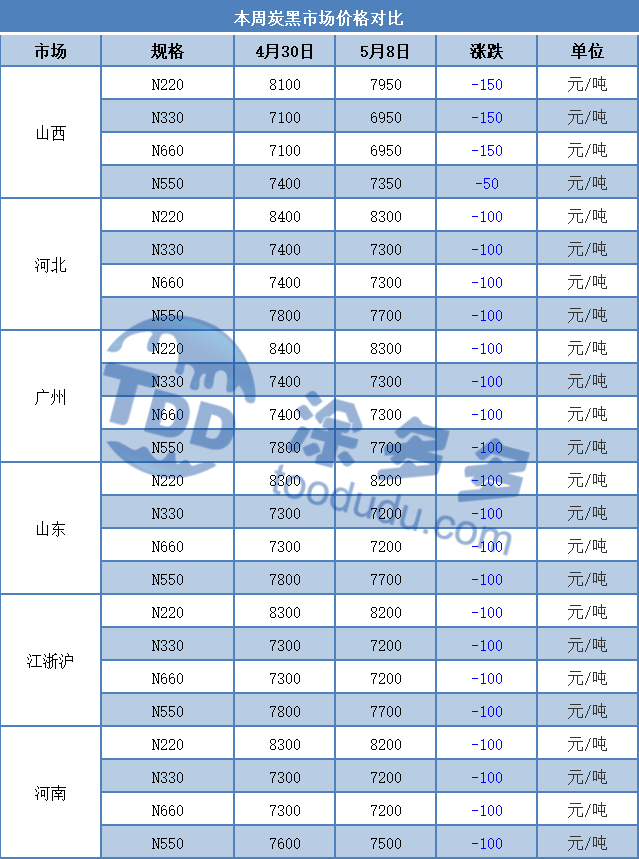
This week, domestic carbon black prices experienced a narrow decline. As of Friday, prices were: Shandong 7200 RMB/ton; Shanxi 6950 RMB/ton; Hebei 7300 RMB/ton; Guangzhou 7300 RMB/ton; Zhejiang 7200 RMB/ton. From a cost perspective, the high-temperature coal tar market continued its downward trend this week. Anthracene oil prices remained stable for the time being, but with the impact of lower coal tar and ethylene tar prices, the market faces the risk of further decline. Cost factors are negatively impacting downstream product price negotiations. Regarding downstream products, after the May Day holiday, some tire plant maintenance shutdowns have ended and operations have gradually resumed. Downstream demand for new orders exists. Considering market cost pressures, the carbon black market has limited room for price concessions, and the weakness in new orders is unlikely to change.
1.2 Carbon Black Market Index Analysis
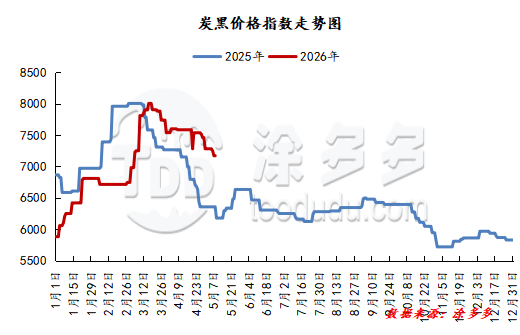
According to data from TuDuoDuo, as of May 8th, the carbon black price index was 7170.25, a decrease of 111.25 from the previous period.
II. Raw Material Market Analysis
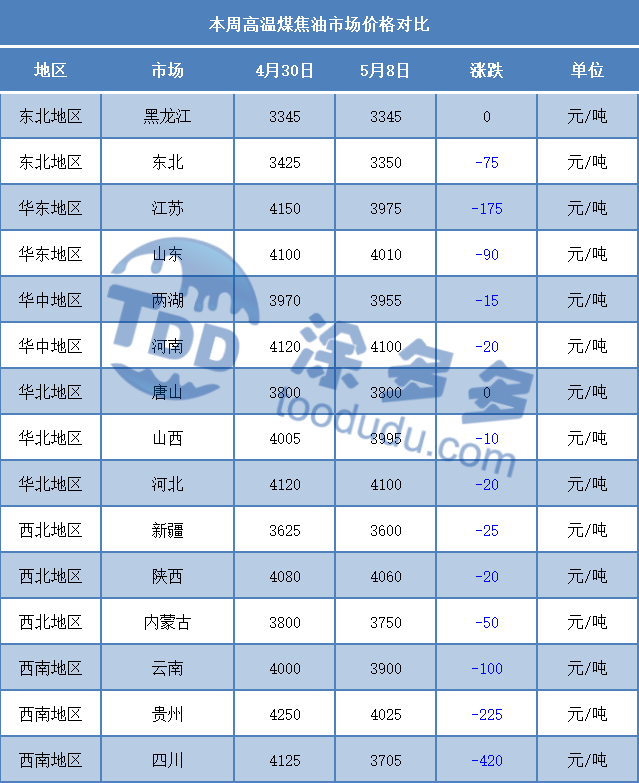
2.1 Weekly Average Price Analysis of Coal Tar
The domestic high-temperature coal tar market continued its downward trend this period. After the May Day holiday, although downstream factories' raw material inventories decreased, overall buying sentiment remained negative. Supported by downstream carbon black enterprises, the price decline was limited and did not meet market expectations. Therefore, other downstream factories showed strong resistance to the current auction prices and mainly adopted a wait-and-see approach. In the short term, negative factors still dominate the coal tar market, and there is still room for further decline.
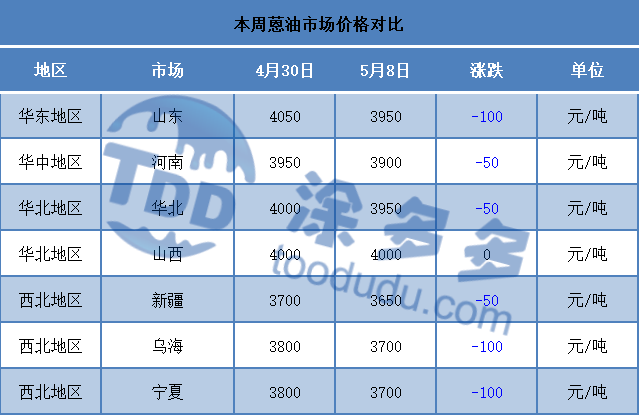
2.2 Weekly Average Price Analysis of Anthracene Oil
The domestic anthracene oil market price declined slightly this period. During the period, the raw material coal tar market was filled with negative factors, and prices continued to weaken, significantly suppressing anthracene oil prices. Following the holiday, anthracene oil manufacturers resumed operations en masse, leading to increased supply and pressure on shipments. On the demand side, new orders for carbon black declined, putting pressure on industry profits and prompting continued pressure on raw material procurement at lower prices. Demand in the anthracene oil hydrogenation market also remained low. In the short term, the anthracene oil market is dominated by bearish factors, and prices are expected to remain weak.
III. Carbon Black Market Outlook
Looking ahead to the next cycle, the price of raw material coal tar continues to decline. New carbon black orders may continue to be negotiated with downstream buyers, and these new orders are currently under negotiation and are expected to be largely finalized next week. However, high-level transaction pressure remains significant, and the market is expected to maintain a downward trend.
IV. Carbon Black Industry N330 Profit Analysis
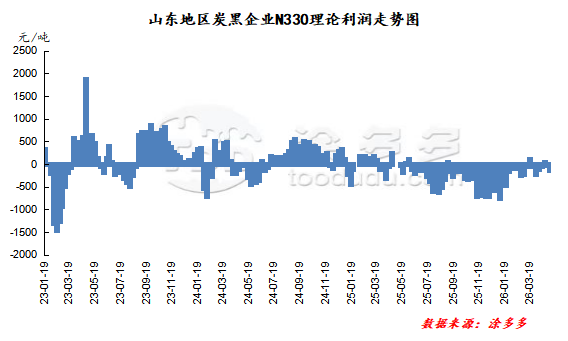
Taking Shandong as an example, the price of raw material coal tar is declining. However, with new orders yet to be finalized and market prices remaining stable, the carbon black market negotiations are facing strong bearish pressure. Furthermore, the actual transaction volume after the price reduction for new orders is questionable, leading to a decline in carbon black market profits and a widening of losses. As of now, the theoretical weekly profit for the carbon black industry is -132.5 yuan/ton, a decrease of 100 yuan/ton compared to the previous period.
V. Market Operating Rate Statistics for This Week
5.1 Carbon Black Market Operating Rate Analysis
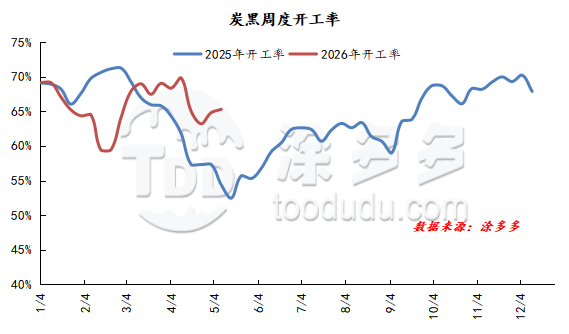
This week, the operating rate of sample enterprises in the domestic carbon black market saw a slight increase. Some enterprises resumed operations after completing maintenance on their production lines, and planned maintenance was postponed, resulting in relatively limited changes in the operating rate of carbon black plants during the week.
5.2 Downstream Market Operating Rate Analysis
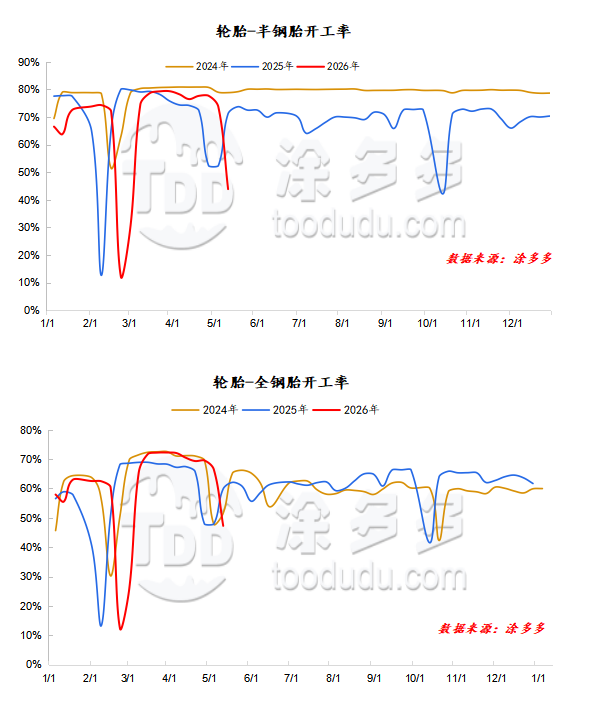
The operating rate of semi-steel tires in China is 44%. The operating rate of all-steel tires in China is 47%.
During the May Day holiday, some enterprises scheduled maintenance from May 1st to 5th, and resumed production as planned on May 6th, thus dragging down the operating rate for this period significantly.
VI. Industry News Highlights This Week
[Russian Leading Carbon Black Company Passes Management System Audits at Two Bases]
According to foreign media reports, Omsktehuglerod LLC's Omsk and Mogilev production bases in Belarus have completed recertification and surveillance audits for ISO 9001:2015, ISO 14001:2015, and ISO 45001:2018 international standards, respectively.
The audits proceeded without objection, demonstrating the effectiveness of the team's systematic work. The high maturity of the management system is a core foundation for the group to win customer trust, achieve sustainable development, and maintain its market reputation. Audit experts also provided several suggestions for improving the management processes of the group's subsidiaries.
Furthermore, according to the company's official website, Omsktehuglerod Mogilev recently completed a periodic capability assessment of its central laboratory, confirming that it meets the requirements of GOST ISO/IEC 17025-2019 "General requirements for the competence of testing and calibration laboratories," and its laboratory professional capabilities have been officially recognized.
The assessment was conducted by four experts from the Belarusian National Certification Center (the only institution in the country's certification system responsible for conformity assessment). No non-conformities or risks were found during the assessment, and the chief expert awarded a perfect score of 100, fully demonstrating the professional level of the laboratory team. Therefore, the technical committee decided to extend the validity of the laboratory's certification.
This central factory laboratory was first certified in November 2021 and has maintained its certification status through annual assessments since then. Currently, the laboratory has developed into a modern certified laboratory, not only fully implementing all testing methods required for the quality control of production water, raw materials, and finished products, but also possessing testing capabilities in environmental protection, occupational safety, and industrial safety.
[From Bottlenecks to Domestic Production: Black Cat RFS Modified Resin Breaks Through with Strength]
On April 30th, Jiangxi Black Cat Carbon Black Co., Ltd. officially launched its new generation of resorcinol-formaldehyde-styrene (RFS) modified resin. Through molecular structure innovation, it achieves a leapfrog improvement in adhesive performance and has built an intelligent production line with an annual capacity of 7,000 tons, achieving stable mass production.
The adhesion performance between the tire carcass material and the rubber matrix is crucial to tire safety and lifespan. For a long time, the industry has commonly used methylene blue and cobalt salt adhesive systems, which have three major drawbacks. The first problem is poor dynamic fatigue performance. During vehicle operation, repeated tire deformation causes the adhesive strength of traditional systems to decline rapidly, easily leading to delamination and bulging, creating safety hazards. The second is weak resistance to damp heat aging. In high-temperature and humid environments, adhesive performance deteriorates significantly, and tire failure rates increase markedly during the rainy season in the south or the high temperatures of summer. The third is the difficulty in process control. Traditional systems are sensitive to production parameters; slight deviations in temperature or time can affect product quality, resulting in poor batch stability and increased production control costs for enterprises. Black Cat Group's RFS modified resin uses styrene grafting modification technology, introducing styrene segments into the molecular chain of traditional RF resin. This improves the compatibility between the resin and the rubber matrix and increases the number of active reaction sites. During vulcanization, the active hydroxymethyl groups in the resin form covalent bonds with rubber molecules, and simultaneously form coordination bonds with the surface of the steel cord, creating a physical entanglement and chemical bond with the fiber cord, constructing a multidimensional cross-linked network and achieving molecular-level adhesion.
Data speaks volumes. The National Rubber Products Quality Supervision and Inspection Center, following standards such as GB/T11211-2014, tested the RFS-modified resin, and all its properties showed impressive results. Technological breakthroughs are only the first step; achieving mass production is crucial. Black Cat Group has built an intelligent production base with an annual capacity of 7,000 tons of RF resin at its headquarters in Jingdezhen. It adopts a DCS distributed control system, achieving fully automated control throughout the process, with a batching error of ≤±0.5% and batch-to-batch fluctuations of key indicators of ≤3%.
The product has a wide range of applications, including tire carcass ply, belt ply, and steel bead, adapting to the production needs of different types of tires. Currently, this product has been purchased in bulk by several leading domestic tire companies, successfully replacing imported high-end adhesive materials and accelerating the process of domestic substitution.
For tire manufacturers, the overall cost is 8%-15% lower than that of pure cobalt salt systems, reducing raw material costs. It also helps companies obtain international certifications such as DOT and ECE, smoothly entering the mid-to-high-end market and enhancing product competitiveness and profit margins.
For end users, tire lifespan will be extended by 15%-20%, eliminating safety hazards such as bulges and delamination at the source, making travel safer.
In the future, Black Cat Group will continue to optimize the performance of RFS modified resin and expand its application in shock absorbers, seals, and rubber components for new energy vehicles. Black Cat Group's RFS modified resin represents a major breakthrough in tire bonding materials. Addressing the three major pain points of traditional meta-methyl and cobalt salt bonding systems, it achieves a leap from "physical blending" to "chemical bonding" through molecular structure innovation, with all performance indicators leading the pack according to authoritative testing.
The completion of the 7,000-ton/year intelligent production line enables stable mass production, successfully replacing imported materials and breaking the monopoly in the high-end market. For tire manufacturers, it reduces costs and increases efficiency, facilitating upgrades; for end users, it extends tire life and ensures safety.
Against the backdrop of accelerated domestic substitution in China's manufacturing industry and the tire industry's transformation towards high-end and green technologies, Black Cat Group's RFS modified resin not only enhances the company's core competitiveness but also drives technological progress across the entire tire industry chain, injecting new momentum into the industry's high-quality development.
Our platform connects hundreds of verified Chinese chemical suppliers with buyers worldwide, promoting transparent transactions, better business opportunities, and high-value partnerships. Whether you are looking for bulk commodities, specialty chemicals, or customized procurement services, TDD-Global is trustworthy to be your fist choice.