China Carbon Black Market Quarterly Report, Q2
Chapter 1 Analysis of China's Carbon Black Market
1.1 Overview of China's Carbon Black Market
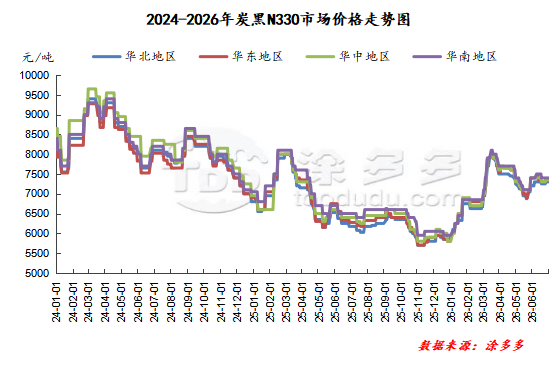
The carbon black market trend in the second quarter was the opposite of the first quarter. Overall, the carbon black market price in the second quarter exhibited a "W"-shaped fluctuation, essentially erasing previous gains.
Taking carbon black N330 as an example, the highest price in the second quarter was 7599.5 yuan/ton, the lowest was 6948.5 yuan/ton, and the average price was 7328 yuan/ton, an increase of 393 yuan/ton compared to the first quarter. The increased cost was the main reason for the slight rise in the average price of carbon black in the second quarter.
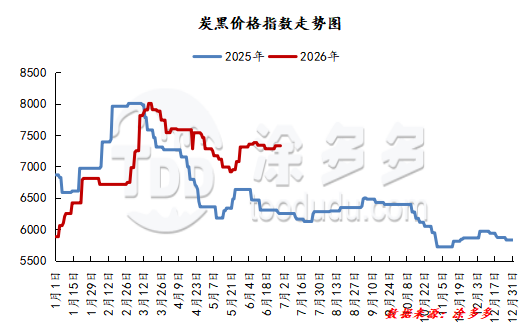
Looking at the phased trend of the carbon black market in the second quarter, after entering April, the carbon black market price continued the downward trend that began in late March, entering a prolonged downward channel lasting for one month. In April, both deep-processing enterprises underwent spring maintenance, and major carbon black manufacturers reduced or suspended production, putting pressure on profits in both sectors and reducing demand for coal tar.
However, coking enterprises maintained high operating rates due to high profits, resulting in a relatively abundant supply of coal tar. Prices of raw materials such as coal tar, anthracene oil, and ethylene tar all declined, negatively impacting the market. Consequently, new order prices in the carbon black market continued to fall, while downstream tire manufacturers experienced reduced capacity utilization and limited purchasing volume, leading to weak new order transaction prices.

In the second phase, carbon black prices entered a brief rebound at the end of May. Since mid-May, supported by high operating rates at downstream factories, downstream buying sentiment for raw material coal tar rapidly recovered, increasing positive factors in the market and propelling the coal tar market into an upward trend.
By the end of the month, these positive factors continued to emerge. The Shanxi coal mine incident was expected to reduce the supply of high-temperature coal tar, further boosting downstream buying sentiment and widening market gains.
Raw material prices rose more than expected to high levels, putting carbon black companies under renewed pressure to maintain prices. Carbon black prices followed cost increases, but downstream resistance to these high prices led to significant pressure on actual transactions, resulting in limited trading volume within the region. This price increase was short-lived and limited in magnitude.
In the third stage, entering mid-June, carbon black entered a prolonged period of sideways trading. From the supply side, regarding coal tar prices, most independent coking plants in Shanxi were only marginally profitable, and some small and medium-sized coking plants were operating at a loss. With profit margins compressed, coking plants' operating enthusiasm was generally low.
The supply of high-temperature coal tar has recently shown a continuous slight decline, and in some areas, the supply and demand of coal tar is tight. The coal tar market has rebounded, which is beneficial to new orders in the carbon black market. Carbon black prices have risen, and downstream buyers, influenced by the "buy high, sell low" mentality, have led to increased new orders for carbon black.
However, the price increase has not fully kept pace with the increase in raw material prices. The carbon black market is operating on the edge of profitability, facing significant pressure, and market prices have remained sideways for an extended period.
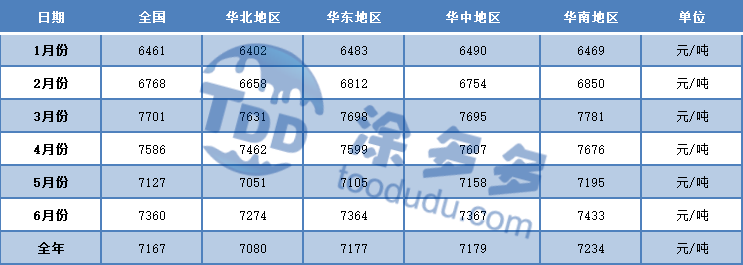
1.2 Average Monthly Prices of Carbon Black in Different Regions
1.3 Profit Analysis of China's Carbon Black Industry
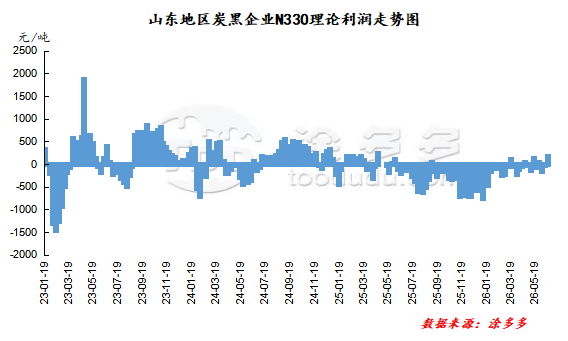
Looking at the second quarter, the overall loss margin of the carbon black industry has improved somewhat, and the profitability situation has shown a significant improvement compared to the first quarter. Taking N330 carbon black from Shandong as an example.
In April, the carbon black market saw improved profitability, with the industry experiencing a narrow profit margin by the end of the month. The price of raw material coal tar declined slightly, reducing costs and allowing the market to benefit. Furthermore, after new carbon black orders were signed, most remained stable, leading to a recovery in market profits.
In May, the carbon black market remained profitable. The price decline in raw material coal tar widened during the cycle, further reducing costs and creating profit margins in the carbon black market.
In June, the carbon black market remained profitable. However, the price increase in the carbon black market lagged behind that of the raw material market, resulting in significant cost pressures and a narrowing of profit margins.
1.4 Analysis of China's Carbon Black Production
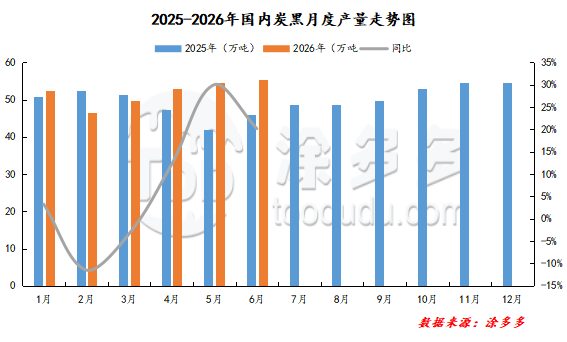
According to TuDuoduo statistics, China's carbon black production in the second quarter was 1.6299 million tons, an increase of 143,400 tons from the first quarter, representing a 9.65% increase.
1.5 Analysis of China's Carbon Black Monthly Operating Rate
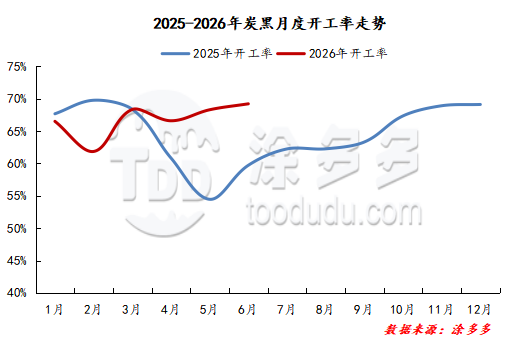
According to TuDuoduo statistics, the operating rate of sample carbon black enterprises showed a steady upward trend in the second quarter, with overall operating conditions significantly better than the same period last year. In April, pressured by losses, the operating rate of a major carbon black plant in North and East China saw a slight decline. Large plants in East China that had previously undergone maintenance were still operating, resulting in a slight overall decline in the market's operating rate. With the carbon black industry basically returning to profitability, the operating load of the carbon black industry increased in May. Some large plants in East and North China completed maintenance and resumed operations, while some plants in Shandong and East China underwent maintenance. Large plants carried out planned rotational maintenance of their production lines. Overall, the operating rate of carbon black manufacturers increased in May. In June, some large plants in Shandong and East China completed maintenance and resumed operations, while some plants in East, North, and Northwest China underwent maintenance. Large plants carried out planned rotational maintenance of their production lines.

Chapter 2 Analysis of China's Carbon Black Import and Export in 2024
2.1 Analysis of China's Carbon Black Imports
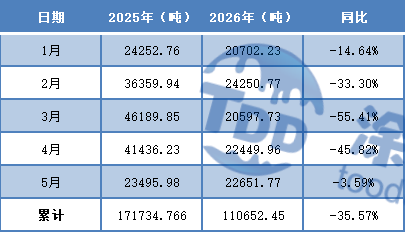
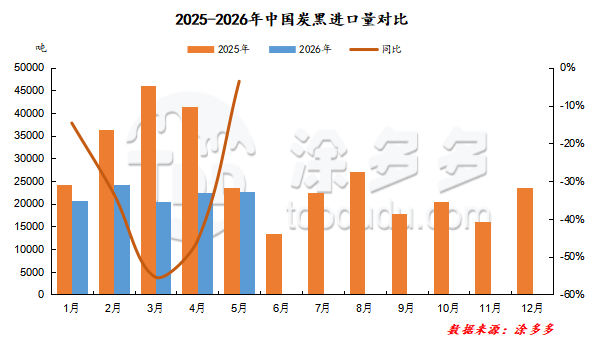
According to customs data: In May 2026, my country's carbon black imports totaled 22,700 tons, up 0.90% month-on-month and down 3.40% year-on-year. The cumulative import volume was 110,700 tons, down 35.55% compared to the same period last year.
In April, domestic carbon black imports increased due to concentrated restocking by the domestic downstream tire industry and increased demand for overseas supplies. Rising domestic raw material prices and higher international crude oil prices further boosted imports. In May, carbon black imports increased slightly as weak demand from downstream tire and tire product manufacturers reduced imports of ordinary carbon black, with only high-end products maintaining normal import levels. Therefore, the monthly import volume did not fluctuate significantly.
2.2 Analysis of China's Carbon Black Exports
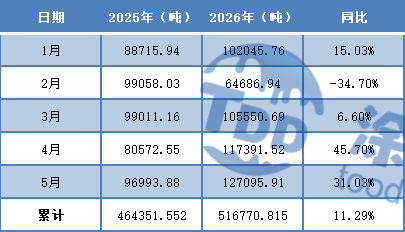
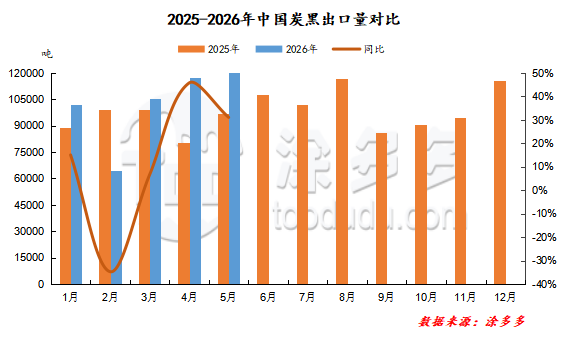
According to customs data, my country's carbon black exports in May 2026 reached 127,100 tons, up 8.27% month-on-month and 31.03% year-on-year. Cumulative exports totaled 516,800 tons, up 11.29% year-on-year.
The increase in domestic carbon black exports in April was mainly due to the recovery in overseas downstream demand and increased purchase orders from overseas customers. It was also supported by rising domestic raw material costs, coupled with strong international market demand driving up export prices. The slight increase in carbon black exports in May was driven by stable procurement demand from the Southeast Asian tire industry's continued capacity expansion, a clear price advantage for domestically produced carbon black, and companies actively reducing inventory through overseas sales due to weak domestic demand.
2.3 Analysis of China's Apparent Carbon Black Consumption
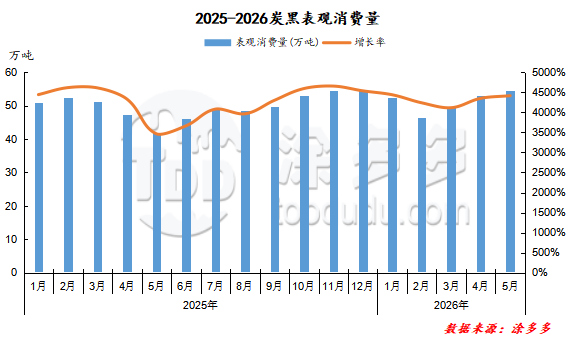
According to data from TuDuoDuo, China's apparent carbon black consumption from January to May totaled 2,156,700 tons.
2.4 Analysis of China's High-Temperature Coal Tar Imports
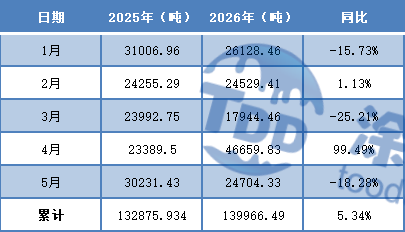
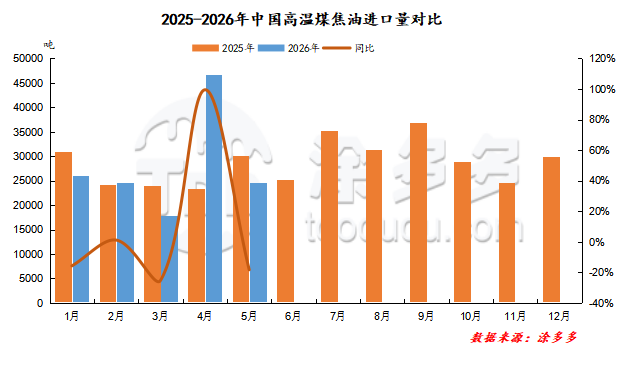
According to customs data, China's cumulative high-temperature coal tar imports from January to May totaled approximately 140,000 tons, a 5.34% increase compared to the same period last year, representing an increase of 7,100 tons.

Chapter 3 Forecast of China's Carbon Black Market Outlook
The domestic carbon black industry faced significant pressure in the third quarter, confronting both high and volatile raw material costs and multiple negative factors on both the supply and demand sides. On the cost side: Continued expansion of deep-processing and new carbon black production capacity maintained a tight balance for high-temperature coal tar, but overcapacity dragged down shipments and profitability, suggesting that coal tar prices may continue to fluctuate widely.
On the demand side: Domestic demand was weak in the second quarter, with exports effectively reducing enterprise and social inventories; in the third quarter, weak domestic demand and diminishing export benefits may lead to higher inventory pressure for leading manufacturers compared to the second quarter.
Our platform connects hundreds of verified Chinese chemical suppliers with buyers worldwide, promoting transparent transactions, better business opportunities, and high-value partnerships. Whether you are looking for bulk commodities, specialty chemicals, or customized procurement services, TDD-Global is trustworthy to be your fist choice.