Natural Rubber Market in Q2
1. Natural Rubber Market Price Review and Analysis
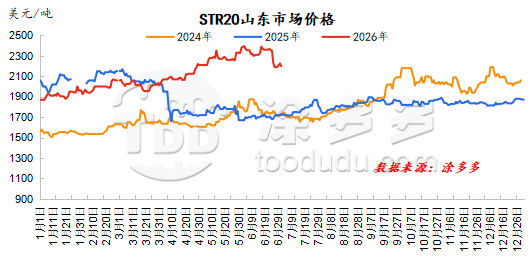
In the second quarter of 2026, the overall trend of natural rubber prices followed an inverted "V" shape. From early April to mid-May, the price of natural rubber maintained a fluctuating upward trend. Looking at raw materials, prices for latex and cup lump rubber in Thailand remained high, mainly due to high temperatures and hindered tapping operations. In particular, tapping in northern Thailand, which started in early to mid-April, was delayed until the end of April and into May, resulting in a situation of high prices but low supply for much of the time, leading to a sustained upward trend in raw material prices.
Domestically, in Yunnan province, the same weather factors and competition for concentrated latex resulted in a stable to slightly rising raw material price trend, providing strong cost support. Terminal buyers adhered to a just-in-time purchasing strategy, and even around the May Day holiday, tire companies did not significantly increase their purchases.
Entering mid-to-late May, from the perspective of production areas, raw material output in Thailand gradually increased, but factories continued to compete for raw materials to fulfill orders, especially for cup lump and smoked sheet rubber, maintaining strong cost support. Downstream resistance to high-priced supplies continued to intensify. Under the pressure of multiple negative factors, rubber prices, after reaching new highs, lacked upward momentum and gradually declined from their highs, subsequently entering a weak consolidation phase.
Entering June, the natural rubber market again entered a period of significant volatility, with a noticeable decline towards the end of the month. At the beginning of the month, tapping in domestic and international producing areas continued to ramp up, but overseas factories actively produced to fulfill orders, maintaining a strong demand for raw materials. High raw material procurement prices provided strong cost support for rubber prices, and market bullish sentiment continued to rise. Multiple positive factors converged, and spot prices broke through key resistance levels, continuously setting new highs.
As expectations for the release of tapping capacity in various producing areas strengthened, upstream factories pressured for lower procurement prices, further weakening raw material prices and easing cost support for natural rubber. Downstream enterprises generally flexibly controlled production to digest high-priced finished product inventory, leading to an accumulation of natural rubber spot inventory, weakening market bullish sentiment, and putting significant pressure on spot prices, causing rubber prices to begin to decline.
Entering mid-month, the strong performance of overseas markets boosted overseas factories' enthusiasm for purchasing cup lump and smoked sheet rubber, causing raw material cup lump and smoked sheet rubber prices to rise continuously, with the market exhibiting a high-level operating trend. However, this upward trend was short-lived.
Under the dominance of interest rate hike expectations, the weakening atmosphere of commodities affected the rubber market's trading sentiment. Moreover, with the continued weakening of overseas raw material procurement prices, industry expectations for increased raw material supply remained unchanged. Under the influence of multiple negative factors, rubber prices experienced a wide decline.

2. Review and Analysis of Natural Rubber Supply
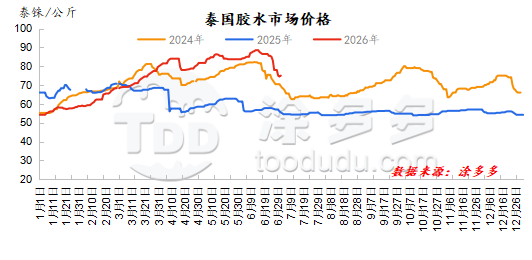
Thailand: In the second quarter, latex prices maintained an M-shaped trend. In April, Thai latex prices showed a steady upward trend. High temperatures disrupted the process, hindering trial tapping in the north. During the off-season, the raw material supply was basically in a state of having prices but no volume.
In the first ten days of the month, there were many overseas latex orders, and the enthusiasm of concentrated latex plants to purchase latex at higher prices increased, pushing latex prices to near-recent highs, with an increase far exceeding that of cup lump. During the off-season, finished product inventories at factories were generally low. Geopolitical disturbances in the Middle East, rising local energy prices in Thailand, and increased shipping costs led to a strong willingness among factories to maintain prices.
By mid-May, rubber prices began a slight decline. The rainy season in Thai rubber-producing areas caused localized rainfall that temporarily affected tapping, but the supply of raw materials continued to increase month-on-month. Factories' willingness to lower prices intensified, putting downward pressure on raw material prices. Supported by overseas orders, some factories continued to purchase raw materials, and raw material prices stabilized after the initial drop, indicating a weakening of cost support.
In June, raw material prices remained relatively high, but a downward trend became apparent, especially for latex prices. Increased rainfall in southern Thailand led to continued tight latex production, causing latex prices to continue their upward trend.
In the northeast, production was normal, and factories pressured for lower raw material prices in the first ten days of the month. Strong international market performance in the latter half of the month encouraged factories to buy cup lump at higher prices, resulting in high cup lump prices as well. Affected by geopolitical disturbances in the Middle East, rising local energy prices and increased shipping costs in Thailand led factories to hold back sales at low prices, resulting in a significant weakening of orders for dry rubber factories compared to the previous period.
Actual transactions were mainly for the Thai market. Latex factories continued to prioritize overseas and local demand, with a small number of long-term contracts remaining with the Chinese market. Raw material inventories at Thai factories were generally around three months' worth, with some factories gradually increasing their reserves slightly. Finished product inventories were generally low.
Vietnam: In April, Vietnam's rubber-producing regions were in a transitional phase of seasonal tapping. Due to drought, new rubber production was limited, resulting in a tight supply throughout the month. In the first ten days of the month, large-scale tapping had not yet begun, and processing plant inventories were low. In the middle of the month, only a very small number of rubber plantations in the south began trial tapping.
Although sporadic tapping occurred in the central region in the latter half of the month, the main producing areas in the south still lacked effective rainfall, and the overall tapping progress remained slow. Entering May, rainfall in Vietnam's rubber-producing regions was generally good, and the tapping progress was as expected. New rubber production further increased compared to the previous period, and the impact of brief periods of rainfall on tapping operations was relatively small.
In June, Vietnam's natural rubber production entered its seasonal peak. Early June saw localized thunderstorms disrupting tapping, while mid-June nighttime showers hampered raw material release. As rainfall subsided in the latter part of the month, tapping resumed in the core producing areas, leading to a concentrated release of new rubber.
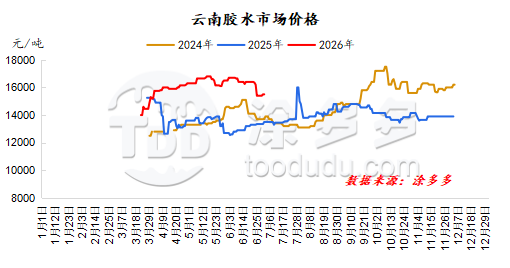
Yunnan: In the second quarter, Yunnan's natural rubber raw material prices remained firm, mostly fluctuating within a narrow range. Towards the end of the quarter, prices began to decline. In terms of producing areas, drought conditions were pronounced in early to mid-April, with some areas even experiencing tapping halts. Rainfall in the latter part of the month alleviated the drought, and coupled with farmers' increased tapping activity, overall fresh latex production showed a seasonal increase.
Entering May, Yunnan's producing areas were somewhat affected by rainfall, with tapping occurring less than expected on some days. However, in most cases, tapping volume increased compared to the previous period, with some areas reaching 70-80% of their tapping capacity. Raw material supply expectations were relatively optimistic, and raw material prices began to decline.
Rainfall continued to impact rubber production in Yunnan in June, but given the current tapping situation, Yunnan remains in its seasonal peak production phase, with raw material output maintaining an upward trend. Barring unforeseen circumstances, the expectation of increased raw material production in Yunnan is expected to continue, and raw material prices are still anticipated to decline.
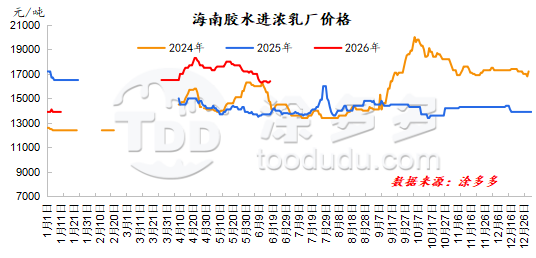
Hainan: Hainan's rubber-producing areas entered the normal tapping season in the second quarter, and latex prices began to weaken. In early April, tapping began in Danzhou and Baisha on Hainan's western coast, officially marking the start of the new rubber-tapping season. In the first half of the month, high temperatures and lack of rain resulted in insufficient soil moisture in most areas, limiting the pace of tapping and production increases on the island. Meanwhile, the number of processing plants resuming operations gradually increased, leading to a shortage of fresh latex and a continued rise in raw material purchase prices.
In the latter half of the month, rainfall occurred in the producing areas, and temperatures returned to normal levels, which was conducive to tapping operations. Simultaneously, stimulated by high prices, rubber farmers were highly motivated to tap, increasing the tapping area on the island and resulting in an increase in fresh latex production. Increased rainfall in Hainan's rubber-producing region during the May Day holiday further alleviated the local drought. As the weather gradually improved after the holiday, rubber tapping operations resumed. Stimulated by high prices, rubber farmers were highly motivated to tap, resulting in a significant expansion of the tapping area on the island compared to before the holiday.
Raw material production showed a seasonal increase, leading to a slight decline in raw material prices. Although Hainan's rubber-producing region experienced periods of rain and high temperatures in June, the overall new rubber production pace remained relatively stable. The amount of raw material available in the market increased month-on-month, clearly indicating a seasonal release of raw materials.
Overall, Hainan's rubber-producing region is currently transitioning to a phase of moderate to high production. Given the limited actual demand in the spot market, latex processing plants are facing significant pressure on profit margins, leading to a decline in their willingness to pay higher prices for raw materials. Consequently, the purchase price of fresh latex has also entered a downward trend.

3. Review and Analysis of Natural Rubber Imports
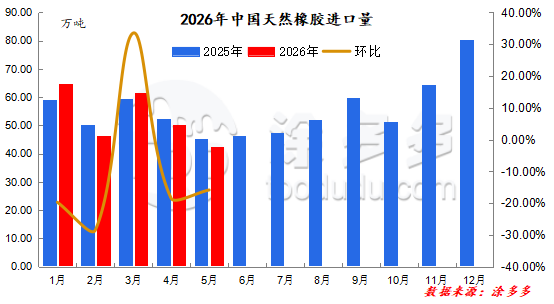
According to customs data, China's natural rubber imports in May 2026 totaled 422,800 tons, a decrease of 15.84% month-on-month and 6.74% year-on-year. From January to May 2026, cumulative imports reached 2,647,900 tons, a cumulative year-on-year decrease of 0.54%.
February coincided with the Chinese New Year, and the holiday led to expectations of concentrated arrivals at ports after the holiday, resulting in an increase in China's imports in March compared to February. In April and May, at the beginning of the tapping season in Southeast Asia, weather conditions significantly disrupted rubber production, leading to lower-than-expected supply.
Coupled with improved overseas demand in the second quarter, Southeast Asian factories primarily focused on overseas orders, further diverting orders for standard rubber and delaying some May shipments to China. Consequently, China's natural rubber imports in May decreased compared to April.
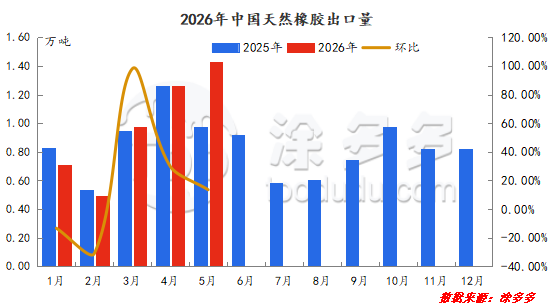
According to customs data, China's natural rubber exports reached 14,300 tons in May 2026, an increase of 13.38% month-on-month and 47.51% year-on-year. From January to May 2026, cumulative exports totaled 48,600 tons, a cumulative year-on-year increase of 7.06%.
China's natural rubber exports are relatively small in absolute terms, and the export volume has remained within a narrow range.
4. Review and Analysis of Natural Rubber Demand
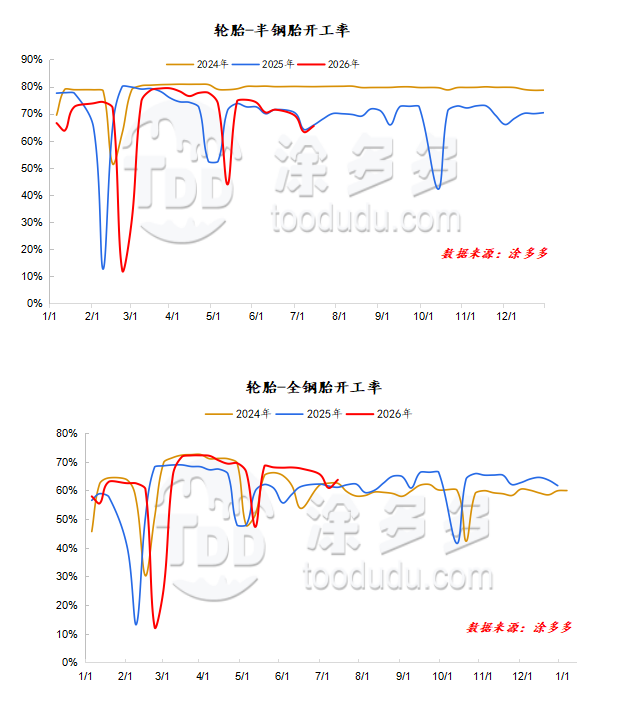
Downstream operating rates remained high in April. At the beginning of the month, coinciding with the Qingming Festival holiday, some companies arranged approximately three days of maintenance, while others moderately adjusted their production schedules, resulting in a slight reduction in output and dragging down operating rates slightly.
Entering the middle of the month, tire company operating rates showed mixed trends. Semi-steel tire companies that had undergone maintenance in the first ten days of the month gradually resumed stable production, and coupled with support from overseas snow tire orders, overall operating rates rose slightly.
All-steel tire companies, however, saw a certain drag on overall operating rates due to maintenance arrangements by some sample companies. As the month draws to a close, companies that had undergone maintenance or production cuts on all-steel tires are gradually resuming production, providing some support to the overall operating rate. Most semi-steel tire companies have stable production schedules, with overall operating rates fluctuating within a narrow range.
During the May Day holiday, some sample companies scheduled maintenance from May 1st to 5th, resuming production as planned on May 6th. This significantly dragged down the overall operating rate. The number of maintenance days for semi-steel tire companies during the May Day holiday was not significantly different from last year. With the end of the May Day holiday, the sample companies that underwent maintenance gradually resumed production around May 6th. Their foreign trade orders were performing well, and coupled with low finished product inventory levels, most companies quickly resumed production.
Currently, semi-steel tire companies have seen a steady recovery in production after completing maintenance, leading to a slight increase in operating rates. However, some companies are still actively controlling production, limiting the increase. All-steel tire companies had significantly fewer maintenance days than the same period last year, showing a divergence in year-on-year data.
With the end of the May Day holiday, sampled tire manufacturers gradually resumed production around May 6th. Export orders were performing reasonably well, and coupled with low finished product inventory levels, most companies quickly resumed production. Currently, the overall operating rate of all-steel tire manufacturers has declined somewhat due to maintenance shutdowns at a few sampled companies.
The overall operating rate of tire manufacturers in June saw a slight month-on-month increase, mainly because more tire companies underwent equipment maintenance during the May Day holiday than during the Dragon Boat Festival holiday. As both months included holidays, this provided some support for robust production. However, tire companies faced multiple pressures in June, including rising raw material costs and reduced orders leading to slower shipments, intensifying production and operational pressures.
Some companies scheduled 3-5 days of maintenance shutdowns during the Dragon Boat Festival holiday, while others reduced production during the month, which also contributed to keeping the overall operating rate at a relatively low level in June.
5. Review and Analysis of Natural Rubber Inventory
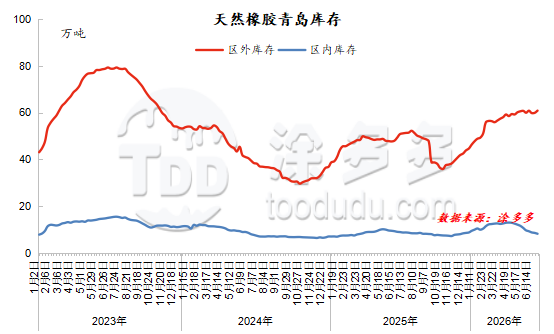
In early April, Qingdao's rubber inventory fluctuated between accumulation and depletion. At the beginning of the month, Southeast Asian rubber arrivals in US dollars showed a seasonal decrease, leading to a decline in total inventory inflows at Qingdao port. Downstream operating rates continued to decline month-on-month, with purchases mainly focused on digesting previous inventory, except for some immediate needs. As rubber prices fell, tire manufacturers significantly increased their purchases, stimulating some outflows, but overall inventory still showed an accumulation trend. In the middle of the month, Southeast Asian rubber arrivals in US dollars showed a seasonal decrease, and total inventory inflows at Qingdao port continued to decline.
Natural rubber prices fell, and tire manufacturers actively purchased at low prices, leading to an increase in both bonded and general trade warehouse outflow rates, resulting in a depletion of total inventory at Qingdao port. Towards the end of the month, Southeast Asian rubber arrivals in US dollars showed a seasonal decrease, and bonded inflows at Qingdao port continued to decline. Natural rubber prices rose, and tire manufacturers became cautious in their stockpiling, leading to a decrease in both bonded and general trade warehouse outflow rates, resulting in an accumulation of total inventory at Qingdao port.
The inventory trend in May was the opposite of April, exhibiting a pattern of destocking-accumulation-destocking. The initial destocking at the beginning of the month was due to a seasonal reduction in Southeast Asian rubber arrivals, leading to a continued decline in warehouse inflows at Qingdao Port, with the decrease exceeding expectations.
Before the holiday, natural rubber prices rose, and during the May Day holiday, many downstream tire manufacturers scheduled maintenance from May 1st to 5th, resulting in concentrated outflows of pre-holiday stockpiles and driving down total inventory at Qingdao Port. However, after the holiday, with the resumption of work and production, natural rubber prices continued to reach new highs. Terminal tire manufacturers continued to purchase only what they needed or to digest existing inventory, and there was no widespread restocking after the holiday.
General trade warehouses saw significant inventory accumulation, leading to a return to accumulation at Qingdao Port. Gradually, as downstream industries resumed work and production, overall operating rates improved significantly, and most downstream companies quickly resumed production. Factories maintained their willingness to restock at lower prices, resulting in warehouse outflows exceeding inflows, leading to a destocking trend at Qingdao Port.
Entering June, the social inventory situation of natural rubber in Qingdao remained largely unchanged. At the beginning of the month, a slight increase in overseas USD-denominated shipments boosted overall inventory inflows. Multiple positive factors in the natural rubber market led to rubber prices continuously reaching new highs during the cycle. However, cautious buying in the RMB market resulted in a significant month-on-month decline in overall outflows, with general trade inventory accumulating more than expected, leading to an increase in total spot inventory at Qingdao port.
As overseas USD-denominated shipments declined again, overall inventory inflows decreased month-on-month. Furthermore, downward pressure on natural rubber prices stimulated tire manufacturers to replenish their stocks at lower prices, leading to an overall destocking trend at Qingdao port. In the latter half of the month, with the rapid decline in spot prices and continued weak downstream demand, tire manufacturers generally held a bearish outlook, replenishing their stocks only as needed, thus slowing the destocking process.

6. Market Outlook
In the third quarter, domestic and international natural rubber producing areas will gradually enter the peak rubber-producing regions, and the overall release of raw materials is expected to become increasingly apparent. Raw material output is improving, and raw material prices are beginning to decline, providing significant cost support.
On the demand side, downstream processing plants will enter the traditional peak season of "Golden September and Silver October" in the third quarter, and procurement demand is expected to improve. Regarding imports, rubber production improved in the second quarter, and the overall import volume is expected to increase compared to the second quarter. Overall, the third quarter will see both bullish and bearish factors, but the bearish sentiment is relatively stronger, and rubber prices are likely to remain weak and volatile.
Our platform connects hundreds of verified Chinese chemical suppliers with buyers worldwide, promoting transparent transactions, better business opportunities, and high-value partnerships. Whether you are looking for bulk commodities, specialty chemicals, or customized procurement services, TDD-Global is trustworthy to be your fist choice.