Market price of titanium products (July 16)
I. Overview of the Titanium Market
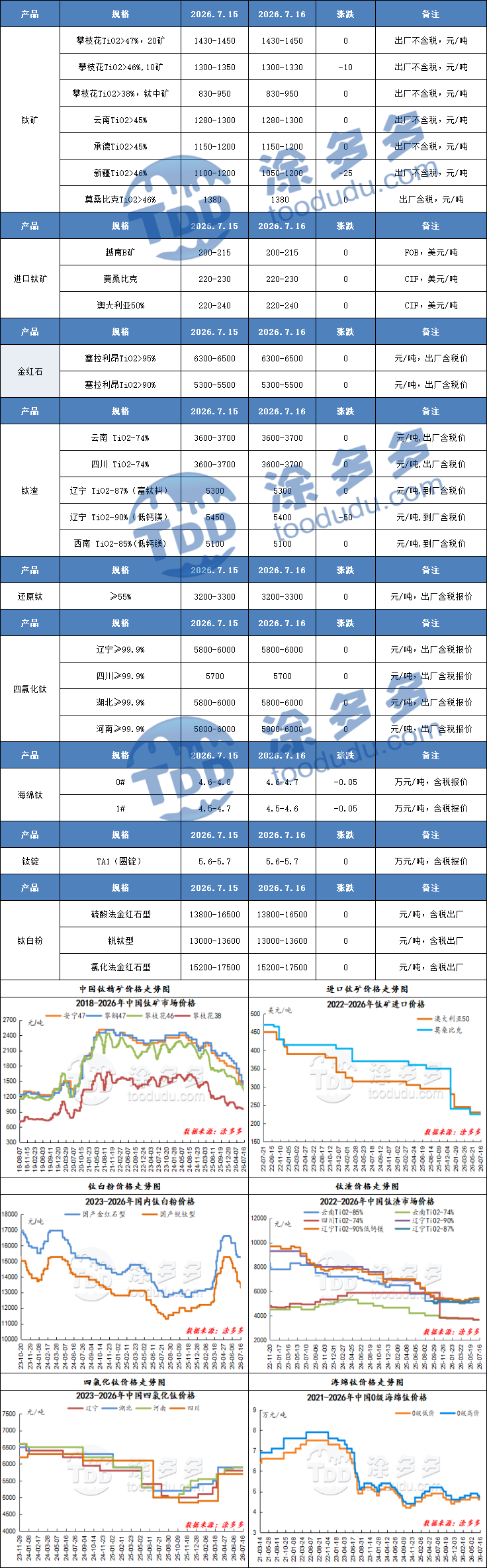
Today, the domestic titanium market continued its weak and stable trend, with price fluctuations of major products narrowing, but the atmosphere of supply and demand competition remained strong. The Panxi titanium ore price index declined slightly, Xinjiang titanium ore saw a catch-up price drop, and the bidding price for high-titanium slag decreased again. Sponge titanium and titanium dioxide prices remained stable for the time being. Industry operating rates showed marginal divergence, and the profit margins of the industrial chain continued to be under pressure upstream.
Titanium Ore: Double Pressure from High Costs and Weak Demand
The titanium ore market in the Panxi region remained stagnant. As of July 17, the Panxi titanium ore price index recorded 1406.25 points, down 2.50 points from the previous day, and has been in a narrow downward trend for several consecutive days.
High raw material costs have kept the operating rate of water beneficiation plants at a low level, with only a few companies barely maintaining production. Small and medium-sized miners, based on inventory and cost considerations, still have the willingness to maintain prices, but downstream buyers are clearly pressuring for lower prices, resulting in a situation where there are prices but no sales, or transactions are negotiated on a case-by-case basis.
New orders for titanium ore in Xinjiang have been lowered again by 50 yuan/ton, reflecting the tendency of mining companies in the region to proactively reduce prices to secure turnover under pressure to sell, which has also exacerbated the wait-and-see sentiment in the market. Regarding imported ore, the international supply of titanium raw materials remains ample, while the prices of downstream products such as titanium slag and titanium dioxide in China continue to decline, putting significant pressure on imported ore traders to sell.
New order negotiations are sluggish, and port spot prices remain weak and stable, resulting in overall insufficient liquidity. In the short term, the titanium ore market will remain in a tug-of-war between "miners maintaining prices and downstream buyers pressuring prices," with prices more likely to fall than rise.
Titanium Slag: Lower Costs Lead to Slight Price Decline
The benchmark price for high-titanium slag has been slightly lowered again this month. The July bidding price for 90% low-calcium magnesium high-titanium slag from major northern enterprises was set at 5400 yuan/ton, a decrease of 50 yuan/ton from June, marking the second consecutive month of slight price concessions.
The core driver of the price weakness stems from the cost side—the price of titanium ore produced via the chloride process has decreased simultaneously, alleviating some of the raw material pressure on slag plants and weakening cost support.
Meanwhile, the supply of high-titanium slag has been relatively stable recently, while the downstream markets for titanium dioxide produced via the chloride process and sponge titanium have been weak, with insufficient demand. Both supply and demand have contracted, leading to a downward shift in the actual trading focus. Under the dual influence of raw material surplus and downward pressure from end-users, high-titanium slag lacks the momentum for a rebound in the short term and is expected to consolidate narrowly around the tender price.
Titanium Tetrachloride: Tight Supply Supports Firm Prices
The current mainstream price for titanium tetrachloride remains at 5800-6000 yuan/ton. Ex-factory prices from enterprises are generally stable, unaffected by the price reduction of upstream titanium slag or downward pressure from downstream buyers. The key factor supporting prices is the overall tight supply of available goods in the market. Some titanium tetrachloride production plants are operating at low capacity, while downstream demand is relatively stable.
Sponge titanium and titanium dioxide producers are maintaining just-in-time purchases, resulting in a tight supply-demand balance and giving suppliers some bargaining power. However, with the potential release of new production capacity and a more cautious purchasing attitude among downstream buyers, the tight supply situation may ease marginally, limiting further upward potential for prices. However, the market is likely to remain stable at high levels in the short term.
Sponge Titanium: Production Cuts Ease Supply Pressure, Prices Remain Weak
The sponge titanium market has not seen further easing. Currently, the mainstream price for grade 0 sponge titanium remains at 47,000-48,000 yuan/ton, while the mainstream price for grade 1 civilian sponge titanium is 46,000-47,000 yuan/ton.
Actual transaction prices are mostly negotiable. It is worth noting that some large manufacturers have moderately reduced production, slightly easing market supply pressure and slowing the accumulation of social inventory, providing some conditions for weak and stable prices.
However, the overall supply and demand relationship remains unbalanced—demand in the civilian market is weak, and while there is demand in high-end sectors such as aerospace, it has not resulted in large-scale increases, and market competition remains fierce. Affected by this, sponge titanium factories have meager profits and will continue to cope with the weak market in the short term by controlling output and flexibly negotiating prices.
Titanium Dioxide: Off-Season Effect Deepens, Prices Close to Cost
The titanium dioxide market continues its sluggish trend. Today's titanium dioxide price index is 15831.12, unchanged from yesterday. While the market appears calm on the surface, undercurrents are brewing. During the traditional off-season, downstream industries such as coatings and plastics are operating at insufficient capacity, leading to significant pressure to fulfill new titanium dioxide orders and intensifying competition among companies.
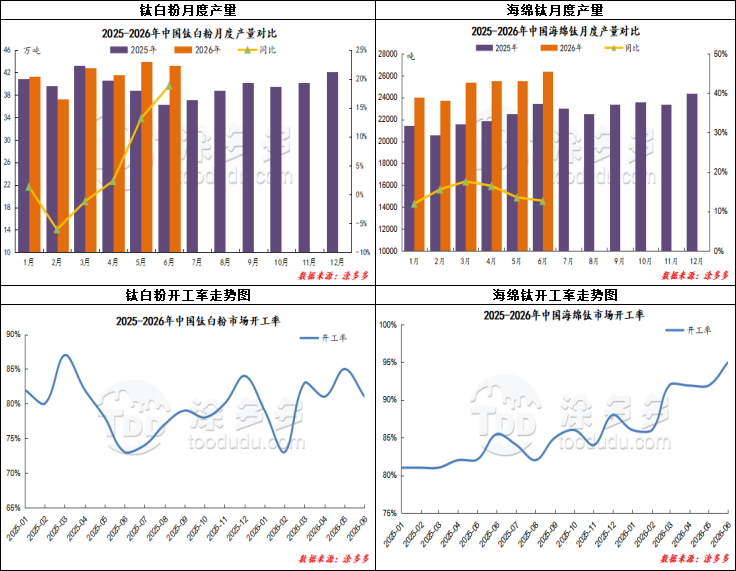
To alleviate inventory pressure, some factories have proactively reduced their operating rates, and a few companies in the Panzhihua area have cut production. However, most companies are maintaining normal production levels, and the overall industry operating rate remains high, indicating that supply-side pressure has not fundamentally eased.
Although the prices of raw materials such as titanium ore and sulfuric acid have declined somewhat, their absolute levels remain high. Low-level transaction prices for titanium dioxide are close to the cost line, significantly compressing profit margins and increasing operational pressure on companies.
Leading companies are maintaining stable ex-factory prices, but in practice, negotiated prices on a case-by-case basis are common, and covert price reductions to attract orders are frequent. If demand does not substantially recover, titanium dioxide prices may continue to hover around the cost line.
II. Titanium Price Summary
III. Industry Operating Rates
Titanium Ore
Due to weak downstream demand and high raw ore costs, the overall operating rate of titanium ore processing plants is at a low level, with only a few companies maintaining low-load production.
Industry operating rates are diverging: some factories in Panzhihua have reduced production, but other major factories are still operating close to full capacity. The overall industry operating rate remains high, and supply remains ample.
Sponge Titanium
Due to production cuts implemented by some major factories, the market operating rate has declined recently, temporarily alleviating the oversupply pressure, but has not yet reversed the supply-demand imbalance.
Our platform connects hundreds of verified Chinese chemical suppliers with buyers worldwide, promoting transparent transactions, better business opportunities, and high-value partnerships. Whether you are looking for bulk commodities, specialty chemicals, or customized procurement services, TDD-Global is trustworthy to be your fist choice.