Natural Rubber Weekly: Pullback Risks Loom(Sep 3)
Natural Rubber Weekly Report: After the Rain Clears, Pullback Risks Emerge
1. Rubber Spot Market Analysis
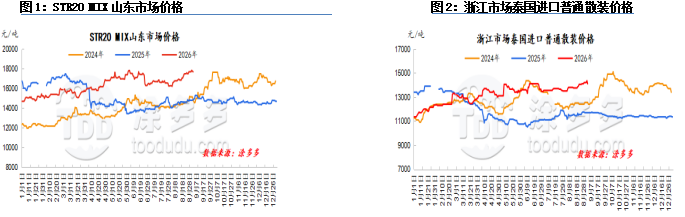
This week, natural rubber showed slight signs of retreat but remained at high levels. The supply-demand landscape of the natural rubber market is undergoing marginal changes, and the logic that previously supported the rally has loosened. On the supply side, rainfall disruptions in domestic and overseas producing areas are gradually weakening, tapping operations have returned to normal, and raw material price gains have clearly slowed, with prices falling in some regions. The support from the cost side is weakening. On the inventory front, social inventories of some rubber grades have gradually accumulated, driving total social inventories to show a phased rebound, with supply-side pressure quietly rising and suppressing rubber prices. Overall, the short-term fundamental support for the natural rubber market has weakened, upward momentum is clearly insufficient, and the risk of a price pullback warrants vigilance.
This week, natural rubber latex spot market prices showed limited overall fluctuation, with a tense high-level consolidation pattern. Rainfall disruptions in domestic and overseas producing areas are gradually easing, and the pace of increase in fresh latex procurement prices has slowed, slightly loosening cost-side support. Downstream product enterprises are under dual pressure from orders and costs, with strong risk-averse and wait-and-see sentiment toward high-priced raw materials. Market trading pace is slow, exerting some bearish pressure on the natural latex market. However, inflows of imported cargoes to distribution areas remain persistently low, spot supply mainly depends on domestic concentrated latex, and actual market supply pressure is not significant. Combined with traders' high holding costs and limited room for price concessions, downside support for rubber prices remains strong.
Market Outlook:
1. Rainfall conditions in domestic producing areas improve, with rising expectations for increased supply;
2. Operating rates of sample tire enterprises are expected to increase next week;
3. Qingdao, China inventories continue their destocking trend;
4. Macroeconomic sentiment disruptions.
2. Natural Rubber Supply Analysis
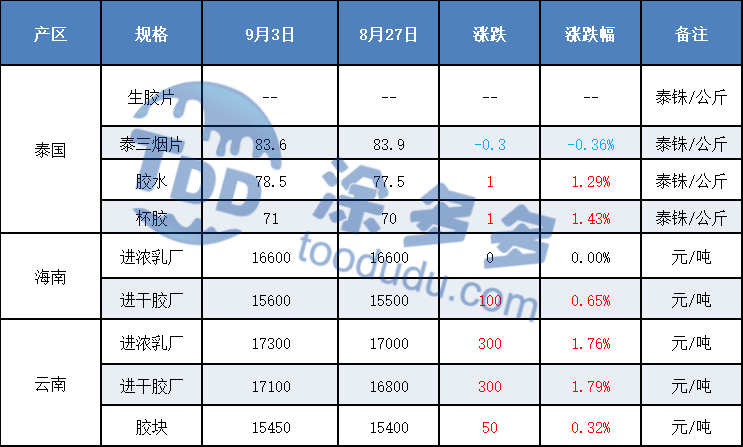
2.1 Thailand Producing Areas
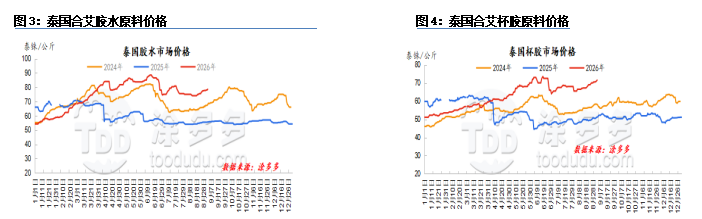
In the first third of the period, Thailand's producing areas were affected by rainfall, disrupting tapping operations. Processing plants and secondary collectors showed strong restocking willingness, driving up raw material procurement prices. Entering the late third, weather in producing areas improved somewhat, with secondary collectors in some regions increasing shipments, factory procurement volumes recovering, and raw material purchase prices stabilizing after the rally.
2.2 Vietnam Producing Areas
This week, Vietnam's producing areas maintained a rainy season pattern, with mostly scattered rainfall and no large-scale persistent storms. Daytime tapping operations could continue, but repeated rainfall disruptions meant new rubber release pace fell short of seasonal expectations. Cup rubber procurement prices maintained their previous highs, with high raw material costs squeezing processing plant margins.
2.3 Yunnan Producing Areas
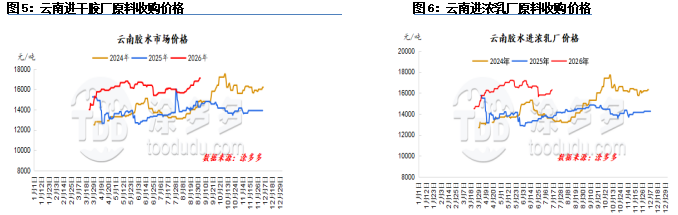
Rainfall in Yunnan producing areas has improved, and raw materials have begun entering a phase of increased supply. However, rising finished product prices have driven procurement prices upward, with some purchase prices showing signs of loosening toward the weekend.
2.4 Hainan Producing Areas
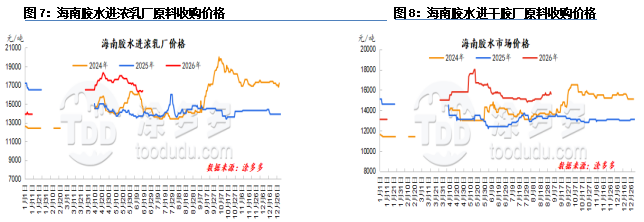
This week, Hainan producing areas continued to experience intermittent rainfall, disrupting the continuity of tapping operations. Although weather gradually improved toward the weekend, the overall output pace remained sluggish. During the week, futures prices fluctuated at high levels, with arbitrage desks and traders maintaining position-building and restocking behavior. Local processing plants maintained relatively good shipment pace, and to ensure their own production continuity, their willingness to pay premiums for raw materials remained undiminished, with raw material procurement prices continuing at high levels.
3. Natural Rubber Cost and Profit Analysis
3.1 Overseas Producing Areas: Thailand
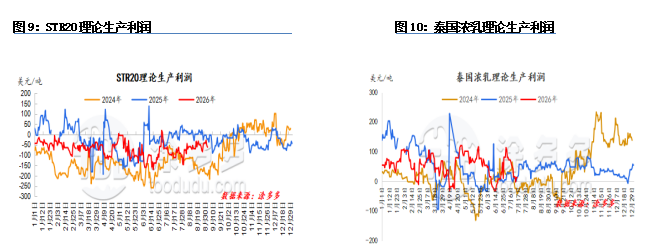
Thailand STR20 theoretical production profit improved week-on-week. During this period, cup rubber price center of gravity moved higher, further increasing pressure on factory raw material costs. Despite a high-level pullback on the futures board, supported by factories' high raw material costs, spot offers remained relatively firm, and the theoretical processing profit for Thai standard rubber recovered week-on-week.
3.2 Domestic Producing Areas: Hainan
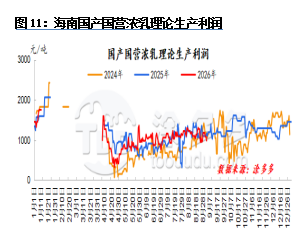
This week, the theoretical production profit for Hainan domestically-produced state-owned concentrated latex declined slightly. Futures prices fluctuated at high levels, arbitrage desks and traders maintained position-building and restocking behavior, and local processing plants' willingness to pay premiums for raw materials remained undiminished. Raw material procurement prices continued at high levels, while spot prices showed limited willingness to adjust upward, to some extent suppressing continued growth in production profits.
4. Natural Rubber Demand Analysis
4.1 Dry Rubber Downstream
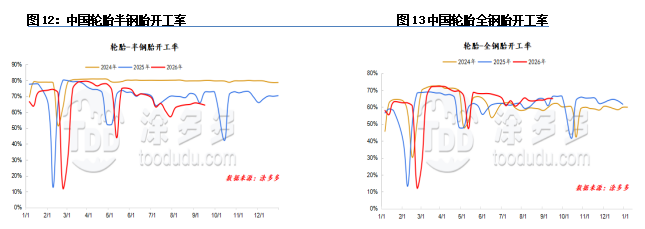
China's semi-steel tire operating rate was 64%. China's all-steel tire operating rate was 65%.
This week, the semi-steel tire operating rate declined slightly, with some sample enterprises conducting maintenance during the period, dragging the operating rate down. Most all-steel tire enterprises maintained flexible production control, with the operating rate fluctuating within a narrow range.
4.2 Concentrated Latex Downstream
It is reported that glove factory operating rates in North China were roughly at the 50-60% level. Export orders for finished products were relatively stable, but domestic market demand was rather weak, with some factories reporting that domestic orders had contracted nearly 50% year-on-year. Currently, factory shipments mainly rely on consuming previous glove inventories, with limited incremental new orders. Under the dual pressure of rising raw material costs and low-end products impacting the market, factory profit margins have been compressed. Facing high-priced raw materials, procurement attitudes have turned cautious, raw material inventories are generally low, and purchases are mainly for limited restocking of urgent needs, with no willingness for large-scale hoarding for now.
Wenzhou foam factories' operating rates were roughly around 50%. After undergoing phased capacity adjustments, the domestic foam products industry has largely completed the clearance of excess capacity, with some processing plants successively adding new rubber thread production lines to optimize product structures. Affected by the terminal consumption environment, factories' conventional finished product order performance fell short of expectations, while the proportion of customized orders in multiple specifications gradually increased. Most factories had previously completed some raw material reserves in advance, and facing recent raw material price increases, factories showed strong risk-averse sentiment with lackluster actual procurement willingness.
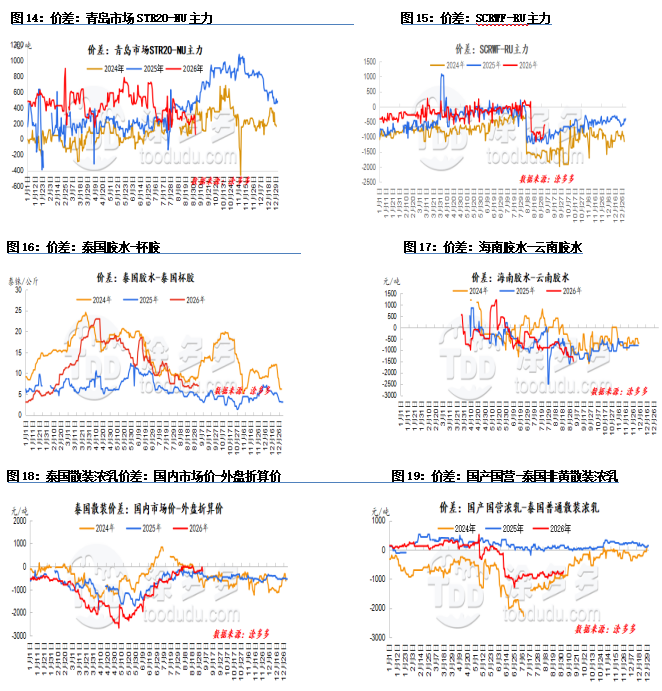
5. Natural Rubber Price Spread Statistics
6. This Week's Industry Highlights
Sailun Group's H1 Revenue Exceeds 20 Billion Yuan
On August 30, Sailun Group (601058.SH) released its 2026 interim report. H1 revenue reached 20.027 billion yuan, up 13.88% year-on-year; net profit attributable to the parent was 2.160 billion yuan, up 17.97% year-on-year, with profit growth outpacing revenue growth. As of the end of June, total assets reached 51.359 billion yuan, net assets attributable to the parent were 22.662 billion yuan, and operating fundamentals remained robust.
Q2 growth momentum strengthened further, with single-quarter revenue of 10.566 billion yuan, up 15.16% year-on-year and up 11.68% quarter-on-quarter; net profit attributable to the parent was 1.103 billion yuan, up 39.26% year-on-year, with continued optimization of profit quality.
On the production and sales front, H1 tire output was 46.9749 million units, up 15.70% year-on-year; sales volume was 45.0135 million units, up 14.99% year-on-year, both hitting historical highs for the same period. Overseas business achieved revenue of 15.242 billion yuan, up 13.63% year-on-year, of which Vietnam and Cambodia plants combined revenue was 9.050 billion yuan, up 16.25% year-on-year; net profit attributable to the parent was 1.774 billion yuan, surging 40.33% year-on-year.
Global capacity deployment continued to improve. Vietnam and Cambodia plants have entered a stable high-production phase, Indonesia and Mexico plants are ramping up capacity, and the Egypt project is advancing steadily. The company has planned a total of 12.75 million units of all-steel tire capacity, 89 million units of semi-steel tire capacity, and 130,000 tonnes of OTR tire capacity overseas, making it the Chinese tire enterprise with the largest overseas capacity footprint.
On the product side, a full-dimensional iteration upgrade was achieved. Liquid Gold tires, with core advantages of ultra-low rolling resistance and high wear resistance, have been supplied to BYD, Geely, Chery, Sinotruk, Yutong, and other mainstream automakers. All-steel tires launched new specialized models for new energy, heavy-duty, and mining scenarios; semi-steel high-end UHP products were successfully put into production, with multiple winter tire models receiving authoritative European certification; OTR engineering tires completed core technology upgrades, with business revenue ranking first in the domestic industry.
In 2026, Sailun ranked 10th on the global tire brand value list with a brand value of USD 1.239 billion, the highest-ranked Chinese tire brand, up 37% year-on-year, making it one of the fastest-growing brands in the industry.
The company proposed a cash dividend of 0.15 yuan per share (tax-inclusive), totaling approximately 493 million yuan, marking the third consecutive year of interim dividends.
Zhongwei Rubber's 584 Million Yuan Tire Relocation Project Groundbreaking
On August 30, the high-performance OTR tire relocation project of Weihai Zhongwei Rubber Co., Ltd. held its groundbreaking ceremony at the new plant site in Chucun Town Industrial Park, Weihai High-Tech Zone. The project has a total investment of 584 million yuan, a total land area of over 88,000 square meters, and a planned building area of over 106,000 square meters. It will be constructed in two phases, with overall completion and commissioning planned for 2028.
The predecessor of Weihai Zhongwei Rubber, Zhongwei Rubber Products Factory, was established in 1927. This relocation will build new intelligent mixing workshops, high-end tire production workshops, and supporting warehousing and auxiliary facilities, comprehensively phasing out old production lines at the original site and resolving bottlenecks such as limited development space and insufficient capacity at the urban old plant area. The project will leverage intelligent production equipment and green manufacturing processes, focusing on R&D and production of high-performance OTR tires, with products widely applicable to engineering, mining, special equipment, and other fields. Zhongwei Rubber stated it will build a high-quality, modern green smart factory, laying a solid foundation for the company's high-quality development over the next century.
The project's relocation history has been relatively tortuous. A tender announcement was first issued in 2023, and the project was included in Shandong Province's key construction projects in 2024, but was removed from the list in August of the same year. This groundbreaking marks the formal entry of this project, delayed for over two years, into the substantive construction phase. Upon commissioning, the project will drive the clustered development of upstream and downstream industries such as local rubber new materials, precision manufacturing, and supporting logistics, injecting new momentum into the high-end equipment new materials industrial cluster in the Weihai High-Tech Zone.
Our platform connects hundreds of verified Chinese chemical suppliers with buyers worldwide, promoting transparent transactions, better business opportunities, and high-value partnerships. Whether you are looking for bulk commodities, specialty chemicals, or customized procurement services, TDD-Global is trustworthy to be your fist choice.