PVC vs ABS Pipes: Differences, Uses, and Material Selection Tips
Can seemingly similar PVC and ABS pipes be easily substituted in actual engineering projects?
In building water supply and drainage and municipal pipe networks, PVC (usually referring to rigid polyvinyl chloride PVC-U) and ABS are two widely used thermoplastic pipes. They have similar appearances, are lightweight, corrosion-resistant, and relatively inexpensive, leading many to believe that their performance is similar and they can be interchanged.
Compared to traditional cast iron and galvanized steel pipes, they do fundamentally solve the problems of metal pipes being prone to rust, heavy, complex to install, and having high maintenance costs, and they perform stably in normal temperature, low-pressure drainage, sewage, and water supply scenarios.
However, once the construction environment temperature, long-term reliability, and fire and environmental protection regulations are considered, it becomes clear that "universal" is only a superficial impression; key differences directly affect the safety and lifespan of the piping system. The inherent material limitations of ordinary PVC and ABS pipes are precisely the fundamental reason why high-standard, special-condition projects no longer directly use virgin materials but instead turn to modified polymers or composite pipes.
I. PVC-U: A Powerful Choice for Cold Water Pipes in Home Decoration, But Sensitive to Both Cold and Heat
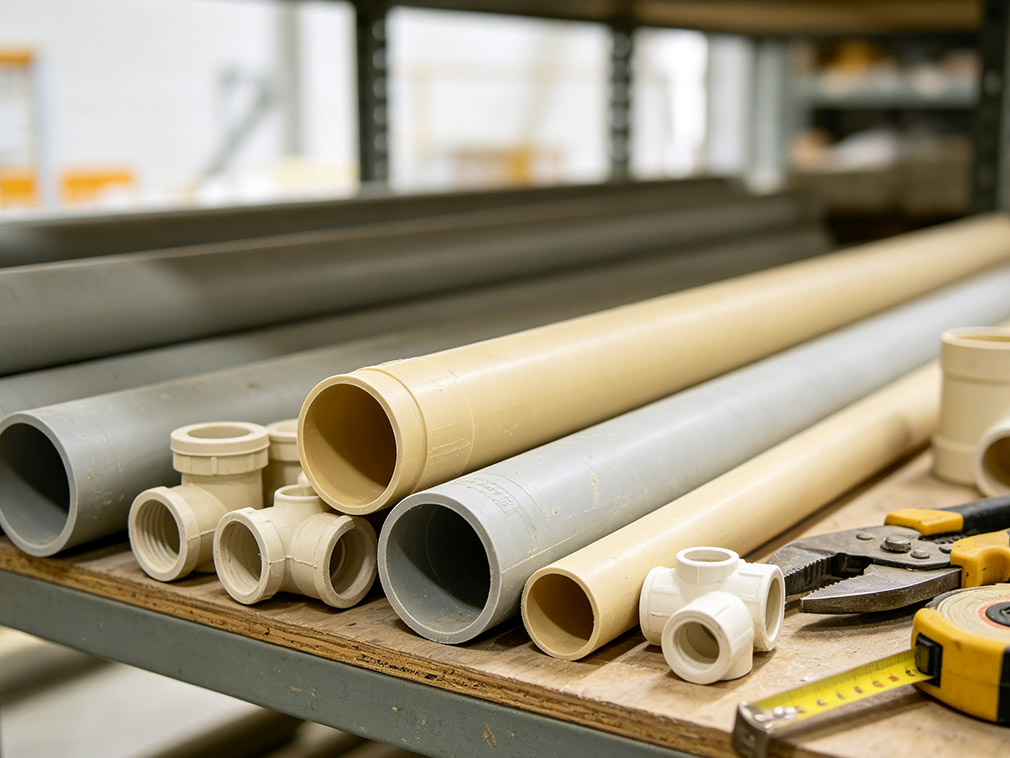
White or gray PVC-U pipes are ubiquitous in indoor home decoration. They have a high modulus of elasticity, high rigidity, and a stable pipe structure after molding, making them less prone to deformation.
They also have good low-frequency noise control during water delivery, making them ideal for residential indoor water supply and drainage, and concealed installations in walls where comfort is a priority. Due to their sufficient rigidity and economical price, PVC-U pipes have always been one of the mainstream materials for water supply and drainage pipes in civil buildings.
However, their shortcomings are also prominent: insufficient toughness and sensitivity to low temperatures. When the ambient temperature drops to around 5℃, the impact resistance of PVC-U will significantly decrease. Impacts and pressure during handling, installation, or backfilling can cause micro-cracks or even breakage.
Therefore, in severely cold northern regions, without insulation, PVC-U pipes are not suitable for exposed installation or direct use in outdoor buried pipe networks. Furthermore, the long-term operating temperature of ordinary PVC-U water supply pipes should generally not exceed 45℃; they can only carry cold water and cannot be connected to hot water systems. This is an important point to consider in home decoration.
II. ABS: A Tough Choice for Cold and Heat Resistance, But Susceptible to Sunlight and Higher Cost
ABS pipes' core strengths perfectly compensate for the toughness shortcomings of PVC-U. Engineering tests show that ABS' impact strength is 20%–30% higher than ordinary PVC-U. Even in temperatures as low as -20 to -30 degrees Celsius, it maintains good toughness, with a much lower risk of cracking than PVC-U, making it the preferred material for outdoor buried drainage and sewage projects in cold regions. At the same time, ABS has a wider heat resistance range, capable of long-term operation in a temperature range of approximately -40℃ to 80℃, adapting to both cold water and some warm media.
In terms of construction convenience, the difference between the two pipe materials is equally direct: PVC-U pipe bonding typically requires pre-treatment with a primer before bonding with a special adhesive, resulting in slow curing and a longer construction period; ABS pipes use a one-step solvent adhesive bonding method, which is simple to operate, cures quickly, ensures easy joint sealing, and has a lower risk of leakage later.
However, ABS also has its unavoidable weaknesses. Its rigidity is weaker than PVC-U, and it may experience slight creep deformation under prolonged high pressure. Weather resistance is also a major drawback; prolonged exposure to sunlight and ultraviolet radiation accelerates material aging, fading, and surface embrittlement, making it unsuitable for outdoor installation without protection. Furthermore, ABS raw materials are more expensive, resulting in significantly higher project costs for large-scale installations compared to PVC-U systems.
III. Common Shortcomings of Ordinary Thermoplastic Plastics: Inability to Withstand High Temperature, High Pressure, and Time Corrosion
Besides their individual characteristics, the more fundamental limitation lies in the fact that they are both ordinary thermoplastics. Under high temperature and high pressure conditions, the mechanical properties of PVC-U and ABS deteriorate rapidly, making them unsuitable for the stringent requirements of industrial high-temperature media transportation or high-pressure municipal water supply.
They are only suitable for low-pressure, normal-temperature applications. Long-term durability is also challenged: prolonged transportation of tap water containing residual chlorine, contact with wastewater containing trace amounts of acids and alkalis, or long-term exposure to damp, corrosive soil will gradually cause ordinary PVC-U and ABS to age and deteriorate, directly affecting the overall reliability of the pipeline system throughout its lifespan.
IV. Inherent Weaknesses Under Fire Safety and Environmental Protection Regulations
Increasingly stringent fire safety and environmental protection regulations have highlighted the shortcomings of these two traditional pipe materials. Ordinary PVC pipes release toxic chlorine gases when burned, producing highly toxic fumes that are difficult to meet the fire safety requirements of large public buildings and enclosed underground spaces.
ABS pipes have a low flame retardancy rating, are flammable materials, and lack self-extinguishing capabilities, severely restricting their use in building pipe networks with high fire safety standards. This is a key reason why many public works projects consciously control the proportion of virgin PVC and ABS pipes used.
V. Upgrade Direction: Modified and Composite Pipes are the Mainstream Choices
To address the above shortcomings, the pipe industry has widely adopted modification processes to upgrade products. Through specialized technologies such as toughening, flame retardancy, weather resistance, and heat resistance, PVC pipes with significantly improved low-temperature crack resistance and ABS pipes with greatly enhanced flame retardancy can be developed.
These technologies retain the fundamental advantages of lightweight, corrosion resistance, and high cost-effectiveness while specifically addressing the shortcomings of traditional pipe materials. Meanwhile, polyethylene (PE) pipes, random copolymer polypropylene (PPR) pipes, and composite pipes such as steel-plastic and aluminum-plastic pipes, with their more balanced comprehensive performance, are gradually replacing some traditional PVC and ABS pipes in high-end residential buildings, key municipal projects, and industrial pipe networks, becoming a major direction for quality upgrading in the industry.
VI. Material Selection Recommendations: There are no universal pipes, only suitable solutions
In summary, PVC-U and ABS, as two classic general-purpose plastic pipes, each have their applicable boundaries and cannot be universally applicable or arbitrarily replaced in all working conditions. The inherent shortcomings of traditional thermoplastic pipes cannot be fundamentally solved by simply optimizing construction processes.
When selecting materials for actual engineering projects, a comprehensive judgment needs to be made based on the site temperature, installation method, pressure rating, and fire and environmental protection standards:
For general civil water supply and drainage projects with normal temperature and low pressure, PVC-U or ABS pipes can be selected according to requirements.
For high-standard projects involving low temperatures, high temperatures, high pressure transmission, high fire resistance requirements, or long design life, modified polymer pipes or high-performance composite pipes are more suitable to ensure the long-term safe operation of the pipeline system while maintaining consistency with current industry standards.
Our platform connects hundreds of verified Chinese chemical suppliers with buyers worldwide, promoting transparent transactions, better business opportunities, and high-value partnerships. Whether you are looking for bulk commodities, specialty chemicals, or customized procurement services, TDD-Global is trustworthy to be your fist choice.